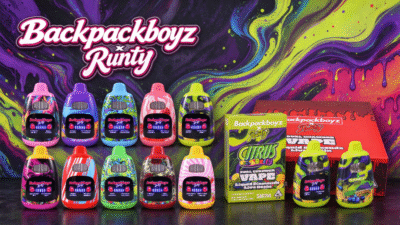
The Rise of Disposable THC Vapes: Why They Are Changing the Vape Market
Stand: April 2026
Disposable THC vapes are growing not merely due to a trend, but because several market forces are converging simultaneously: the shift from traditional cannabis flower to extracts, the high level of acceptance of vaping among younger consumer groups, and a product format that greatly simplifies usage. This phenomenon is particularly evident in Canada—one of the most transparent legal cannabis markets—where legal recreational cannabis sales rose to CAD 5.5 billion in the 2024/25 fiscal year. Concurrently, inhaled extracts emerged as the fastest-growing category (+12.8%), already capturing 31.1% of the total market.
1. The actual shift is taking place within the product categories.
Anyone seeking to understand why disposable THC vapes are gaining prominence should first look at the shift in product trends. In Canada, dried flower is no longer the sole focal point of the market. The share of inhaled extracts is growing faster than other categories, while some traditional segments are slowing down or even declining. This suggests that consumers are increasingly favoring products that are more highly processed, easier to consume, and more readily standardized.
Patterns of consumption are shifting as well. According to data from Canadian health authorities, cannabis smoking among non-medical users declined from 89% in 2018 to 69% in 2024. In the same dataset, cannabis vaping stood at 37% in 2024. While this does not prove that every user is automatically switching to disposable devices, it clearly demonstrates that vaping is no longer a niche behavior.
2. Younger Adults Drive the Dynamic
U.S. data confirm this picture. A CDC analysis for 2022 shows that 15.3% of adults reported current cannabis use. Among current users, 30.3% consumed cannabis via vaping; among those aged 18 to 24, this figure was even higher, at 44.7%. This is significant because this specific age group frequently adopts new product formats more rapidly and facilitates their diffusion into both legal and semi-legal markets.
NIDA data also underscore the relevance of this format among young adults: for 2023, 22% of 19- to 30-year-olds reported vaping cannabis within the past year, and 14% within the past month. At the same time, youth prevention remains a central priority: according to the *Monitoring the Future* survey, 5.6% of 12th graders in 2024 still reported having vaped cannabis within the past year. This indicates that market growth and public health risks are advancing in parallel.
3. Why Disposable Formats Scale So Quickly
Official surveys do not break down the purchasing motives for THC disposables in every minute detail. Nevertheless, as a market interpretation, their rise is plausible: disposable devices lower the barrier to entry because they function without any separate setup; they appear discreet, are easy to transport, and offer a more standardized user experience than improvised methods of consumption. In a market that is already shifting toward extracts, the disposable format therefore aligns perfectly with the demand for convenience, consistency, and simplicity.
Added to this is a structural point: the more markets professionalize, the more important products become that can be clearly packaged, standardized, and easily categorized within the retail environment. This is precisely where disposable vapes hold an advantage over loose flower or less standardized concentrates. This does not constitute an official measurement of causality, but rather represents a compelling market logic based on observed category shifts.
4. Growth Does Not Automatically Mean a Secure Market
Gerade weil sich der Markt in Richtung Extrakte bewegt, rücken Qualitäts- und Sicherheitsfragen stärker in den Vordergrund. Die CDC weist darauf hin, dass Cannabis-Vaping mit potenziell schädlichen Kontaminanten oder Streckstoffen verbunden sein kann. Im Zusammenhang mit dem EVALI-Ausbruch wurde Vitamin-E-Acetat stark mit THC-haltigen Vape-Produkten verknüpft. Die CDC empfiehlt deshalb ausdrücklich, keine THC-Vape-Produkte aus informellen Quellen zu verwenden.
Europe, too, is sending warning signals. The EUDA continues to describe cannabis as, by far, the most widely consumed illicit drug in Europe; an estimated 24 million adults aged 15 to 64 consumed cannabis in the past year, and the EU retail market is estimated to be worth at least 12.1 billion euros. At the same time, the agency warns that high-potency extracts and edibles have been linked to cases of acute intoxication in emergency rooms, and that some products sold as cannabis may be laced with potent synthetic cannabinoids.
Particularly relevant to the future of the vape segment is the rise of semi-synthetic cannabinoids in Europe. According to the EUDA, 20 new cannabinoids were identified in Europe in 2024—18 of which were semi-synthetic. Substances such as HHC, HHC-P, and THCP have recently gained greater prominence on the European market; in the Czech Republic alone, more than 170 cases involving HHC were recorded between June 2022 and February 2024. This demonstrates how quickly new product variants can outpace regulatory frameworks.
5. Regulation and enforcement are becoming a competitive factor.
The more the market grows, the less mere brand aesthetics suffice. Traceability, laboratory transparency, clear labeling, and clean supply chains are becoming the decisive factors. The fact that regulatory authorities are scrutinizing this area more closely is further demonstrated by the FDA: it continuously lists Warning Letters issued against companies illegally marketing cannabis- or cannabinoid-related products, emphasizing that it continues to monitor the market and take measures to protect consumers. At the same time, the FDA points out that—with the exception of a few approved medications—no products containing cannabis or cannabinoids have been approved as safe and effective for general use.
For the market, this means that the growth of disposable THC vapes is determined not solely by demand, but increasingly by regulatory oversight. Products that are convenient and appealing—yet remain inadequately safeguarded in terms of regulation or quality—carry the highest risk of recalls, bans, and reputational damage.
Conclusion
Disposable THC vapes are gaining prominence because they sit precisely at the intersection of three trends: extracts are growing faster than traditional forms of cannabis; younger adults engage in vaping at disproportionately high rates; and the disposable format reduces barriers to entry. However, the very factors that drive the segment’s growth also make it particularly susceptible to quality issues, youth prevention concerns, and regulatory intervention. The real story, therefore, is not merely a product trend, but rather the professionalization of a market where convenience and risk are more closely intertwined than many brand messages would suggest.
Attention : cookies lemonade switch dual chamber 1g+1g | cookies vape | dual chamber vape pen | wholesale vapes
 empty 1g vape
 empty 2g vape
 empty 3g vape
 empty dual chamber vape
 empty led vape
 USA STOCK VAPE
 EU German stock vape