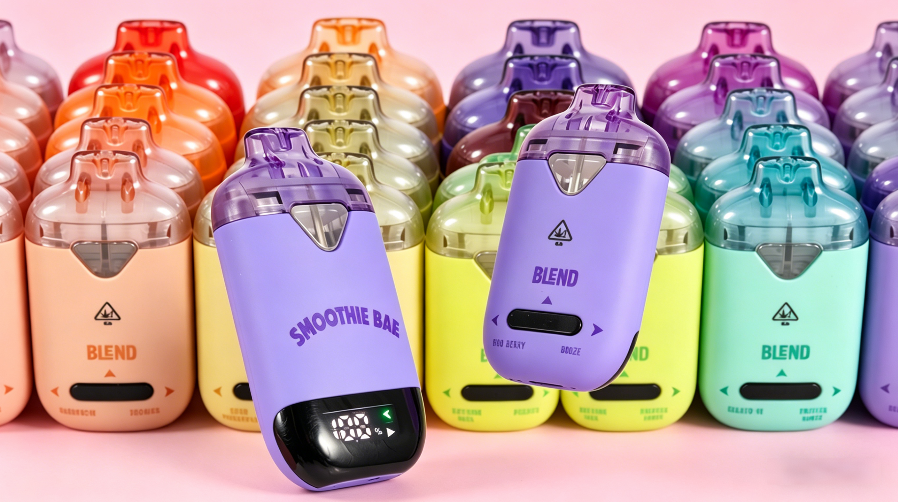
Spotlight on Smoothie Bar 510 Vape Cartridges: Safety, Regulation, and Market Trends 2026
Anyone searching for the term **“smoothie bar vape cartridge 510”** today is typically interested not only in design or flavor, but increasingly also in **safety, market transparency, and regulatory classification**. This is no coincidence: The World Health Organization now estimates that **more than 100 million people** worldwide use e-cigarettes—including at least **86 million adults** and **15 million adolescents aged 13 to 15**. At the same time, current US data indicates that **7.0% of adults** used e-cigarettes in 2024.
1. Why the Market Will Be Watched More Closely in 2026
The vaping market is vast, yet it is currently under significantly closer scrutiny than it was just a few years ago. In the U.S., while the FDA and CDC reported a decline in youth usage for 2024, 1.63 million middle and high school students nevertheless continued to use e-cigarettes within the past 30 days. Among these current adolescent users, 26.3% used e-cigarettes daily, and 87.6% opted for flavored products. These figures demonstrate why product categories involving cartridges, batteries, and refill systems are now subject to heightened scrutiny from both a public health and regulatory perspective.
2. What Users Really Compare Today
When discussing 510 cartridges, the conversation—from a consumer perspective—typically revolves around three key points: compatibility, reliability, and day-to-day controllability. In a mature market, however, the inquiry extends beyond simply asking whether a product is “pleasant” or “practical.” It has become far more important to determine whether the product information is transparent and verifiable, whether the packaging and labeling comply with legal requirements, and whether the system is distributed within a regulated framework. Precisely for this reason, the discourse in 2026 is increasingly shifting away from marketing terminology and toward documentation, compliance, and product architecture.
3. Regulation Is Now a Quality Filter
In the European Union, Article 20 of the Tobacco Products Directive 2014/40/EU continues to apply to e-cigarettes and related consumer products. The European Commission sets out specific requirements therein: among other things, products must be child-resistant and tamper-evident; they require a leak-proof refill mechanism; ingredients must be of high purity; and consistent nicotine delivery must be ensured under conditions of normal use. Furthermore, advertising and promotional elements on packaging are prohibited, and manufacturers or importers must notify authorities of products via a standardized electronic system prior to placing them on the market.
This regulatory trend intensified further in 2025. On July 16, 2025, the European Commission presented a proposal to revise the Tobacco Taxation Directive. Under this proposal, the scope of application is to be explicitly extended to e-cigarettes, heated tobacco products, and nicotine pouches. The objective is not merely fiscal, but also public health-related: new products are to be subject to stricter controls and rendered less attractive as alternative options. For the market, this means that regulatory compliance and market transparency will become even more critical in the future.
4. Why Product Safety Is More Important Than Brand Image
To this day, the discussion surrounding vape products remains dominated by safety concerns. The CDC notes that **Vitamin E acetate** has been strongly linked to the EVALI outbreak. In a national analysis, **82%** of EVALI patients reported using THC-containing vape products; the agency explicitly advised against using such products—particularly those **obtained informally**. Although not every category of vape cartridge is the same, the central lesson remains relevant: **unclear origins, inadequate oversight, and opaque supply chains** constitute a significant risk.
Precisely for this reason, in 2026, a product will no longer become “interesting” simply because it features eye-catching packaging or frequently appears in search queries. Today, the truly relevant questions are: Is the origin traceable? Is the labeling clear and accurate? Does the product comply with the regulations of a regulated market? And is the entire system—cartridge, hardware, packaging, and labeling—consistently documented? For consumers, these criteria carry far more weight than mere brand hype.
5. Why "Preferred Choice" Should Be Defined Differently Today
In marketing, the term "preferred choice" is often imbued with associations of taste, design, or convenience. From a neutral perspective, however, it should be understood differently in 2026: A product becomes a preferred choice when it is reasonably regulated, thoroughly documented, and transparent to consumers. This interpretation also aligns with current market data: While the WHO reports over 100 million e-cigarette users worldwide, U.S. authorities simultaneously indicate that youth usage, flavorings, and product types remain sensitive issues. As the market continues to grow, branding alone is no longer sufficient.
In this environment, neutral informational concepts—such as **security**, **authenticity**, **market transparency**, and **regulatory classification**—are gaining in importance. For blog content intended to endure over the long term, this approach is generally more stable than traditional advertising language. It is more objective, aligns more readily with current regulations, and is simultaneously better suited for building trust.
Conclusion
In 2026, the term **“smoothie bar vape cartridge 510”** can only be meaningfully understood within a broader context: the market is vast, and usage is high worldwide; yet, at the same time, demands regarding **safety, labeling, regulation, and supply chain transparency** are on the rise. Consequently, anyone seeking to credibly assess a product or product category should not look primarily for hype, but rather for **compliance, traceability, and consumer protection**. Today—more than any advertising message—it is precisely these factors that determine how a vape product is perceived in the long run.
Attention : smoothie bar 2g disposable | wholesale smoothie bar vape pen | empty 2 gram disposable | cheap vape
 empty 1g vape
 empty 2g vape
 empty 3g vape
 empty dual chamber vape
 empty led vape
 USA STOCK VAPE
 EU German stock vape