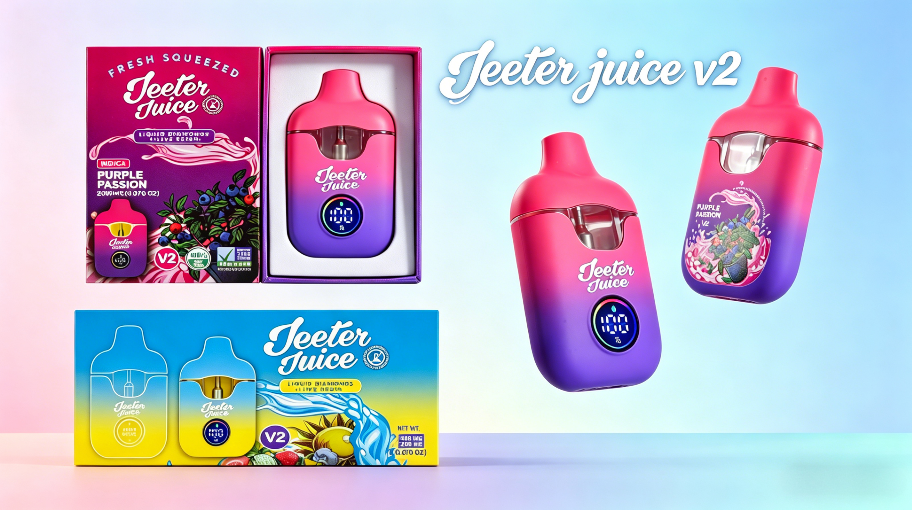
Choosing the Right Battery for Your Jeeter Juice V2 Pen: Key Features to Consider
Anyone searching for the best **batteries for the Jeeter Juice v2 pen** typically isn't looking to buy just any battery. At this mid-funnel stage, the focus is on something more specific: **Which battery truly pairs well with Jeeter-compatible cartridges, delivers clean performance, protects the oil, and minimizes issues such as clogging, overheating, or inconsistent draws?**
That is exactly what this guide is about.
First, and most importantly: Do you even need a separate battery?
Jeeter itself today clearly distinguishes between two types of products:
- AIO Vapes (All-in-One): fully integrated devices, without a separate battery or setup
- 510 Cartridges: classic cartridges that must be connected to an external battery.
This is important because the term "Jeeter Juice V2 Pen" is not always used precisely online. On official Jeeter websites, the distinction is clear; however, among third-party vendors, "Jeeter Juice V2" sometimes appears as a designation for hardware or disposable devices. Therefore, to ensure a legitimate purchase:
If your product is a genuine AIO or disposable device, you do not need a separate battery. However, if you are using a Jeeter 510 cartridge, choosing the right battery is crucial.
Why the Battery Is So Important for Jeeter-Compatible Cartridges
Jeeter describes its Liquid Diamonds carts as oil embedded in “proprietary hardware” that is specifically calibrated for that oil. In practice, this means that it is not just the cartridge itself that matters, but also how consistently and controllably the battery delivers power.
Particularly with more viscous oils—such as Live Resin or Liquid Diamonds—the battery is not merely a peripheral accessory, but a genuine performance factor. An overly aggressive or unstable power output can degrade flavor, draw quality, and consistency; conversely, an underpowered battery often results in unsatisfying draws and connectivity issues. These dynamics are also reflected in the current specifications of leading 510 manufacturers, who are increasingly prioritizing variable voltage, preheat functions, and cartridge-flexible designs.
The 6 Most Important Features of Batteries for the Jeeter Juice v2 Pen
1. 510 compatibility is the first filter.
If you are using a Jeeter 510 cartridge, your battery must be 510-thread compatible. CCELL continues to describe 510 cartridges as the most common type on the market, and many current premium batteries are designed specifically for this format.
What to look out for:
- Cleanly finished 510 connection
- Stable fit without wobbling
- Enough space for different cartridge sizes
- No overly narrow housing opening for thicker cartridges
This is particularly crucial in the middle of the funnel: buyers are not looking for just any battery, but rather for a perfectly fitting, seamless combination.
2. Variable Voltage Instead of Fixed Output
Today, a modern 510 battery should offer **multiple voltage levels**. The market standard in the premium segment clearly indicates the direction in which the industry is heading:
CCELL’s Fino operates with **8 voltage levels ranging from 2.2 V to 3.6 V**, while the M3B Plus features variable control designed for different cartridge sizes and usage profiles.
Why this is relevant for Jeeter-compatible carts:
- Higher voltages usually produce denser clouds, but can place a greater strain on the oil.
- höhere Spannungen liefern meist kräftigere Wolken, können aber das Öl stärker belasten
- Variable voltage makes the battery adaptable to oil viscosity, ambient temperature, and user preference.
For MoFu content, this serves as a powerful buying trigger: not "battery—yes or no," but rather: **which voltage control best supports my product profile?**
3. A preheat function is almost mandatory for thicker oils.
Modern 510 manufacturers no longer treat preheating as a mere gimmick, but rather as a standard feature. For several of its models, CCELL highlights a 10-second preheat function—a feature that offers distinct advantages, particularly with thicker oils and at cooler temperatures.
Why this is important:
- Improves the first move.
- Reduces the risk of sluggish oil flow.
- Can reduce blockages and weak drafts.
- Is particularly useful for Live Resin, Liquid Diamonds, and cold environments.
Therefore, if your shop or product page promotes batteries for the Jeeter Juice V2 pen, Preheat should not be presented merely as an add-on, but rather as a core feature.
4. Sufficient Battery Capacity for Real-World Use
Not every 510 battery is designed for the same type of use. Premium models currently on the market generally range between 280 mAh and 550 mAh in compact pen or palm-sized formats, while dock or hybrid solutions exceed this range. CCELL, for instance, lists 280 mAh, 400 mAh, 500 mAh, and 550 mAh in its current product lineup.
What this means for buyers:
- 280–350 mAh: compact, lightweight, great for on the go
- 400–550 mAh: Better for frequent use and more reliable everyday practicality.
- Docking or Add-on Solutions: Useful for Power Users or Retail Bundles
For MoFu, you should not merely explain the decision in technical terms, but translate it through the lens of consumer psychology:
Do your customers want maximum discretion, or do they want to charge as infrequently as possible?
5. USB-C and reliable charging are becoming increasingly important.
Current battery systems and modern hardware designs increasingly rely on USB-C or clearly defined, manufacturer-specific charging solutions. At the same time, the FDA reiterated in 2024 that users should charge their vape devices only safely and in accordance with the manufacturer's recommendations—on a clean, flat surface and away from heat sources or highly flammable materials.
For the purchase, this means:
- prefers models with a clearly documented charging architecture
- No no-name solutions without verifiable specifications.
- No improvised charging habits
- Ideally, a visible status indicator for the battery level
This is not merely a matter of convenience. The FDA and UL explicitly treat battery, charging, and protection systems as critical safety-relevant components. In this context, UL refers to UL 8139—the standard for electrical systems in e-cigarettes and vaping devices.
6. Security features are not a bonus, but a mark of quality.
The FDA explicitly recommends paying close attention to safety aspects regarding vape devices—such as proper charging, protection against extreme temperatures, and the correct handling of batteries. UL 8139 evaluates precisely these areas: electrical safety, heating, and battery and charging systems.
What to look out for:
- Overcharge Protection
- Short-circuit protection
- Controlled power output
- Child-safe locking or lock function
- Manufacturer specifications regarding certification, testing, or protection logic
This is particularly pronounced at the MoFu stage, as many prospects have already realized that cheap hardware entails hidden costs: a poorer user experience, more complaints, and more frequent defects.
Which battery pairs best with Jeeter-compatible 510 carts?
For most buyers, a clear ideal profile emerges:
**The best choice is usually a 510-thread battery featuring variable voltage, a preheat function, solid capacity in the range of approximately 400–550 mAh, safe charging electronics, and good compatibility with various cartridge sizes.** This combination of features meets the requirements of modern, viscous oils significantly better than very simple stick-style batteries lacking fine-tuning capabilities.
A Practical Selection Guide for MoFu Buyers
When comparing batteries for the Jeeter Juice V2 pen, ask yourself these five questions:
- Should I use an AIO device or a 510 cartridge?
- Do I need Preheat because I am using thicker oils or am in colder environments?
- Do I prefer maximum discretion or longer battery life?
- Does the battery offer variable voltage instead of just a single power level?
- Are there any discernible indications regarding safety and charging quality?
Common Buying and Setup Mistakes
Some mistakes recur time and again when making purchasing decisions:
- An AIO device is accidentally treated like a 510 cartridge.
- Attention is focused solely on price, not on voltage control.
- Thick oils are used without preheating.
- The battery is being charged using unsuitable chargers or in an unsafe manner.
- Large cartridges meet battery housings that are too small or incompatible.
Conclusion: What Really Matters When It Comes to Batteries for the Jeeter Juice v2 Pen
Today, the right battery for Jeeter-compatible products is not simply "just a 510 battery." The critical factors are compatibility, variable voltage, preheat functionality, sufficient capacity, and genuine safety features. Jeeter itself makes it clear that 510 cartridges require an external battery, whereas AIO devices feature an integrated one. At the same time, current market specifications from leading hardware providers demonstrate that high-quality 510 batteries are clearly evolving toward greater control, superior oil performance, and enhanced safety.
Therefore, anyone comparing options at the MoFu stage should not look for the cheapest battery, but rather for the best fit for Jeeter-compatible 510 carts.
Attention : jeeter juice disposable v2 2g | jeeter disposable | 2g disposable vape | thc vape
 empty 1g vape
 empty 2g vape
 empty 3g vape
 empty dual chamber vape
 empty led vape
 USA STOCK VAPE
 EU German stock vape