Exploring the Benefits of 510-Threaded Choice Labs: What US Buyers Should Know About Choice Labs 510-Threaded Carts in 2026
The US cannabis vape market is changing rapidly. All-in-one devices are gaining market share, 2g formats are growing, and premium extracts are becoming more important, while brands face increasing price pressure.
Nevertheless, one hardware platform remains remarkably stable: 510-threaded cartridges.
According to the latest headset industry report from February 2026, 510-threaded devices accounted for 91.3% of the tracked vapor pen hardware in the US market. By contrast, proprietary systems remain a significantly smaller segment. At the same time, vapor pens already accounted for approximately 25.5% of total US cannabis sales in Q4 2025.
That is precisely why the keyword **510 choice lab threaded carts** is interesting from a B2B perspective.
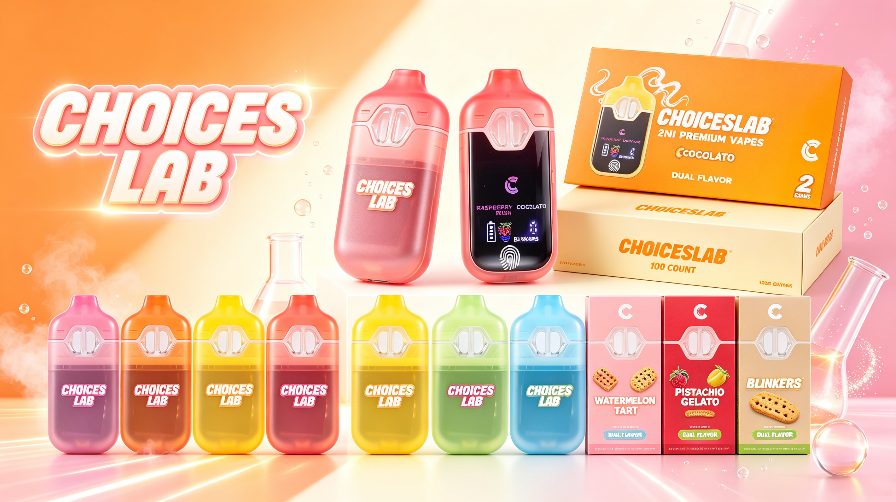
Choice Labs has historically strong ties to the Michigan market and has been associated with cartridge brands such as Drip and Crude Boys, among others. Current retail listings in Michigan continue to show 1g products from Choice Labs featuring a 510-thread configuration.
For purchasing managers, however, it is not a matter of simply pursuing a well-known product name.
The crucial question is:
Why does the 510 platform remain commercially relevant despite the rise of disposables—and what technical and supplier-related criteria should brands evaluate before placing an OEM order?
The 510 thread remains a dominant hardware standard.
Der größte Vorteil von 510 ist nicht ein einzelnes technisches Feature.
Es ist das Ökosystem.
Headset zeigt für 2025 eine starke Konzentration auf 510 Threaded: 91,3 % Anteil in den USA und 99,8 % in Kanada innerhalb der ausgewiesenen Hardware-Klassifizierung.
Für B2B-Einkäufer hat diese Standardisierung mehrere Vorteile.
Eine Marke kann beispielsweise eine Batterieplattform entwickeln und anschließend verschiedene Cartridge-SKUs darauf aufbauen.
Hardware und Verbrauchsprodukt bleiben voneinander getrennt:
Battery → wiederverwendbare Hardware
Cartridge → austauschbares Produktsystem
Diese Modularität kann Produktentwicklung, Sortimentsplanung und Second-Sourcing erleichtern.
Genau darin liegt einer der wichtigsten wirtschaftlichen Vorteile von 510 choice lab threaded carts beziehungsweise vergleichbaren 510-Cartridge-Konzepten.
Vorteil 1: Größere Flexibilität bei der Produktentwicklung
Bei einem All-in-One-Gerät sind Batterie, Reservoir, Heizelement und Elektronik dauerhaft in einem Produkt kombiniert.
Bei einer klassischen 510-Lösung können Batterie und Cartridge separat entwickelt werden.
Für Marken bedeutet das mehr Flexibilität.
Innerhalb einer Cartridge-Familie können beispielsweise unterschiedliche:
- Reservoirgrößen
- Mouthpieces
- Heating systems
- Extraktformulierungen
- Oberflächen
- Packaging
- Preispositionierungen
entwickelt werden, während eine kompatible Batterieplattform bestehen bleibt.
Das kann insbesondere für Marken interessant sein, die mehrere Produktlinien oder unterschiedliche Preisstufen aufbauen wollen.
Vorteil 2: 510 kann Supplier Lock-in reduzieren
Proprietäre Systeme können starke Markendifferenzierung schaffen.
Sie können aber auch Abhängigkeiten erzeugen.
Wenn nur ein Hersteller eine bestimmte Batterie-Cartridge-Verbindung liefern kann, wird ein Lieferantenwechsel komplizierter.
Werkzeugänderungen, Produktionsausfälle, steigende Preise oder eine eingestellte Plattform können dann Auswirkungen auf die gesamte Produktlinie haben.
Beim 510-System ist der potenzielle Lieferantenpool größer.
Das bedeutet nicht, dass jede 510-Cartridge mit jeder Batterie vollständig kompatibel ist.
Aber ein etablierter Schnittstellenstandard gibt Einkaufsabteilungen mehr Möglichkeiten für:
Supplier Qualification, Second Source Development, Preisverhandlungen und Business Continuity Planning.
Für größere OEM-Programme kann diese Flexibilität einen erheblichen strategischen Wert haben.
Gleichzeitig gewinnen Disposables massiv Marktanteile
Ein professioneller Einkauf sollte die 510-Chance jedoch nicht isoliert betrachten.
BDSA berichtet, dass der US-amerikanische Cannabis-Vape-Markt in den zwölf Monaten bis Mai 2026 rund 8 Milliarden US-Dollar Retail-Umsatz erzielte und etwa 26 % des Cannabis-Gesamtmarktes ausmachte.
Noch wichtiger: Disposable-Umsätze stiegen um etwa 41 % von 2,7 auf 3,8 Milliarden US-Dollar, während Cartridge-Umsätze um rund 14 % zurückgingen. Im April 2026 überholten Disposables Cartridges erstmals auf monatlicher Basis.
Bedeutet das, dass 510 verschwindet?
No.
Es bedeutet vielmehr, dass sich der Markt in unterschiedliche Hardwarestrategien aufteilt.
All-in-One: Convenience, größere Kapazität, integrierte Hardware.
510 Cartridge: Modularität, Batteriewiederverwendung, breite Kompatibilitätsbasis und flexible Produktentwicklung.
Für Einkaufsmanager ist deshalb eine Portfoliofrage wichtiger als die Frage, welches Format pauschal „besser“ ist.
Michigan bleibt für Choice-Labs-bezogene Beschaffung besonders relevant
Choice Labs hat einen starken historischen Bezug zu Michigan.
Und Michigan bleibt ein großer Vape-Markt.
Nach den neuesten Headset-Daten erzielte die Kategorie Vapor Pens im Juli 2026 rund 49,47 Millionen US-Dollar Umsatz in Michigan, ein Plus von 5,1 % gegenüber dem Vorjahr.
Das ist besonders interessant, weil Michigan gleichzeitig zu den preislich aggressivsten Cannabis-Märkten der USA gehört.
Headset meldete für Q4 2025 einen durchschnittlichen Vapor-Pen-Preis von nur etwa 8,24 US-Dollar pro Gram Equivalent in Michigan, verglichen mit einem US-Durchschnitt von 21,81 US-Dollar.
Für Procurement Manager ergibt sich daraus ein klares Spannungsfeld:
hohes Volumen + starke Konkurrenz + niedrige Preise.
In einem solchen Markt können wenige Cent Hardwarekosten bei großen Bestellungen relevant sein.
Aber Qualitätsprobleme können gleichzeitig die gesamte Einsparung wieder vernichten.
Choice Labs hat sich 2026 organisatorisch verändert
Dieser Punkt ist für aktuelle SEO- und Einkaufsinhalte besonders wichtig.
Im Juli 2026 wurde öffentlich bekannt gegeben, dass sich das frühere Choice Labs/Glorious-Geschäft unter der Marke Intrinsic neu positioniert hat.
Laut der am 28. Juli veröffentlichten Branchenmeldung ist Intrinsic in Jackson, Michigan, ansässig und bedient mehr als drei Viertel der Provisioning Centers im Bundesstaat.
Für B2B-Einkäufer hat diese Entwicklung eine wichtige Konsequenz:
Ein historisch bekannter Markenname ist nicht automatisch gleichbedeutend mit der aktuellen juristischen oder kommerziellen Lieferstruktur.
Wenn ein Lieferant heute „Choice Labs carts“, „Choice Labs OEM“ oder ähnliche Produkte anbietet, sollte der Käufer prüfen:
- Wer ist der aktuelle Markeninhaber?
- Welches Unternehmen produziert das Produkt?
- Unter welcher Lizenz wird es hergestellt?
- Ist die angebotene SKU aktuell?
- Ist der Verkäufer autorisiert?
- In welchem US-Bundesstaat darf die Ware gehandelt werden?
- Handelt es sich um originale Markenware oder lediglich um generische Hardware mit fremdem Branding?
Gerade bei Markenübergängen wird Supplier Verification wichtiger.
510-kompatibel bedeutet nicht automatisch vollständig kompatibel
Einer der häufigsten Fehler bei der Beschaffung lautet:
„Es hat ein 510-Gewinde, also funktioniert es.“
Mechanisch mag eine Cartridge passen.
Technisch kann die Kombination trotzdem problematisch sein.
Professionelle Käufer sollten mindestens vier Ebenen testen.
1. Mechanische Kompatibilität
The following are to be examined:
- Gewindetoleranzen
- Cartridge diameter
- Gesamtlänge
- Center-Pin-Position
- Kontaktierung
- Sitz in recessed Batteries
Eine Cartridge, die zu tief oder zu locker sitzt, kann Kontaktprobleme verursachen.
2. Elektrische Kompatibilität
Define:
- Resistance zone
- recommended voltage
- maximum operating voltage
- Scope of services
- Contact resistance
- Behavior at low battery level
A cartridge should not function at only a single laboratory voltage.
3. Thermal compatibility
The heating core, resistance, and operating voltage jointly determine the thermal behavior.
Therefore, the battery and cartridge should be tested as a system.
4. Formulation compatibility
Different formulations may impose different requirements on:
- porosity
- Wicking
- Heating surface
- Inlet openings
- temperature
- Airflow
place.
A hardware design that functions reliably with a lower-viscosity distillate will not necessarily yield identical results with a different formulation.
Material quality is becoming a crucial procurement issue.
When it comes to cartridges, quality checks should not be limited to the word "ceramic."
A study published in *Scientific Reports* in 2025 analyzed six groups of legal cannabis vape products, including five product groups featuring 510-thread cartridges.
Researchers detected metal particles—specifically metals such as aluminum, cobalt, chromium, copper, nickel, tin, and zinc—in the vape liquids analyzed and, in some cases, in the resulting aerosol. Of particular relevance to hardware purchasers: among the 510-thread products examined, the marketing of a ceramic heating element did not automatically result in a lower total content of the metals typically associated with heating components.
That does not mean that ceramic cartridges are inherently bad.
It means:
"Ceramic" is a description of the construction—not complete proof of quality.
Purchasing managers should therefore ask more probing questions.
Which alloys are used?
Which materials come into contact with the formulation?
Which metallic components are present in the heating system?
What material are the center pin and contacts made of?
Which seals and adhesives are used?
Were finished cartridges tested, rather than just raw materials?
Such questions provide significantly more information than a marketing label.
Why material specifications should be defined in writing
A cartridge can look identical on the outside, even though important internal components have changed.
A manufacturer could, for example, replace:
A manufacturer could, for example, replace:
Ceramic core → different supplier
Seal → other elastomer
Center pin → different metal composition
Adhesive → alternative wording
For the buyer, the visual inspection is then practically useless.
Therefore, a professional OEM project should operate with a locked BOM.
This means that critical materials and components are documented and, following sample approval, are not modified without written consent.
"Golden sample" instead of "similar production sample"
A good sample does not yet prove a good series production.
A good sample does not yet prove a good series production.
Engineering Sample → Compatibility Test → Pre-Production Sample → Golden Sample → Pilot Run → Mass Production
The golden sample defines the approved configuration.
These include, for example:
- Dimensions
- Resistance zone
- Heating system
- Materials
- surface
- Airflow
- Mouthpiece
- logo
- Packaging
Serial production items should subsequently be checked against this reference.
Which QC metrics should be included in a 510-RFQ?
If your company is evaluating 510 choice lab threaded carts or comparable OEM hardware, quality requirements should be defined prior to the purchase order.
Leakage rate
How many units may exhibit leaks after filling, storage, and transport?
Resistance tolerance
Which resistance range is permitted?
A large resistance spread can lead to varying heating behavior.
Airflow
Define a reproducible airflow range instead of just a "smooth draw."
Contact failure
Cartridges must reliably establish contact with the designated battery.
Aging test
Do not test only immediately after the filling.
Test the product after a defined storage period and under relevant temperature conditions.
Cosmetic defects
Distinguish between functional, critical, and purely cosmetic defects.
Batch traceability
It should be possible to trace each production batch back to key components and production data whenever possible.
1g remains important – but larger formats are growing.
Headset shows that **1g remained the dominant vape pen format in the US in 2025, accounting for 75.1% of sales**.
At the same time, 2g products grew by an impressive 95.8% year-on-year, while 0.5g products declined significantly.
For cartridge OEM projects, this means:
1g remains a proven core standard.
However, procurement and product development teams should monitor whether increased capacity in their specific market is becoming economically viable.
However, a larger cartridge places greater demands on:
- Tightness
- Wicking throughout the entire service life
- Material compatibility
- Thermal stability
- Storage behavior
Therefore, increased capacity should not simply be achieved by means of a larger reservoir.
The entire hardware system must be validated.
Falling prices make the total cost of quality more important.
According to Headset, the average US vape pen price per gram equivalent fell from $28.30 in early 2024 to around $21.70 in late 2025.
This price pressure ripples through the entire supply chain.
Retailers are squeezing distributor prices.
Distributors drive down brand prices.
Brands drive down hardware costs.
This is precisely where the risk of misguided cost-cutting arises.
Assume Supplier A is $0.07 cheaper per cartridge.
For a quantity of 500,000 units, the buyer initially saves:
35.000 US-Dollar.
However, if Supplier A produces a significantly higher leakage or failure rate, additional costs arise due to:
- lost phrasing
- Committee
- Rework
- Replacement deliveries
- Express Freight
- Retail Credits
- additional inspections
- Customer Service
- Imageschäden
The relevant purchase price is therefore not merely FOB.
It is:
Unit Cost + Cost of Quality + Cost of Failure.
Battery documentation is also part of the 510 system.
The cartridge itself usually does not contain a battery.
However, the finished 510 ecosystem uses rechargeable lithium batteries.
PHMSA clarifies that lithium cells and batteries offered for transport must have passed the relevant UN 38.3 design tests. Manufacturers must also make the corresponding test summary documents available upon request.
For brands that offer cartridges and batteries together as a product family, the supplier record should therefore include both areas:
Cartridge Quality Documentation
and
Battery Transportation Documentation.
A good cartridge with a poorly documented battery does not make for a professional overall system.
Michigan licenses and supply chains should be verified separately.
The Michigan Cannabis Regulatory Agency regularly publishes reports on adult-use licenses; for 2026, current reports are available up to July, among others.
The agency also publishes monthly statistical reports as well as enforcement and recall information.
For B2B buyers, this regulatory infrastructure should be part of supplier due diligence.
When it comes to filled cannabis products, buyers should not rely solely on statements made on websites.
Verify the relevant licensees, production facilities, testing status, and distribution channels directly through the competent regulatory sources.
This applies in particular when historical brand names continue to appear on the market following a rebranding.
What should purchasing managers request before placing a 510 OEM order?
A professional inquiry should go well beyond "Price for 100,000 units?"
Demand at least:
Technical Documentation
- technical drawing
- Dimensional tolerances
- Resistance zone
- Heating Core Specification
- List of materials
- Airflow specification
- recommended voltage range
Quality documentation
- IQC-Prozess
- In-Process QC
- Final QC
- OQC
- AQL-Standard
- Leakage test
- Aging test
- Batch traceability
Production Information
- monthly capacity
- Level of automation
- critical sub-suppliers
- Change control process
- Pilot run capability
compatibility
- Target battery tested
- Goal formulation tested
- relevant viscosity tested
- Storage conditions validated
Commercial Terms
- MOQ
- Production time
- Warranty Policy
- Complaint handling process
- CAPA process
- Alternative arrangement
A supplier capable of clearly addressing these points offers significantly greater informational value than a provider who merely sends out samples and price lists.
Was bedeutet der Choice-Labs-Fall für OEM-Käufer?
In 2026, the true value of the keyword **510 choice lab threaded carts** lies less in simply copying an existing brand.
Far more interesting are the structural signals behind them.
Choice Labs had a strong presence with vape and cartridge products in one of the most competitive cannabis markets in the U.S. Michigan continues to generate nearly $50 million in monthly vape pen sales, while the 510 format remains a dominant hardware standard.
At the same time, the recent rebranding to Intrinsic demonstrates the importance of distinguishing between:
Brand Name
Legal Entity
Licensed Processor
Hardware Supplier
and
OEM Manufacturer
to distinguish.
Therefore, for its own private-label project, a brand should not attempt to reproduce Choice Labs packaging, logos, or trade dress belonging to another party.
The more sustainable approach is a proprietary, non-infringing 510 hardware platform, with technical specifications and brand identity controlled by the buyer.
Fazit: Warum 510 für professionelle Einkäufer relevant bleibt
The vape market is clearly moving towards all-in-one devices.
But that does not make 510 irrelevant.
Current data on vape cartridges shows strong standardization around the 510-thread format, while Michigan generated **$49.47 million in vape pen sales** in July 2026.
For B2B buyers, the 510 system continues to offer important advantages:
Modularity
greater supplier flexibility
separate development of battery and cartridge
an established hardware standard
Second-sourcing options
flexible OEM customization
But a 510 thread alone does not define a high-quality cartridge.
Materials, heating system, resistance tolerances, airflow, seal integrity, formulation compatibility, production control, and traceability determine whether the hardware functions reliably in the real-world market.
The most important procurement question is therefore not:
"Is it 510?"
Rather:
How well-documented, tested, and reproducible is this specific 510 system?
Are you looking for a 510-cartridge OEM partner?
If your company is developing empty 510 cartridges or custom vape hardware for a legitimate and properly licensed project, the supplier selection process should begin with technical documentation—not the lowest unit price.
Leerervape is already publishing sourcing and OEM content regarding 510-cartridge platforms, focusing on material quality, compatibility, golden samples, QC, and change control.
For a new project, you should brief potential suppliers on cartridge capacity, formulation goals, the desired heating core, battery configuration, branding, packaging, order quantity, and target market.
Then, before placing a larger order, request:
Production Sample + Technical Specification + Material Information + QC Standard + Golden Sample + Batch Traceability.
A professional OEM partner should be able to speak just as concretely about materials, engineering, compatibility, quality control, and production consistency as about MOQ, price, and lead time.
That is precisely where a robust, long-term supply chain partnership begins.
Attention : choicelab fingerprint 2g vape pen | choice lab vape bulk | dual chamber disposable bulk | wholesale vapes
 empty 1g vape
 empty 2g vape
 empty 3g vape
 empty dual chamber vape
 empty led vape
 USA STOCK VAPE
 EU German stock vape