The Rise of 510-Thread Big Chief Duo V2 Batteries: Why Modular Vape Hardware Remains Relevant for Buyers
The US vape market is changing faster in 2026 than in many previous years.
On the one hand, all-in-one and disposable systems are gaining significant market share. On the other hand, the 510-thread connection remains by far the most important standard in the cartridge segment.
For purchasing managers, distributors, cannabis brands, and OEM project managers, this raises an important question:
Should one continue to invest in 510-thread batteries, even though the market for disposables is growing so rapidly?
The current data point to a nuanced response.
In its 2026 market analysis, Headset reports that 510-thread hardware accounts for 91.3% of US sales in the cartridge hardware segment. Proprietary systems, by contrast, remain comparatively small.
At the same time, the latest BDSA data show that disposables accounted for more than half of the US cannabis vape market for the first time in April 2026. By May, their share had already reached 51.1% of vape sales.
Das bedeutet nicht, dass 510 verschwindet.
Rather, it means that two hardware strategies are developing in parallel:
Modular cartridge systems with a standardized 510 connection and integrated all-in-one systems for maximum convenience.
That is precisely why B2B buyers should view search terms like 510 thread big chief duo v2 batteries not merely as product keywords, but as indicators of a broader procurement trend.
First, an important clarification: the Big Chief Duo V2 and the 510 battery are not the same thing.
This distinction is crucial for a professional B2B article.
The term "510 thread Big Chief Duo V2 batteries" appears in search queries, but technically, it can conflate two different product categories.
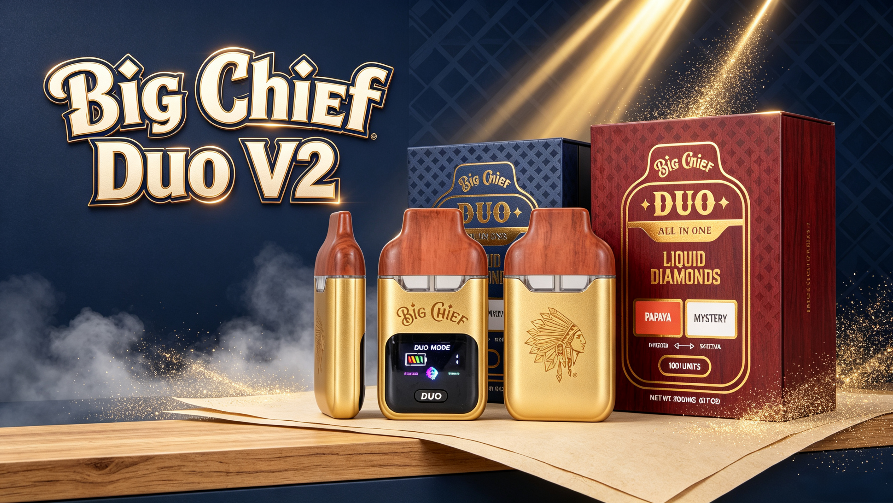
Big Chief currently offers a standalone **Big Chief 510-thread battery** in its official shop. At the same time, the DUO products are marketed as all-in-one systems; for instance, the DUO-V3 line is listed separately in the current product range.
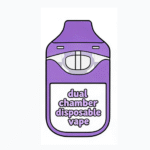
Leerervape also describes the Big Chief Duo V2 as empty 2g dual-chamber hardware—featuring two chambers and a rechargeable system—rather than as a standard battery for a screw-on 510 cartridge.
For purchasing agents, this is no small matter.
A classic 510 system consists of:
Battery + 510 Connector + replaceable cartridge.
In contrast, a Duo-V2-style all-in-one system typically integrates:
Battery + two reservoirs + heating system + electronics + airflow + housing in a single device.
Both concepts can be commercially attractive, but they require different approaches to procurement, testing, and costing.
Why the 510 thread remains important despite the disposable boom
The strength of the 510 system lies less in a new technical feature than in its standardization.
With a 91.3% market share in the US cartridge hardware segment, 510 is effectively the established connection standard for this product category. In Canada, according to Headset, that share is as high as 99.8%.
For a procurement manager, a widespread standard primarily means flexibility.
A company is less heavily dependent on a single proprietary battery system.
This can offer advantages for:
- Second-source strategies;
- OEM selection;
- Spare parts and battery planning;
- Cartridge compatibility;
- Supplier negotiations
- changing product ranges;
- Product development;
- and business continuity planning.
A shared battery platform can make economic sense, particularly when a company offers multiple cartridge SKUs.
Market Trend No. 1: Vaping is now an $8 billion category.
The hardware decision should not be viewed in isolation.
According to BDSA, the US cannabis vape market reached approximately $8 billion in retail sales in the twelve months ending in May 2026.
Vape products thus account for around 26% of the total US cannabis retail market and grew by approximately 6% compared to the same period last year.
Nationally, Flower remains larger, at approximately 40%.
In certain particularly mature markets, however, the ratio has already shifted.
In May 2026, according to the BDSA, vape was in:
Washington at 32% of the cannabis market compared to 26% for flower, and California at 31% compared to 30% for flower.
This development is crucial for hardware purchasers.
Vaping is no longer a secondary product category.
In some of the key US markets, it has meanwhile become one of the highest-grossing product groups of all.
Market Trend No. 2: Disposables are growing – but cartridges remain relevant.
The biggest change in 2026 is the change of format.
According to BDSA, the share of disposables rose from 42.9% of vape sales in June 2025 to 51.1% in May 2026.
Over the past twelve months, sales of disposable vapes grew by approximately 41% to $3.8 billion, while cartridge sales declined by around 14% to $4.1 billion.
Nevertheless, it would be wrong for purchasing departments to conclude from this:
"Cartridges are a thing of the past."
Die jüngsten zwölfmonatigen Zahlen zeigen nämlich, dass das absolute Cartridge-Geschäft weiterhin mehrere Milliarden Dollar groß ist.
And within this cartridge business, the 510 standard dominates with a market share of more than 90%.
The more sensible procurement question is therefore:
What role should 510 cartridges and all-in-one systems play in our portfolio?
Why Big Chief is an interesting example of this development
The current Big Chief product architecture illustrates precisely this portfolio logic.
The official shop carries a separate Big Chief 510-thread battery as well as cartridges and all-in-one products.
From a B2B perspective, this is more interesting than looking at an individual SKU.
A brand can use different hardware formats to address various purchasing motives:
510 Cartridge: Modularity and compatibility.
Separate 510 Battery: reusable power platform.
All-in-One / Duo: Convenience and integrated hardware.
For OEM buyers, this means: It is not strictly necessary to decide that only one concept will survive in the long term.
A differentiated product range can be stronger than a single-format strategy.
Why the 510 model remains attractive for OEM projects
With a traditional 510 system, the battery and cartridge are purchased separately.
That changes the cost structure.
With an all-in-one system, a lithium battery is supplied with each product.
With the 510 model, however, the same battery can be used across multiple compatible cartridge purchases.
For brands, this can give rise to a platform model:
One battery SKU supports multiple cartridge SKUs.
This can yield advantages in terms of unit costs, merchandising, accessory sales, and customer loyalty.
From a purchasing perspective, the separation also offers another possibility:
The battery and the cartridge can be qualified independently of one another and—where technically appropriate—secured through different supplier strategies.
510-Kompatibilität bedeutet nicht automatisch identische Performance
One of the most common misconceptions in purchasing is:
If both products have a 510 thread, they are compatible.
Mechanically, that may be correct.
Technically, it still doesn't have to be correct.
Professional procurement should examine at least four levels.
Mechanical compatibility
The following should be checked:
- Thread tolerance;
- Center-pin height;
- Connector depth;
- Cartridge diameter;
- Air route;
- and the seating of the cartridge.
Even minor deviations in tolerances can lead to contact problems or complaints.
Electrical compatibility
The supplier should specify:
- Output voltage;
- Voltage tolerance;
- supported resistance level;
- maximum output current;
- Low-voltage cutoff;
- Short-circuit protection;
- and shutdown logic.
Thermal compatibility
Two cartridges with the same connection can have different heating systems.
Therefore, the battery should not be tested in isolation.
Battery + cartridge + intended formulation must be validated as a system.
Firmware und Bedienlogik
For batteries with:
Preheat, multiple voltage levels, LED display, or automatic shut-off
the OEM manufacturer should be able to document the actual firmware logic.
A technical specification is more valuable than a marketing claim like "powerful battery."
Variable voltage can be a real product advantage.
Big Chief has incorporated multiple voltage settings and a preheat function into the previously described 510 battery platforms.
The concept is now widely adopted in the market.
Variable voltage is of interest for OEM projects because different cartridge and heating technologies may require different power ranges.
But:
Higher voltage does not automatically mean better performance.
A procurement department should not simply select the battery with the highest output voltage.
More important are:
- stable output voltage;
- reproducible voltage levels;
- low production variance;
- matching cartridge resistance;
- controlled heating;
- and reliable behavior as the state of charge drops.
A professional RFQ should therefore define an acceptable tolerance range.
The real difference in quality often lies in the battery.
The external shape of a vape battery can be copied relatively easily.
The quality of the internal cell is significantly lower.
That is precisely why a battery should not be specified solely by its mAh rating when sourcing for OEM applications.
A purchasing manager should ask:
Who produces the cell?
Which specific cell specification is being used?
What is the capacitance tolerance?
Which charging IC is used?
What protective functions does the PCB have?
Is the production cell the same as the cell in the test documentation?
These questions become more important, not less so, with large production volumes.
UN 38.3 belongs in the supplier file.
Transport documentation for lithium batteries is particularly relevant for US-based purchasers.
The U.S. Pipeline and Hazardous Materials Safety Administration (PHMSA) requires that lithium cells and batteries offered for transport have passed the relevant design tests in accordance with the UN Manual of Tests and Criteria, Section 38.3.
These tests take into account, among other things:
- Altitude simulation;
- thermal load;
- vibration;
- Thrust;
- external short circuit;
- Impact/Crush;
- Overloading;
- and forced discharge.
PHMSA also points out that manufacturers and downstream distributors must make the corresponding Lithium Battery Test Summaries available for the supply chain.
Für einen B2B-Einkäufer bedeutet das:
A PDF with the heading "UN38.3" is not automatically sufficient.
The model number and battery description in the test summary should match the cell actually supplied.
Why a BOM lock is particularly important
A frequently underestimated risk arises after sample approval.
The approved sample contains, for example, a specific lithium cell.
Three months later, this cell becomes more expensive or less available.
The manufacturer replaces it with another cell of the same nominal capacity.
From the outside, the product looks identical.
Technically, it can still be a different product.
PHMSA points out that modifications to a lithium battery that could affect its ability to pass UN 38.3 tests may result in the battery being treated as a new type and requiring re-testing accordingly.
Therefore, an OEM agreement should include a BOM lock and change control process.
Changes to:
Cell, PCB, charging IC, connector, firmware, or protection circuit
should not be carried out without written approval.
UL 8139 is a useful safety standard.
Another relevant standard for more demanding vape hardware programs is UL 8139.
UL Solutions describes UL 8139 as a standard for evaluating the safety of:
- electrical systems;
- heating systems;
- Batteries;
- charging systems;
- battery management;
- mechanical load-bearing capacity;
- unbeabsichtigter Aktivierung;
- and interconnected components
for electronic cigarettes and vape devices.
Important:
UL 8139 does not evaluate the content or physiological effects of the consumable used.
UL-8139 certification does not replace product authorization under cannabis or tobacco laws.
For a hardware purchaser, however, the standard offers a good technical frame of reference.
Even if an OEM project does not require UL certification, purchasing and engineering teams can use the testing categories to formulate better questions for suppliers.
Flight and transport regulations demonstrate why battery safety is economically significant.
The issue of battery quality does not end at the factory gate.
The FAA explicitly lists vape pens and electronic smoking devices as lithium-powered devices.
According to the FAA regulations—most recently updated as of August 10, 2026—vaping devices must be carried in hand luggage during air travel and protected against damage, short-circuiting, and accidental activation; they must not be transported in checked baggage.
For procurement managers, this is no trivial travel advisory.
It shows how strongly battery design is linked to:
Logistics, product liability, packaging, user information, and risk management
is connected.
A battery is not a commodity item.
It is a safety-critical component.
What buyers should ask for in a 510 battery RFQ
A professional RFQ for 510-thread hardware should include at least the following points.
1. Battery Specification
Ask for:
- Cell manufacturer;
- Cell model;
- Rated Capacity;
- Nominal voltage;
- Charging Voltage;
- Charging current;
- Discharge Limits;
- Cycle-life data;
- and protection parameters.
and protection parameters.
Define:
- Voltage levels;
- Output Tolerance;
- Resistance Range;
- Preheat Parameter;
- Cut-off time;
- and LED Logic.
3. 510 Connector Specification
The manufacturer should specify tolerances for:
- Thread;
- Center pin;
- Connector depth;
- and mechanical seat
be able to specify.
4. Charging System
USB-C devices should have at least the following features:
- Charging input;
- Charging current;
- Charging Time;
- Overcharge Protection;
- Connector Cycle Test;
- and charging indicator logic
be determined.
5. Safety Documentation
Request at least the applicable UN 38.3 test summary and relevant lithium battery transport information.
6. QC and AQL
Before production begins, define which defects:
critical, major, or minor
are.
Typical areas of testing are:
- Charging;
- Output Voltage;
- Thread Fit;
- Button Function;
- LED;
- Preheat;
- Protection Logic;
- Cosmetic Quality;
- and packaging.
What buyers should also check regarding Duo-V2-style dual-chamber hardware
Anyone actually looking for dual-chamber all-in-one hardware via the search query **510 thread Big Chief Duo V2 batteries** needs a different checklist.
With a dual-chamber system, additional sources of error arise:
Reservoir A + Reservoir B + two heating paths + switching logic + sealing + airflow + battery + PCB.
Leerervape describes its currently listed Big Chief Duo V2 hardware as a 2g system with dual-chamber architecture that is supplied empty—without oil, nicotine, THC, or CBD—and offered for OEM/ODM projects.
For such an order, purchasers should additionally check:
- Isolation of the two chambers;
- Leakage between the reservoirs;
- Coil consistency;
- Switching logic;
- uniform battery load;
- Activation of each individual chamber;
- Behavior in dual mode;
- Aging tests;
- and formulation compatibility.
A dual-chamber product is technically more complex than a simple 510-stick.
This should also be reflected in the QC process.
2G hardware is a particularly important trend for 2026.
The commercial relevance of Duo and 2G hardware is supported by current market data.
BDSA reports that 2g disposables have more than doubled their share of US disposable vape sales within two years, rising from approximately 16% to 35%.
In some states, the concentration is significantly higher.
In May 2026, for example, the 2g share of disposable sales stood at:
Oklahoma: 94%
Arizona: 73%
Utah: 72%
Illinois: 59%
Accordingly, BDSA identifies 2g disposables as the fastest-growing size format in the cannabis vape segment.
For buyers of dual-chamber hardware, this is a significant market signal.
But that does not mean that 2G systems are automatically the right solution in every federal state.
Procurement must be carried out in accordance with the specific requirements of the federal state.
The US vape landscape differs significantly across the various cannabis markets.
For May 2026, BDSA reports a disposable share of vape sales of:
Arizona: 79 %
New York: 66 %
Michigan: 64 %
opposite:
Kalifornien: 46 %
Pennsylvania: 39 %
Florida: 32 %.
That means:
A hardware concept that fits the market structure in Arizona very well is not necessarily the right product selection for Florida.
For national brands, therefore, sourcing should not be based solely on an overall US trend.
It should be sent to:
State + Product Format + Capacity + Oil Type + Retail Price Point
be segmented.
Premium oils also change hardware requirements.
Another trend is relevant for battery and hardware suppliers.
BDSA reports that live resin already accounted for 28% of US vape sales in May 2026.
Live resin and rosin combined accounted for around 32% of vape sales, compared to 28% the previous year.
Das bedeutet für Hardware-Einkäufer:
The requirements for heating technology and voltage control are becoming increasingly important.
A device should not be qualified using only a single standard test liquid.
For OEM projects, the hardware and the intended formulation should be validated together.
This applies in particular to:
- viscosity;
- inlet design;
- coil resistance;
- ceramic structure;
- output voltage;
- preheat behavior;
- and storage temperature.
Why the cheapest supplier is rarely the most cost-effective supplier
Let's assume Supplier A offers a battery for $0.20 less per unit than Supplier B.
At 100,000 units, this initially looks like a saving of:
20.000 USD
out of.
However, procurement should also consider:
- DOA Rate;
- Charging Failure;
- Connector Failure;
- Retailer Credits;
- Replacement Freight;
- Warranty Labor;
- Quarantine Inventory;
- and lost follow-on sales.
If a reusable 510 device fails, the damage can extend beyond the value of the battery.
The customer may simultaneously lose confidence in the compatible cartridges.
That is why Total Cost of Quality is often a better metric than FOB unit price.
A practical supplier scorecard model
For an OEM comparison, US buyers can evaluate suppliers in five areas.
Engineering – 25%
Can the provider explain actual technical specifications, tolerances, and protection logic?
Quality System – 25 %
Are there incoming inspection, in-process QC, final inspection, AQL, and CAPA?
Battery & Documentation – 20 %
Is there traceability for cell data and UN 38.3 documentation?
Production Consistency – 15%
Is there a locked BOM and formal change control?
Commercial Support – 15 %
How good are lead times, forecasting, contingency arrangements, communication, and after-sales support?
This makes supplier selection more measurable.
And the lowest price does not automatically win.
Brand authorization should also be checked.
With a well-known brand like Big Chief, there is an additional factor: brand and product authenticity.
The current Big Chief website explicitly points to a dedicated app that allows users to verify products.
Professional buyers should therefore clearly distinguish between two projects:
Purchase of an authentic branded product through an authorized channel
and
Development of proprietary empty vape hardware under the OEM/ODM model.
If a supplier offers the Big Chief logo, packaging, or brand-specific designs, a B2B buyer should verify the relevant authorization.
A factory capable of printing a logo does not automatically possess the right to use that logo.
For private-label projects, a proprietary, non-infringing design is usually the more robust strategy in the long run.
What does this mean for Leerervape customers?
For visitors to leerervape.com, the key takeaway regarding the keyword 510 thread big chief duo v2 batteries should not be that all the mentioned hardware types are technically identical.
On the contrary.
It is precisely this distinction that leads to a better purchasing decision.
If your project requires a classic cartridge platform, 510-thread batteries remain a relevant hardware category due to their market-wide standardization.
If, on the other hand, your project focuses on dual-chamber, 2g, or all-in-one hardware, the battery, reservoirs, heating system, and switching electronics should be qualified as an integrated, complete system.
Beide Kategorien haben 2026 eine Berechtigung.
The right choice depends on the target market and business model.
Conclusion: The 510 thread remains important – but the market demands a portfolio strategy.
The current figures do not show a simple winner-loser story.
The 510 thread continues to dominate the US cartridge hardware segment with a 91.3% share.
At the same time, disposables will have already reached **51.1% of total US cannabis vape sales** by May 2026.
And within the disposable category, demand for larger formats is rising particularly sharply: 2g products have more than doubled their share from 16% to 35% in the space of two years.
For professional buyers, the conclusion is therefore not:
“510 or All-in-One?”
Rather:
“Which hardware format offers the best combination of compatibility, quality, cost, differentiation, and supply capability for our specific market?”
It is precisely at this point that supplier selection becomes crucial.
Are you looking for a vape hardware or OEM/ODM partner?
If your company is evaluating 510-thread batteries, empty dual-chamber vape hardware, 2g all-in-one systems, or custom OEM/ODM projects for a legally permissible market, supplier selection should not begin with the lowest unit price.
First, demand:
Production sample, locked BOM, battery specification, UN 38.3 documentation, QC standard, AQL criteria, lot traceability, and clear change control rules.
For branded products, the authorization to sell the brand should also be verified.
For private-label projects, independent branding and non-infringing product design provide a better foundation for building a brand that is scalable in the long term.
According to current product information, Leerervape offers empty vape hardware—free of oil, nicotine, THC, or CBD—as well as OEM/ODM support for business customers.
When evaluating a new hardware program, do not simply send your potential supply partner the desired quantity.
Please also send your requirements regarding target market, hardware format, battery, capacity, branding, packaging, QC, and planned production volume.
A professional OEM partner should be able to answer these points just as specifically as the questions regarding MOQ and price.
For in the 2026 vape hardware business, it is not just a matter of which product is currently attracting attention.
The decisive factor is which supplier can deliver this product in a reproducible, documented, and scalable manner.
Attention : big chief duo v2 disposable vape | big chief vape | dual chamber disposable bulk | thc vape
 empty 1g vape
 empty 2g vape
 empty 3g vape
 empty dual chamber vape
 empty led vape
 USA STOCK VAPE
 EU German stock vape