Spotlight on Super Dope Vape: Why the battery is becoming increasingly important for professional buyers
Anyone talking about **Super Dope Vape** in 2026 shouldn't just talk about design, format, or brand recognition.
For professional buyers, another component is at least as important:
the battery and the entire electrical system behind the Vape unit.
The US cannabis vape market is changing rapidly. According to BDSA, the vape segment generated approximately $8 billion in retail sales in the twelve months ending May 2026, accounting for around 26% of the total cannabis retail market. At the same time, sales of disposable vapes rose by about 41%—from $2.7 billion to $3.8 billion—while cartridge sales declined by roughly 14%. In April 2026, disposables overtook cartridges in monthly sales for the first time.
For purchasers, this means:
Demand is shifting towards more highly integrated vape systems—and with this, the quality of the battery, PCBA, charging system, heating element, and protection logic is increasingly becoming part of the overall product quality.
Especially with a brand name like super dope vape, one should therefore not only ask:
"What does the device look like?"
Rather:
“What battery is actually inside, how consistently does it perform in mass production, and can the supplier document the technical specifications?”
Super Dope Vape: First identify the product generation, then evaluate the battery.
An important point for procurement departments is the distinction between the brand name and the specific hardware specification.
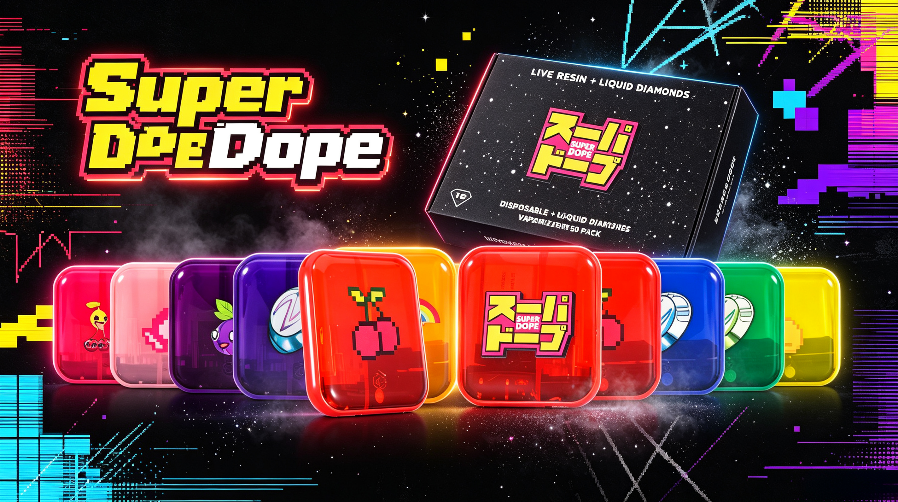
Super Dope's current official online presence confirms that the brand develops vape products. For instance, Super Dope announced its Pocket Mini Vapes for 2025; the brand also documents the launch of the newer Pocket XL Vapes in Michigan.
At the same time, no single universal technical battery specification can be found in current, verifiable primary sources that automatically applies to every "Super Dope Vape" device offered online.
This is important for purchasers.
On the open market, varying capacities, form factors, and technical specifications are offered under similar product names.
Therefore, a procurement manager should never assume:
“Super Dope Vape = always the same battery.”
Instead, the technical assessment must always be based on the exact SKU, product generation, and production BOM.
Why the battery is more strategic today than in the past
For a long time, the battery in simple vape devices was viewed primarily as a cost factor.
This works less and less well with modern all-in-one systems.
A vape battery must simultaneously:
provide sufficient energy for the planned product service life;
deliver a stable voltage under load;
work with the selected heating element;
can be reliably charged;
correctly execute protective functions;
fit into a small housing;
withstand temperature fluctuations;
and be appropriately documented for transport and logistics.
This means the battery is no longer a separate component.
It becomes a system component of the entire product architecture.
UL Solutions describes precisely this approach for UL 8139: It evaluates not just individual battery cells, but the interaction between the electrical system, heating system, battery, charging system, and battery management of a vape device.
For professional buyers, this is an important mindset.
The right question is not:
"Is the battery good?"
Rather:
"Is this battery technically suitable and reproducible in this hardware configuration?"
Benefit 1: A reliable battery reduces hidden quality costs.
A battery problem is rarely just a battery problem.
If a unit fails to charge or fails prematurely, the following can result:
Financial losses can mount, particularly with larger all-in-one formats.
As more product functionality relies on a single battery and a single electronics platform, any hardware failure becomes more costly.
Therefore, purchasing departments should not compare only the FOB price.
A professional comparison takes into account the:
Total Cost of Quality
Assume Supplier A offers a unit for $0.15 less than Supplier B.
At 100,000 units, the visible saving amounts to:
$15.000.
However, if Supplier A produces a significantly higher rate of DOA, charging, or field failures, that $15,000 can quickly disappear due to replacement shipments, scrap, freight, and customer service costs.
Therefore, the most favorable purchase price is not automatically the lowest total cost.
Advantage 2: Stable voltage improves reproducibility.
When it comes to vape hardware, professional buyers are interested in more than just the nominal battery capacity in mAh.
Equally important is the battery's behavior under load.
The electrical performance affects the output of the heating element.
If the output power fluctuates significantly between devices or during discharge, product performance can also become inconsistent.
This becomes particularly relevant when vape portfolios employ more sophisticated formulations.
The current US market is not shifting solely toward disposables. BDSA also reports an increasing share of premium vape formulations; the category is becoming more technologically sophisticated and is no longer defined exclusively by low-cost distillates.
For hardware purchasers, this means:
The battery, PCBA, heater, and formulation must be qualified as a system.
A battery with a high mAh rating does not, on its own, guarantee good performance.
Why mAh shouldn't be the most important factor when buying
Battery capacity is easy to understand on product pages.
That is why it is frequently promoted prominently.
For example, 500 mAh automatically sounds better than 350 mAh.
From an engineering perspective, the assessment is more complex.
A professional comparison should also take into account:
actual capacitance tolerance;
Cell quality;
Discharge behavior;
Voltage under load;
Charging current;
Loading time;
Low-voltage cutoff;
Overcurrent protection;
Short-circuit protection;
Temperature behavior;
mechanical integration;
and production consistency.
A larger battery may also require more space and influence the housing design.
The correct specification is therefore not:
"as many mAh as possible".
Rather:
“sufficient capacity with stable, documented performance for the planned application”.
Advantage 3: Rechargeable hardware can enable larger formats.
The market trend towards larger all-in-one formats is also changing the requirements for batteries.
BDSA explicitly cites the rapid growth of larger disposable formats as one of the factors driving the current shift from cartridges to disposables.
For a larger product, however, simply incorporating more reservoir capacity is not enough.
The battery must support the intended service life.
That is why USB-C charging systems, battery indicators, and controlled charging electronics are becoming increasingly important for many modern all-in-one designs.
For OEM buyers, this means that a rechargeable system should at least be jointly tested for:
Lithium batteries bring their own specific requirements to the supply chain.
The U.S. Pipeline and Hazardous Materials Safety Administration clarifies that lithium batteries and corresponding product configurations are subject to the relevant requirements of UN 38.3. A battery test summary must include, among other things, information regarding the battery or product model, the manufacturer, and the testing laboratory.
For a US buyer, therefore, a statement such as:
“UN38.3 available”
not sufficient.
He should check:
Which battery model is listed in the test summary?
Who is the manufacturer?
Which cell is actually in serial production?
Does the document correspond to the current BOM?
Did the supplier change the battery after sample approval?
This last question is particularly important.
If a "golden sample" is approved using Battery A, while serial production subsequently uses Battery B, the original qualification may lose its validity.
UL 8139 offers purchasers a meaningful technical reference framework.
Not every vape hardware project automatically requires UL 8139 certification.
Nevertheless, the standard is very useful for procurement teams.
UL Solutions states that UL 8139 evaluates the following areas, among others:
battery management;
heating systems;
charging systems;
Mechanical stress;
Accidental Activation;
Compatibility between connected systems;
Environmental Resilience.
This shows how a professional hardware purchaser should think.
A battery is not evaluated in isolation.
The entire electrical architecture must be compatible.
Even if an OEM project does not begin with formal UL certification, these test areas can serve as a basis for improved supplier qualification.
Super Dope Vape and Brand Risk: Don't Buy Hardware Based Solely on the Logo
Another problem arises with well-known product names:
Brand recognition can replace technical due diligence—although it never should.
The official Super Dope website explicitly points out that products in legal markets such as California, Florida, and Michigan are offered through local, licensed partners, and warns against fraudulent or fake social media channels.
This is an important signal for B2B buyers.
When a supplier offers "Super Dope Vape Hardware" or corresponding packaging, two completely different sourcing scenarios should be distinguished.
Scenario A: Genuine branded goods
Then it must be clarified:
Is the supplier or distribution channel actually authorized?
Scenario B: Empty OEM hardware
Then it should be clearly documented:
What constitutes hardware, what constitutes brand IP, and which elements may be lawfully used?
A low-cost producer capable of printing a logo is not automatically an authorized manufacturer.
For OEM projects, an original, controllable hardware platform is often more strategic.
For private-label projects, it may make more sense in the long run to build your own product rather than relying on someone else's brand identity.
An OEM buyer can, for example, define a hardware platform via:
Form Factor
Battery Capacity
Heating Technology
Airflow
Charging System
Surface Finish
LED Behavior
Packaging
Branding
This results in a product whose specifications and brand identity can be controlled by the client.
For professional procurement, this verification is more valuable than a superficial visual resemblance to a well-known product on the market.
The US vape market is simultaneously growing and becoming tougher.
The market environment makes these questions of quality even more important.
BDSA reports not only an $8 billion vape market but also significant consolidation.
More than 1,100 active vape brands disappeared within a year from the market monitored by BDSA, while successful brands are increasingly differentiating themselves through clear product identity, format strategy, and higher-quality product positioning.
This is an important message for hardware suppliers.
A growing market does not automatically mean that every provider is growing.
The competition is becoming more professional.
That is why the following are increasingly important:
Product Reliability
Cost Control
Traceability
Technical Documentation
Differentiation
Fast CAPA Response
Stable Supply
A procurement manager is not just looking for a device.
He is looking for a supplier who can meet these requirements over several production cycles.
The super-dope vape market also shows that product generations are evolving faster.
Official Super Dope communications have been documenting Pocket Disposables since 2023, followed by the Pocket Mini vapes and, more recently, Pocket XL products.
For B2B buyers, there is an important lesson in this:
Vape hardware has a product life cycle.
A design that is in high demand today can be replaced within a relatively short time by a new size, a new housing, or a new platform.
That is why procurement should not only ask:
"How much does this model cost?"
Rather:
“For how long can the supplier consistently reproduce this specification?”
This influences:
Reorders;
Spare parts and claims management;
Packaging investments;
Inventory levels;
OEM tools;
and product relaunches.
Golden Sample + Locked BOM: two of the most important tools in vape sourcing.
A professional project should define a Golden Sample.
This sample represents the approved hardware.
Even more important, however, is the associated Locked BOM.
It should identify critical components, for example:
component
What Procurement Should Document
Battery Cell
Manufacturer, model, capacity, voltage
PCBA
Version, main components, firmware
Heating Element
Type, resistance, tolerance
Charging IC
Specification and supplier
USB-C Port
Design and load-bearing capacity
Housing
Material and surface
Seals
Material and dimensions
Firmware
Version number and protection logic
It should then apply that:
No critical component change without written approval.
This rule seems simple.
In practice, it can prevent significant quality problems.
Which key performance indicators should US purchasing managers require?
"Stable quality" is not a metric.
Neither is “premium battery.”
A professional supplier should be able to speak about measurable results.
For a hardware project similar to **Super Dope Vape**, the following—among other things—may be relevant:
DOA rate
How many devices are not functioning upon receipt of goods?
Charging failure rate
How many units cannot be loaded correctly?
Battery Capacity Tolerance
By how much may the actual capacity deviate from the nominal value?
Output Consistency
How significantly does electrical performance differ between devices?
Leakage rate
How many devices show leaks after defined aging tests?
Activation Failure
How reliably does the draw or button system work?
Port Durability
How many USB-C mating cycles were tested?
Aging Performance
How does the device behave after storage under defined time and temperature conditions?
CAPA Response
How quickly can the supplier document the root cause and corrective action in the event of a batch problem?
It is precisely this data that distinguishes a strategic manufacturer from a mere product seller.
What should be included in the RFQ for a vape battery?
An RFQ should request at least the following information:
Battery
Cell manufacturers
Model
Rated capacity
Nominal Voltage
Charge Voltage
Discharge Specification
Cycle Data
Electronics
Output Range
Low-Voltage Cutoff
Short-Circuit Protection
Overcurrent Protection
Overcharge Protection
Charging
Input
Charging Current
Charging Time
Port Type
Charge Indicator Logic
Compliance & Logistics
UN 38.3 Test Summary
relevant battery documentation
Model allocation for series production
Quality
AQL
DOA Standard
Aging test
Charging Test
Traceability
CAPA Procedure
If a supplier cannot answer these questions, a low unit price should not be interpreted as an advantage.
What does this mean for leerervape.com and professional hardware buyers?
For a B2B platform like leerervape.com, the greater opportunity does not lie in simply presenting well-known vape brands as trendy products.
The more effective approach is to help interested parties understand the hardware from a technical perspective and identify supplier risks at an early stage.
For Super-Dope-related hardware inquiries, a clear distinction should therefore be made between:
branded finished products
and
empty, unfilled vape hardware for lawful OEM/private-label applications.
This is particularly relevant because leerervape.com currently explicitly describes a Super Dope-related 2g hardware solution as unfilled and free of oil, nicotine, THC, or CBD.
For professional clients, this leads to a more meaningful discussion:
Not:
"Which variety sells the best?"
Rather:
“Which bare hardware platform meets our technical requirements?”
Conclusion: The battery is a key procurement factor, not a secondary feature.
The most important advantage of a well-designed vape battery is not simply that it lasts longer.
Their commercial value lies in the fact that they support the reliability of the entire device.
The current US market makes this more important than ever.
According to BDSA, cannabis vapes account for around **$8 billion in annual sales**, disposables recently grew by approximately **41%**, and competition among brands is undergoing significant consolidation.
For buyers evaluating a hardware product similar to the Super Dope Vape, the decision should therefore not depend solely on the brand's visual appeal, the mAh rating, or the unit price.
A professional shopping list includes much more:
Battery Specification + PCBA + Heating Compatibility + Charging System + UN 38.3 + Golden Sample + Locked BOM + AQL + Aging Tests + Lot Traceability + CAPA.
That is precisely where long-term supplier quality is created.
Are you evaluating vape hardware or an OEM project?
If your company is developing or sourcing empty vape hardware for a legitimate market, the initial supplier meeting should not begin with the final unit price.
First, request a production-representative sample, complete hardware specifications, battery data, UN 38.3 documentation, QC standards, BOM information, and a clear change control process.
For an OEM or private-label project, it should also be clearly established which brand and design elements your company legally controls.
For technical inquiries regarding empty, unfilled vape hardware and OEM customizations, procurement and product development teams can contact LeererVape and submit details—such as desired capacity, battery architecture, heating technology, packaging requirements, and planned order volume—for technical review.
A good supplier does not just sell a device.
He can explain and document why this device should function reliably in serial production as well.
Meta Title: BackpackBoyz Runty Vape Taste: Ursachen und Hardwarequalität Meta Description: Warum schmeckt eine BackpackBoyz Runty Vape anders? Erfahre mehr
Einleitung Die Wahl der passenden Vape Battery ist ein wichtiger Schritt bei der Bewertung von Cartridge-Hardware. Anschlusskompatibilität, technische Spezifikationen, Ladefunktion
 empty 1g vape
 empty 2g vape
 empty 3g vape
 empty dual chamber vape
 empty led vape
 USA STOCK VAPE
 EU German stock vape