Cookies The Freak Brothers V3 and 510-Thread Batteries: Benefits, Market Trends, and Sourcing Criteria for US B2B Buyers
Anyone looking for 510-thread "Cookies the Freak Brother v3" batteries in 2026 will quickly come across two hardware concepts that are often conflated in the vape market: classic 510-thread batteries for interchangeable cartridges and modern all-in-one or dual-chamber devices, in which the tank, heating system, electronics, and battery are integrated into a single unit.
For professional buyers, this distinction is crucial.
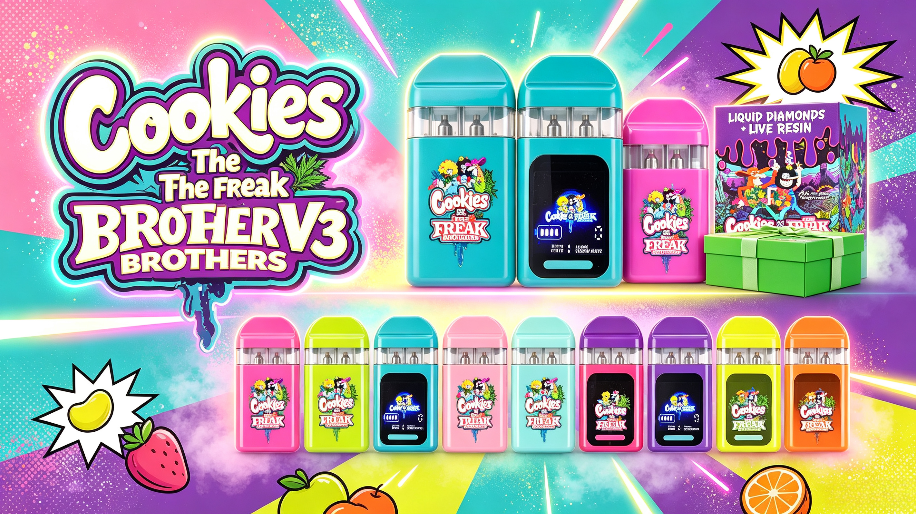
The Cookies × The Freak Brothers V3 currently listed on Leerervape is offered as an empty 2g/2ml dual-chamber device featuring two chambers, LED elements, and a rechargeable design. According to the product description, the hardware contains no oil, no nicotine, and no THC/CBD. Consequently, it is not technically equivalent to a standard, separate 510-thread battery.
At the same time, the 510 thread remains enormously relevant in the US market.
A current industry report on cartridges from February 2026 shows that 510-thread hardware accounts for 91.3% of the US cartridge segment. In Canada, the standard reaches as much as 99.8%.
For a US purchasing manager, the strategic question is therefore not:
“510 or V3?”
Rather:
“Which hardware architecture suits my product range, formulation, target market, and procurement strategy?”
Why the 510 thread remains relevant despite the disposable boom
The US vape market is changing faster than it was just a few years ago.
According to data from BDSA, cannabis vapes generated approximately $8 billion in retail sales in the twelve months ending May 2026, representing around 26% of the total cannabis retail market. Total sales for the category rose by approximately 6% year-over-year.
Within this category, however, the hardware format is shifting.
Sales of disposable—or all-in-one—vapes grew by approximately 41% to $3.8 billion within a year, while cartridge sales fell by 14% to around $4.1 billion. In April 2026, disposables overtook cartridges on a monthly basis for the first time; by May, they accounted for 51.1% of US vape sales.
However, that does not mean the 510 thread is disappearing.
Rather, the headset reveals two parallel developments:
All-in-One-Geräte gewinnen Marktanteile, während sich das verbleibende Cartridge-Segment immer stärker auf 510 Thread standardisiert.
It is precisely this combination that is of interest to purchasing departments.
Two different hardware strategies
factor
510-thread system
Cookies × The Freak Brothers V3-style Dual Chamber
architecture
Separate battery + cartridge
Battery, tanks, and electronics integrated
standardization
Very high
Product-specific
reuse
Battery can support multiple cartridges.
Hardware as an integrated unit
Product range flexibility
Different cartridges with a single battery
Two chambers within one device
OEM complexity
Relatively standardized
Greater height thanks to dual-chamber system
Critical QC points
Connector, voltage, battery, charging electronics
Additionally: chamber separation, two heaters, switching, and firmware.
US market position
91.3% of the cartridge hardware segment
Part of the rapidly growing all-in-one trend
The two concepts solve different commercial problems.
The 510 thread offers compatibility and modularity.
Dual-chamber all-in-one hardware offers product differentiation and a more integrated user experience.
Vorteil Nr. 1: 510 Thread bietet ein etabliertes Ökosystem
From a B2B perspective, the biggest advantage of a 510 battery is not necessarily a single technical feature.
It is the installed base.
With a **91.3% market share in the US cartridge hardware segment**, the 510 thread has become a de facto industry standard. According to Headset, proprietary systems play a significantly smaller role; Stiiizy, the largest proprietary hardware type, accounts for approximately 5%.
This can simplify procurement.
For example, a brand owner can develop multiple cartridge SKUs without introducing a completely new battery platform for each product line.
For distributors, this can mean:
fewer hardware variants in stock;
simpler second-supplier strategy;
wider range of compatible components;
lower risk of complete dependence on a proprietary system;
and easier product portfolio expansion.
However, these advantages apply only if mechanical and electrical compatibility has actually been validated.
"510 thread" does not automatically mean "universally identical performance."
Mechanical compatibility is just the beginning.
Professional buyers should check at least four levels when evaluating a 510 battery.
Mechanical compatibility
Threads, center pin, connector depth, and cartridge diameter must be within defined tolerances.
A cartridge should neither fit unusually loosely nor require excessive tightening to establish electrical contact.
Electrical compatibility
Relevant factors include, among others:
Output voltage;
Voltage tolerance;
supported resistance range;
Current-carrying capacity;
Short-circuit protection;
Low-voltage cutoff;
and behavior under load.
Thermal compatibility
A battery can function differently with two mechanically identical cartridges if their heating resistances or heating technologies vary.
Therefore, the battery cartridge system should be qualified jointly.
Formulation compatibility
The subsequent filling also affects performance.
Viscosity, heating behavior, and hardware design must be compatible.
For an OEM purchaser, a complete system test therefore makes more sense than an isolated battery test.
Headset reports that for Q4 2025, vapor pens accounted for approximately 25.5% of the total US cannabis market, making them the second-largest product category.
The wording within this category is also evolving.
Distillates remained the leader in 2025, accounting for 56.7% of US vape pen sales, though they lost market share to higher-end extract formats. Live resin continued to gain traction, while diamond-based products grew by more than 60% year-over-year in the markets tracked by Headset.
BDSA confirms this premiumization.
Live resin and rosin together accounted for 32% of US vape sales, compared to 28% the previous year. Live resin alone recently accounted for around 28% of monthly sales.
For a hardware purchaser, this means:
A good battery platform should not be developed for just a single SKU.
It can become part of a broader hardware strategy that supports various cartridges and product positionings.
Where Cookies × The Freak Brothers V3 fits into this development
The search phrase **510-thread Cookies The Freak Brother V3 batteries** suggests that buyers might be looking for a classic 510-thread battery version of the V3.
Die derzeit auf Leerervape sichtbare V3-Hardware gehört jedoch zu einer anderen Kategorie.
The product page describes:
2 ml total capacity;
Dual-chamber design;
two separate chambers;
LED-oriented design;
rechargeable hardware;
and empty, unfilled delivery units without oil, nicotine, or THC/CBD.
This clarification is particularly important for B2B customers.
After all, a 510 battery and a dual-chamber all-in-one device should be evaluated using different RFQs, different quality checks, and different supplier scorecards.
Dual Chamber offers another advantage: differentiation.
The greatest commercial advantage of a dual-chamber platform does not lie in standardization.
It offers the possibility of integrating two separate reservoirs within a single product.
For a brand owner, this can create an interesting platform for diverse product profiles, provided this is legally permissible in the respective target market and the content is regulated or tested accordingly.
From a hardware perspective, such a concept can offer greater shelf presence and differentiation than a standard stick battery.
However, the technical complexity is higher.
A purchasing team must now verify, among other things:
This increases the number of potential sources of error.
More functions require stricter quality control.
A dual-chamber device should not be tested solely with the question:
"Does it work?"
Concrete checks are better:
Does chamber A operate independently?
Does Chamber B operate independently?
Do both fluid paths remain separate?
Is the draw resistance between the chambers comparable?
Does the heater resistance meet the specification?
Does the switching remain reliable over multiple cycles?
How does the battery behave at a low state of charge?
Does USB-C charging continue to work reliably after a certain number of charging cycles?
This is the kind of question that distinguishes a professional OEM approval from a simple sample order.
2G hardware is growing particularly fast.
The 2 ml/2 g class of the V3 hardware also aligns with one of the strongest current market trends.
Headset reports that 1g products continued to account for 75.1% of the US vapor pen market in 2025.
However, growth was concentrated on larger formats.
2g products increased by 95.8% compared to the previous year.
BDSA shows an even clearer structural shift for disposables.
2g disposables increased their share from approximately 16% to 35% of total disposable vape sales within two years.
This trend is relevant for product developers.
Increased capacity can enable a higher selling price and a stronger value proposition.
However, it also increases the economic risk of a hardware failure.
The greater the product value embodied in a device, the more important hardware reliability becomes.
Price pressure changes supplier selection.
Headset reports an average US price of around **$21.81 per gram equivalent** for vapor pens in Q4 2025.
This represented a decline of approximately 11% compared to the previous year.
Since January 2024, the corresponding figure fell from US$28.30 to approximately US$21.70 by the end of 2025.
This creates classic cost pressure for purchasing managers.
Retailers want better purchase prices.
Distributors put pressure on brand owners.
Brand owners negotiate with hardware manufacturers.
The dangerous shortcut, then, is:
"Can the manufacturer save another ten cents on the battery, heater, or PCBA?"
Cost optimization makes sense.
It is not an uncontrolled BOM change.
The cheapest battery is not necessarily the most economical one.
Let’s take a hypothetical OEM project involving 100,000 batteries.
Supplier A is $0.15 cheaper per unit.
The theoretical saving amounts to:
15.000 US-Dollar.
Supplier B, on the other hand, supplies:
documented battery components;
stable PCBA specifications;
defined output voltage;
UN 38.3 documentation;
Lot traceability;
a locked BOM;
and a documented CAPA procedure.
If Supplier A produces a higher failure rate, the projected $15,000 can quickly vanish due to returns, replacement shipments, retailer credits, additional freight costs, and damaged customer relationships.
The professional comparison is therefore not:
Unit Price A vs. Unit Price B
rather:
Total Cost of Quality A vs. Total Cost of Quality B
UN 38.3 belongs in every battery RFQ.
For US buyers, battery documentation is not a minor matter.
The U.S. Department of Transportation's Pipeline and Hazardous Materials Safety Administration states that lithium cells and batteries being transported must have passed the relevant design tests of the UN Manual of Tests and Criteria, Section 38.3.
The examinations take into account, among other things:
Altitude conditions;
thermal load;
vibration;
Shock;
external short circuit;
Impact/Crush;
Overloading;
and forced discharge.
PHMSA also clarifies that the test summary requirement applies to batteries installed in products as well. Manufacturers and downstream distributors must be able to make the relevant information available within the supply chain.
For a purchase, this means:
Don't just ask:
“Do you have UN38.3?”
Ask:
“Does this test summary correspond to the exact battery model installed in the approved mass-production unit?”
That is a significantly better quality filter.
The BOM should also be fixed for 510 batteries.
A professional 510 battery OEM should specify at least the following components:
Lithium cell;
Cell manufacturer;
Rated capacity;
PCBA;
Charging IC;
510 Connector;
Center pin;
Button or draw sensor;
Output voltage logic;
firmware;
USB-C-Port;
and housing material.
After release, it should become a Locked BOM.
Changes should only be made via a documented engineering change process.
Otherwise, the mass-produced product may look identical on the outside yet contain a different battery or electronics than the approved sample.
UL 8139 is a useful benchmark for professional hardware programs.
In addition to transport requirements, ANSI/CAN/UL 8139 is an important technical reference point for the electrical systems of e-cigarettes and vaping devices.
The standard addresses, among other things, electrical systems, batteries, charging functions, and protection mechanisms. In the current standards landscape, ANSI/CAN/UL 8139 continues to be listed as the safety standard for this product category.
A clear distinction must be made here:
UL 8139 evaluates electrical and battery-related safety aspects.
It is not a statement regarding the safety, legality, or regulatory admissibility of a substance filled in at a later time.
For hardware buyers, it is nevertheless a useful benchmark, as it helps shift supplier discussions from marketing terms to technical security criteria.
Transport regulations show why battery design remains relevant.
The FAA also explicitly treats vaping devices as battery-operated devices subject to specific transport requirements.
Electronic vaping devices must not be transported in checked baggage on passenger flights. They must be carried on one's person or in carry-on baggage and secured against accidental activation.
This is not a guide for consumers; it is for B2B procurement.
Rather, it demonstrates that accidental activation, battery protection, and transport safety are real technical issues.
A poorly designed switch or inadequate protection logic is therefore not merely a UX problem.
It can also create logistical and security risks.
What should a US purchasing manager check regarding a supplier?
Different technical tests are recommended for a 510 battery project or V3-style dual-chamber hardware, yet the same procurement discipline applies.
1. Production-Representative Sample
The approved sample must correspond to the components that will actually be mass-produced later.
A special "sales sample" with superior components is worthless if the production BOM differs.
2. Locked BOM
Battery, heater, PCBA, connector, charging electronics, and critical materials should be documented in writing.
3. Electrical Specification
For 510 hardware:
Tension;
Voltage tolerance;
Resistance range;
cutoff;
Preheat, if available;
Low-voltage protection;
and short-circuit protection.
For dual-chamber hardware, additionally:
Channel control;
Heater A/B;
Switching logic;
and display/LED behavior.
4. UN 38.3 Test Summary
The documentation must match the production battery actually installed.
5. AQL and Defect Classification
Define the following before production begins:
Critical Defect
Major Defect
Minor Defect
and specify which AQL limits apply.
6. Lot Traceability
It should be possible to trace a serial-production unit back to its production date and critical component lots.
7. Change Control
No changes to cells, PCBs, heaters, or materials without documented buyer approval.
Brand name and hardware authorization should be checked separately.
Cookies and The Freak Brothers have a documented history of official collaboration; for instance, Cookies released an official joint Freak Brothers collaboration.
However, this does not automatically mean that every piece of V3 hardware offered online or every product bearing both brand names is part of the same authorized supply chain.
The official Cookies shops currently stock both Cookies Dual Chamber 2g and Freak Brothers products, though this does not automatically validate every third-party V3 wholesale variant.
For a professional buyer, the following should therefore apply:
Known collaboration ≠ automatic authorization of every single SKU.
For a branded product, the supplier should be able to document the relevant rights or the legitimate commercial supply chain.
For a genuine private-label OEM project, a different strategy is cleaner in the long run:
Own brand + own packaging + sufficiently differentiated hardware design.
510 Thread or Dual Chamber: Which strategy is better in 2026?
There is no universal answer.
The 510 thread is particularly interesting if:
cartridge compatibility is important;
a large installed battery base already exists;
multiple cartridge SKUs are to be supported with a single battery;
second sourcing is strategically relevant;
or a modular hardware approach is preferred.
Dual-chamber all-in-one is particularly interesting if:
hardware differentiation is more important;
two separate chambers are part of the product concept;
shelf presence is highly valued;
an integrated device is required;
and the buyer is prepared to professionally qualify the additional hardware complexity.
Both platforms can be useful if:
a company serves different market segments, formulations, or distribution channels.
The current data actually support precisely this differentiated strategy.
All-in-One is growing rapidly.
The 510 thread remains the dominant cartridge standard.
Both are true at the same time.
Conclusion: Standardization and innovation develop in parallel.
The key insight behind the keyword **510-thread Cookies The Freak Brother V3 batteries** is that the market in 2026 is not moving in just one direction.
On one side, there is a 510 thread.
With a **91.3% share of the US cartridge hardware market**, it remains by far the most important standardized connection.
On the other hand, there are integrated devices—such as the Cookies × The Freak Brothers V3 Dual-Chamber Hardware offered by Leerervape—where product differentiation is achieved through dual chambers, integrated electronics, and a more prominent hardware design.
At the same time, the overall US vape market continues to grow: BDSA currently values the cannabis vape market at around **$8 billion**, while disposables are accounting for more than half of monthly vape sales for the first time.
For purchasing managers, this results in a clear priority:
It is not necessarily the hardware format that is currently the most eye-catching that wins—but rather the one that best combines market demand, technical reliability, cost control, and supply chain transparency.
Are you evaluating 510-thread or dual-chamber hardware for an OEM project?
If your company is evaluating empty vape hardware for a legally permissible market, the next supplier inquiry should go well beyond unit price and MOQ.
Request a production-representative sample, a technical data sheet, a locked BOM, battery specifications, the corresponding UN 38.3 test summary, QC criteria, AQL specifications, lot traceability, and a documented change control process.
For 510-thread projects, connector tolerances, output voltage, and cartridge compatibility should also be defined.
For dual-chamber projects, both chambers, heater consistency, switching logic, charging behavior, and long-term reliability should be validated separately.
According to its own product description, Leerervape offers empty hardware—free of oil, nicotine, or THC/CBD—as well as OEM/ODM support. Consequently, companies evaluating a 510-thread or dual-chamber platform can request technical specifications and a production-grade sample before making a major procurement decision.
A professional OEM partner should be able to speak just as transparently about engineering, battery compliance, quality control, production consistency, and change management as they do about price and delivery times.
That is precisely where a robust, long-term supplier relationship begins.
Meta Title: BackpackBoyz Runty Vape Taste: Ursachen und Hardwarequalität Meta Description: Warum schmeckt eine BackpackBoyz Runty Vape anders? Erfahre mehr
Einleitung Die Wahl der passenden Vape Battery ist ein wichtiger Schritt bei der Bewertung von Cartridge-Hardware. Anschlusskompatibilität, technische Spezifikationen, Ladefunktion
 empty 1g vape
 empty 2g vape
 empty 3g vape
 empty dual chamber vape
 empty led vape
 USA STOCK VAPE
 EU German stock vape