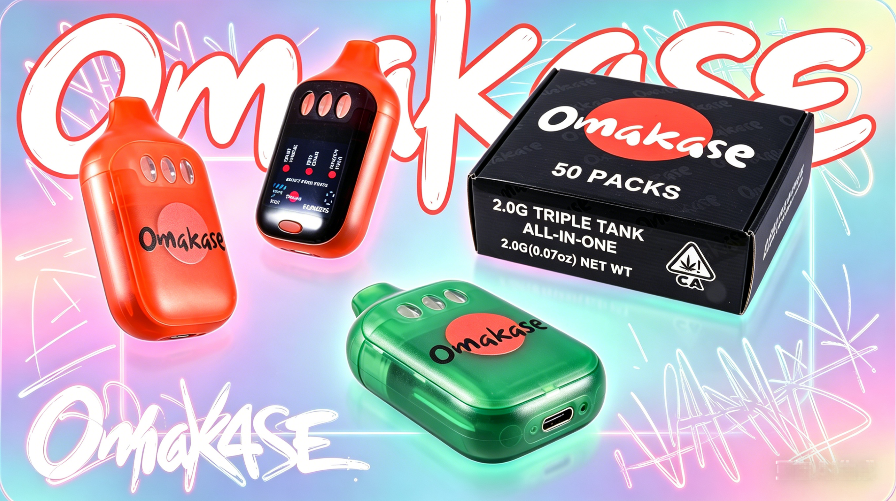
Omakase Pens for Cartridges: What Really Matters in 2026 Regarding Compatibility, Battery Safety, and Purchase Verification
Those searching for "omakase pens for cartridges" are, in practice, usually looking for more than just a product name; they are seeking answers to three specific questions: Does the pen reliably fit standard cartridges? How robust are its battery and charging systems? And how can one identify a device that carries less regulatory and technical risk in the year 2026? These very questions are more critical today than ever before, as the market for vape hardware is no longer evaluated solely on the basis of convenience and design. The U.S. Food and Drug Administration (FDA) currently lists only 41 e-cigarettes as legally authorized for sale—a fact that underscores the extent to which the market is now shaped by formal review processes and regulatory classification.
1. Why Cartridge Pens Are Evaluated Differently Today Than Just a Few Years Ago
Just a few years ago, cartridge pens were marketed primarily on the basis of their everyday practicality: small, lightweight, and ready for use at a moment's notice. Since then, however, this category has come under much closer scrutiny. While the CDC reports a decline in current e-cigarette use among U.S. adolescents in 2024—dropping to 5.9%—certain device categories continue to dominate within this user group: 55.6% used disposables, 15.6% used pre-filled or refillable pods or cartridges, and 87.6% used flavored products. This explains why cartridge pens today are no longer viewed merely as accessories, but rather as part of a product class subject to heightened scrutiny.
2. The actual benefit of a pen format lies in the separation of hardware and cartridge.
The practical advantage of a cartridge pen lies not merely in its form, but in the separation between **hardware** and **content**. From a user's perspective, this separation can be beneficial because the battery, charging behavior, and connectivity logic can be evaluated independently of the actual consumable product. At the same time, regulatory trends in key markets indicate that reusable hardware appears strategically more robust than traditional disposable models. In the United Kingdom, the sale of **single-use vapes** has been prohibited since **June 1, 2025**; only reusable systems may continue to be sold. For readers, this serves as an important signal: a cartridge-based pen system aligns more closely with the market trajectory toward which both regulation and commerce are currently moving.
3. Battery and charging electronics will be a genuine quality factor in 2026.
With cartridge pens, the battery is often underestimated—even though, in everyday use, it is the deciding factor for reliability, charging frequency, and a sense of safety. The U.S. Consumer Product Safety Commission points out that batteries and chargers can pose risks such as **overheating, fire, and electric shock**, and that incidents have been reported **during use, storage, and charging**. In a further safety advisory, the agency recommends using only the included or approved charger, following the manufacturer's instructions, and disconnecting the device once charging is complete. This is particularly relevant for cartridge pens, as small lithium-ion systems—when subjected to poor charging quality—not only degrade more rapidly but can, in worst-case scenarios, also become a critical safety hazard.
4. Why Generic or Questionable Chargers Are a Warning Sign
When purchasing a pen, consumers often focus first on branding or form factor. However, from a safety and quality perspective, the charging ecosystem is at least equally important. UL explicitly states that a generic or incompatible charger can trigger thermal runaway, even in a correctly manufactured lithium-ion battery. Furthermore, UL points out that genuine or certified batteries may possess internal protection mechanisms against overcharging and overheating, whereas counterfeit or substandard components often lack precisely this level of protection. For buyers, this has a very practical implication: a pen only truly conveys a sense of high quality if its cable, charging port, and power supply are demonstrably compatible with the device.
5. The EU Shifts Hardware Assessment Towards Longevity
European regulation is also changing the perspective on such devices. The new EU Battery Regulation has been in force since August 17, 2023. According to the European Commission and the Council, starting in 2027, consumers should, as a general rule, be able to remove and replace portable batteries in electronic products. While this is not a specific regulation solely for vapes, it very clearly indicates the regulatory direction: more durable, traceable, and more easily maintainable hardware is gaining in importance. From this perspective, cartridge pens featuring reusable hardware appear—in terms of market logic—to be more stable than fully sealed, disposable concepts.
6. What Readers Should Really Check Regarding "Omakase Pens for Cartridges"
Anyone interested in **omakase pens for cartridges** should therefore pay less attention to grand advertising claims and more to four sober points: First, whether the device integrates seamlessly—from a technical standpoint—with its intended cartridges. Second, whether the battery and charger appear sound and safe. Third, whether the product format aligns with the target market, where disposable and reusable systems are subject to vastly different legal regulations. And fourth, whether the source is sufficiently credible to be able to answer questions regarding safety, authenticity, and compliance in the first place. In 2026, this logic of scrutiny is more important than hype, as market oversight, battery regulations, and youth protection measures are visibly shaping this product category far more profoundly than they did just a few years ago.
7. Why This Thematic Approach Interests Readers More Than Purely Promotional Language
This is precisely where the subject becomes compelling for readers: the truly interesting question today is no longer merely whether a pen “looks good” or “draws smoothly.” What matters is whether it can survive in a market characterized by stricter regulation, heightened sensitivity regarding youth appeal, and higher expectations for battery safety. The convergence of FDA approval realities, youth usage data, the UK ban on disposables, and EU battery regulations demonstrates that, in 2026, hardware will be judged more on its reliability, maintainability, and traceability than on mere trend appeal.
Conclusion
In 2026, an article about omakase pens for cartridges carries the most weight if it begins not with hype, but with context. Today, a good cartridge pen does not impress simply because it appears compact or modern. What truly matters are compatibility, reliable charging, transparent hardware, and the question of whether the device aligns with a market logic that is clearly shifting away from disposable models. This is precisely what makes the subject so compelling for readers: behind a seemingly simple product name now lies a much larger story—one involving technology, regulation, and consumer decision-making.
Attention : omakase disposable 2g | omakase disposable bulk | disposable vape with screen | vape for sale
 empty 1g vape
 empty 2g vape
 empty 3g vape
 empty dual chamber vape
 empty led vape
 USA STOCK VAPE
 EU German stock vape