Exploring the Benefits of 510 Pens for Vaping Enthusiasts: What US Buyers Should Know About Modern Vape Hardware
For US vape and cannabis brands, the 510 pen is now far more than just a simple battery-and-cartridge combination. The platform influences product development, supplier flexibility, return rates, inventory planning, and ultimately the profitability of an entire product line.
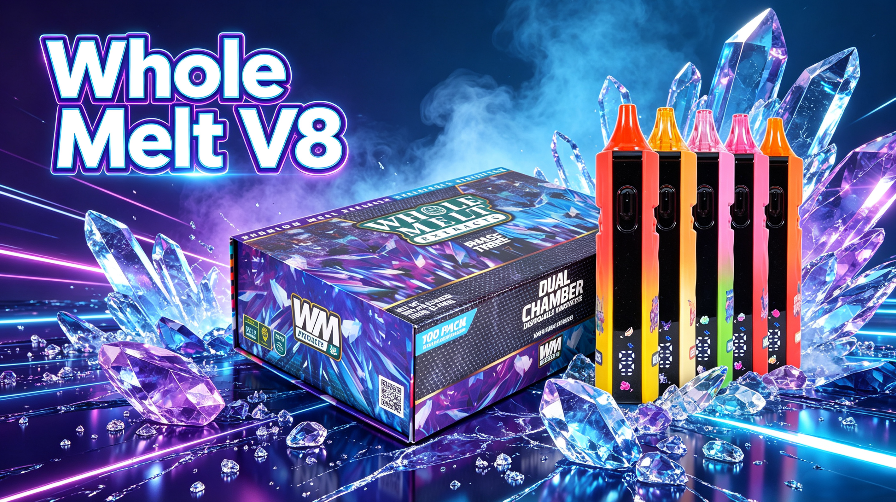
The growing interest in **Whole Melt V8 510 pens** reflects a broader industry trend: buyers are seeking modular hardware that can be more easily adapted to various cartridge concepts, brand positionings, and OEM requirements.
According to current data from Grand View Research, the global cannabis vaporizer market was valued at approximately US$5.9 billion in 2024. It is projected to reach around US$7.6 billion by 2026 and approximately US$13.1 billion by 2030. North America accounted for a 38.3 percent share of revenue in 2024.
The broader US e-cigarette and vape market also remains dynamic. Revenue for 2024 was estimated at around US$14.1 billion; by 2030, the figure is projected to reach just under US$69.5 billion.
For procurement teams, the message is clear: as the market grows, so do the requirements regarding hardware quality, documentation, and supplier oversight.
Why the 510 platform remains relevant for OEM sourcing
The biggest B2B advantage of the 510 format lies in its standardization.
Instead of permanently tying the brand and customer to a proprietary system, 510-based projects can offer greater flexibility regarding batteries and compatible cartridges.
Typical advantages include:
- wider range of hardware options
- shorter product development times
- simpler pattern matching
- less dependence on a proprietary platform
- flexible OEM and private-label options
- more efficient inventory planning
However, a purchasing manager should never equate "510 compatible" with "universally compatible."
Mechanical threads may fit, even though resistance, voltage, center pin, airflow, or cartridge geometry are not optimally matched.
Professional procurement therefore begins with a technical compatibility matrix.
1. Modularity reduces development risks.
For brands developing projects based on **whole melt v8 510 pens** or comparable hardware platforms, modularity is a decisive advantage.
In principle, the battery platform can be evaluated independently of various cartridge versions. This facilitates, for example:
- different capacities,
- different heating systems,
- alternative mouthpieces,
- different viscosity ranges,
- various packaging formats.
For procurement, this means that a weak cartridge supplier does not automatically necessitate a complete restart of the battery project.
This flexibility can reduce development risks and improve the negotiating position vis-à-vis suppliers.
2. Battery quality affects the entire product platform.
With a 510 pen, the battery is not merely a power source; it determines the power range within which a cartridge operates.
Procurement managers should request at least the following data:
- nominal battery capacity
- actual usable capacity
- Output voltage
- existing voltage levels
- Preheat function
- automatic switch-off time
- Short-circuit protection
- Overcharge protection
- Deep discharge protection
- USB-C charging specification
- Temperature behavior
For vape devices, the FDA explicitly recommends using only suitable batteries and charging equipment and adhering to the manufacturer's instructions.
For OEM buyers, this means: "USB-C" or "rechargeable" alone are not sufficient technical specifications.
The supplier should be able to document which charging current is supported, how the charge termination works, and which protection circuits have actually been implemented.
3. Resistance and voltage must be defined together.
A 510 cartridge might fit mechanically yet still be poorly matched electrically.
If, for example, a battery delivers a higher output than intended for the heating core, thermal behavior may change. If the power output is too low, performance can also become inconsistent.
Therefore, projects involving **whole melt v8 510 pens** should include a clearly defined operating range.
The technical dataset should at least record:
- nominal cartridge resistance
- permissible resistance tolerance
- recommended voltage
- maximum voltage
- recommended preheating parameters
- maximum activation duration
An OEM that merely claims its battery works with "all 510 cartridges" should be able to substantiate this claim with test data.
4. Material quality becomes a strategic purchasing topic
The professional vape hardware market is increasingly moving towards measurable material and safety standards.
ASTM International is currently developing several standards for electronic cannabinoid delivery systems through its Cannabis Committee D37. These include projects concerning device safety, ceramic heating materials, restricted substances, and methods for aerosol collection for elemental analysis.
This is a relevant market signal for purchasing managers.
The next generation of professional procurement will no longer base hardware solely on:
- Look,
- Capacity,
- Price,
- Delivery time
evaluate.
Also gaining in importance are:
- Material declarations
- Metal alloys
- Ceramic specifications
- Sealing materials
- Coatings
- chemical resistance
- Batch Traceability
A technically competent OEM should be able to provide this information.
5. Ceramic heating systems require genuine technical data.
Many modern 510 cartridges use ceramic heating structures.
From a marketing perspective, "Ceramic Core" sounds simple. From a purchasing perspective, however, the term is too imprecise.
Relevant examples include:
- Ceramic composition
- porosity
- Pore size
- thermal properties
- mechanical stability
- Resistance structure
- metals used
ASTM is currently explicitly working on requirements for ceramic materials in electronic cannabinoid delivery systems.
For procurement teams, therefore, the question should not be:
"Does it use ceramic?"
Rather:
“Which ceramic specification is used, and how is its consistency controlled from lot to lot?”
6. Leakage must be viewed as a financial metric.
A low leakage rate is not merely a mark of quality; it directly impacts the margin.
For an order of 100,000 units:
- 0.5% defect rate = 500 problematic units
- 1.0% = 1,000 units
- 2.0% = 2,000 units
The actual costs are higher than the mere value of the hardware.
In addition, there are:
- verlorenes Produkt
- Replacement deliveries
- Customer Service
- Merchant credits
- additional inspections
- Express shipping
- negative reviews
Therefore, a 510 system with a slightly higher unit price can be more economically attractive if it achieves significantly lower complaint and leakage rates.
7. Golden samples are indispensable for OEM projects.
A common procurement error is approving a good sample without fully documenting its technical configuration.
At a later stage, a sub-supplier can be replaced or a component modified.
For example:
- another battery cell,
- a new charging chip,
- an alternative seal,
- a different ceramic core
- a different ceramic core
The device may look identical, but it can react differently in technical terms.
Therefore, a project for whole melt v8 510 pens should include a binding "Golden Sample."
The following should be archived along with it:
- technical drawing
- complete BOM
- Battery specification
- PCB version
- Firmware version
- Cartridge specifications
- Material declarations
- Packaging version
Critical changes should only be made with written approval.
8. Define AQL and quality control prior to the start of production.
For large OEM orders, quality requirements should not be discussed only after a problem has arisen.
Before production begins, the buyer and supplier should agree on:
Critical Defects
Issues that can cause security or significant compliance risks.
Major Defects
Errors that significantly impair normal functioning.
Minor Defects
Cosmetic or minor deviations with no significant impact on functionality.
In addition, critical technical parameters should be assigned their own limit values.
A professional review process can include:
- Incoming Quality Control
- In-process inspection
- Final functional test
- Outgoing Quality Control
- Sampling according to agreed AQL
In this way, quality becomes a measurable part of the contract.
9. Which tests should US buyers request?
A robust OEM validation plan for 510 pens should cover several areas.
Battery cycle test
Evaluates charging and discharging behavior over defined cycles.
Output voltage test
Checks whether the actual output voltage is within the specification.
Short-Circuit Protection Test
Validates the actual response of the protection circuit.
Overtemperature test
Checks battery, PCB, and housing temperatures under load.
Connection test
Checks the stability of the 510 thread and center contact.
Drop and Vibration Test
Simulates stresses during transport and distribution.
Aging test
Tests hardware after defined or accelerated storage.
Cartridge Compatibility Test
Validates selected cartridge resistors and designs with the final battery.
A single working sample is no substitute for this data.
10. Regulatory pressure increases the importance of reputable supply chains.
Supplier due diligence is becoming increasingly important for US buyers.
The FDA continues to step up enforcement against unauthorized e-cigarette products. For example, in January 2025, the FDA, Homeland Security Investigations, and U.S. Customs and Border Protection reported the seizure of more than 628,000 unauthorized e-cigarette products with an estimated value of over $7 million.
In 2026, the FDA simultaneously authorized additional ENDS products via the PMTA process.
These measures primarily concern tobacco and nicotine products and cannot be directly applied to state-regulated cannabis products. However, they clearly indicate the direction of the US hardware market: documentation, provenance, and regulatory status are becoming increasingly important.
Purchasing managers should therefore not assume that a product can be imported or marketed without difficulty simply because a supplier is already selling it to other customers.
11. Total Cost of Ownership instead of FOB price
Professional US procurement teams should compare whole melt v8 510 pens and other hardware based on total costs.
Total Cost of Ownership includes:
- Unit price
- Tooling costs
- Sampling
- technical adjustments
- Laboratory tests
- Pre-shipment inspection
- Defect rate
- Returns
- Replacement units
- Express freight
- Bearing failures
- Bearing failures
- potential compliance issues
A supplier who is five percent cheaper but has a significantly higher error rate can turn out to be the more expensive partner in the long run.
More meaningful KPIs are:
- Defect rate
- On-time delivery
- Complaint rate
- Battery failure rate
- Batch Consistency
- Corrective Action Response Time
12. Where is the 510-pen market heading?
The 510 platform is increasingly being differentiated through engineering rather than purely through aesthetics.
Particularly relevant trends are:
- more compact batteries
- USB-C charging
- more precise voltage control
- better battery indicators
- formulation-specific cartridges
- optimized ceramic systems
- Material traceability
- stricter QC documentation
- more sustainable packaging
- greater OEM customization
ASTM is also working on a harmonized classification of electronic cannabinoid delivery systems. This standardization effort underscores the increasing professionalization of the market.
For American brands, this means that a reliable hardware partner must in future offer more than just a catalog and a low price.
Shopping Checklist for Whole Melt V8 510 Pens
Before an OEM project is approved, purchasing managers should confirm at least the following points:
- Battery manufacturer and cell specification
- actual battery capacity
- Output voltage
- Cartridge resistance range
- 510 connection tolerances
- Protection circuits
- Charging parameters
- Material declarations
- Battery cycle test
- Drop and vibration test
- Aging test
- Golden sample
- AQL criteria
- Batch Traceability
- documented change management
- Packaging Release
- IP and Trademark Release
- Complaint and replacement process
Conclusion: 510 pens are platform products.
The biggest B2B advantage of whole melt v8 510 pens and comparable 510 systems lies not solely in the familiar threading.
Their strategic value lies in their modularity.
A professionally developed 510 platform enables brands to more precisely tailor the battery, cartridge, heating system, and packaging to different product lines while simultaneously reducing their reliance on proprietary systems.
For US purchasing managers, therefore, design and unit price should not be the only decisive factors. Battery quality, compatibility, documented safety features, batch-to-batch consistency, AQL, traceability, and controlled change management determine long-term economic success.
Leerervape supports brands, distributors, and procurement teams with custom 510 hardware projects—ranging from technical specifications and prototype development to battery and cartridge compatibility, packaging, and controlled mass production.
If you are planning a new 510-pen project, please contact our team with your requirements regarding battery capacity, voltage, cartridge specifications, order quantity, branding, and the US target market. Together, we can evaluate which OEM platform best aligns with your product strategy from both a technical and economic perspective.
Attention : whole melt v8 vape 2g | whole melt disposable | empty 2 gram disposable | cheap vape
 empty 1g vape
 empty 2g vape
 empty 3g vape
 empty dual chamber vape
 empty led vape
 USA STOCK VAPE
 EU German stock vape