Exploring the Benefits of Using Tyson Punch Bulk Carts for Efficient Material Handling
Note: This article discusses material handling (receiving, warehousing, order picking, packing, shipping) and hardware/packaging workflows. It contains no content or instructions on fillers or substances.
When teams in production or fulfillment grow, the biggest losses rarely occur in unit price – but rather in time, errors, transport damage, and inconsistent processes. This is precisely where working with standardized "bulk" units – as many in the market refer to Tyson Punch bulk carts (as an SKU family/model name in B2B purchasing) – can make a measurable difference: less chaos in material flow, faster handling, and more consistent quality.
In the following, I will show why and how the use of tyson punch bulk carts pays off in everyday operations – focusing on current, reliable best practices in occupational safety, ergonomics and compliance (without link overkill).
1) Standardization reduces friction in the bearing – immediately noticeable
The biggest lever is simple: uniform form factors + repeatable packaging units.
With standardized tyson punch bulk carts (same packing dimensions, same protective caps/trays, same label logic) you reduce:
- Umpackzeiten im Wareneingang
- Mismatched picking (fewer “similar-looking” variants)
- Training effort (one SOP, fewer exceptions)
- Special cases in shipping (one carton type, one cushioning standard)
Das Ergebnis ist ein ruhigerer Materialfluss: weniger Stop-and-Go, weniger “ad hoc”-Entscheidungen am Packtisch.
2) Faster goods receipt processes (dock-to-stock) through clear QC SOPs
For bulk SKU families, a clean goods receipt routine is particularly worthwhile because you can run it identically every time:
Recommended QC components for bulk carts/hardware:
- AQL sample + defined critical defects (e.g., threads/fit, seals, breaks, visible contamination)
- Count/Weight Check per master carton
- Lot/Batch Assignment (Barcode/QR + Photo of Label)
- “First-Article Check” per delivery (1–2 units thoroughly inspected)
The more standardized your Tyson Punch bulk carts are, the sooner QC becomes routine rather than a discussion – and “Dock-to-Stock” becomes predictable.
3) Ergonomics & Occupational Safety: Carts beat carrying – if implemented correctly
“Efficient material handling” is not just about speed, but also reduced physical strain. There are clear guidelines for this:
- In an ergonomic context, OSHA recommends using conveyor technology or carts for horizontal movement whenever possible.
- NIOSH emphasizes that forceful pushing/pulling is a relevant risk factor and that design/route/handling aids are crucial.
- For pushing/pulling operations, there are current assessment tools, e.g. the HSE-RAPP tool (updated 2025), to systematically assess risks.
What does this mean in practice for bulk handling with Tyson Punch bulk carts?
If you are moving bulk units (e.g., trays, master cartons, kitting tubs), a setup that makes pushing/pulling easier is worthwhile:
- Plan routes (no tight curves, as few ramps as possible)
- Weight limits per vehicle (better more trips than overloading)
- Roller quality (low rolling resistance = less effort)
- Clear line of sight (do not stack higher than is reasonable; OSHA warns, among other things, of obstructed vision when pushing).
This makes bulk handling not only faster, but also more robust (fewer breakdowns, less “peak stress” in the team).
4) Reduced transport damage due to repeatable protective packaging
Bulk carts/hardware are often “small but fragile”: threads, contacts, mouthpieces/openings, housing edges. The trick is a unified protection architecture:
Proven in bulk handling:
- Formtrays (each unit is fixed, no friction)
- Caps/plugs (protection against dust/particles)
- Inner carton standard + Master carton standard
- Drop-test mindset: better “too stable” than “just barely”
With tyson punch bulk carts as a standardized line, you can define this protection architecture cleanly once and then scale it – instead of starting from scratch with each model.
5) Kitting & Order Picking: More output, fewer errors
When you're doing kitting (e.g., device + accessories + label set + insert), two things are crucial: cycle time and error rate.
Bulk standardization helps you with both:
- Pick slots are cleaner (fewer variations per slot)
- Scanner logic is simpler (SKU rules are consistent)
- The packing table layout remains stable (no daily reconfiguration).
Especially in “high-mix/high-volume” workflows, this is the difference between “running sort of” and “running like a dream”.
6) Inventory management & traceability: Batches become manageable
Bulk B2B without traceability quickly becomes risky (complaints, quality tracking, recalls).
With tyson punch bulk carts as a defined SKU family, you can “bake in” traceability:
- Lot codes per master carton
- Scan upon goods receipt → automated storage location
- Scan during packing → Order/Lot assignment
- Uniform naming convention (no “free” aliases within the team)
This dramatically reduces search times when something suspicious is detected.
7) Compliance & suitability for shipping: Particularly relevant when batteries are involved
Depending on what you mean by “carts”, there are two cases:
Case A: Pure carts/cartridges (without battery)
Then the focus shifts more towards packaging, labeling, product safety and, if applicable, local e-waste/EEE obligations (depending on the market).
Case B: All-in-One/Disposable with lithium battery
Shipping and transport compliance then becomes crucial. For lithium batteries, UN 38.3 is the fundamental transport test standard (UN Manual of Tests and Criteria). In addition, there are requirements for test summaries (e.g., in the USA via PHMSA).
And in the EU context, you should keep an eye on developments from the EU Battery Regulation (2023/1542) (including requirements that will be phased in gradually over the years).
Important: This is not about replacing legal advice – but about the fact that “efficient material handling” in B2B is only truly efficient if goods can also be transported smoothly.
Note regarding my source IDs: The relevant primary sources are already available via web search (UN Manual / PHMSA / EU Regulation). If you wish, I can cleanly cite the 3-4 key passages with exact references in my next reply, without increasing the number of links.
8) KPI thinking: How to make the benefits measurable
When you implement Tyson Punch bulk carts for efficient material handling, set up 4 key performance indicators (KPIs):
- Dock-to-Stock Time (Delivery → Ready for Storage)
- Pick Rate (Lines/Hour or Units/Hour)
- Damage/DOA Rate (per 1,000 units)
- Rework time (repacking, recounting, handling complaints)
Even small improvements (e.g., 10–20% less rework) pay off immediately with bulk quantities.
9) A pragmatic rollout in 3 steps
Step 1 (Weeks 1-2):
- 1. Define packaging standard (tray/cap/carton)
- 1. Write QC-SOP (sample, defects, photo rules)
- 1. Fix the SKU naming scheme
Step 2 (Weeks 3–6):
- Scanner required at goods receiving and packing station
- Storage areas for bulk fast-moving goods
- RAPP/Push-Pull-Check for vehicles/routes (if you transport a lot internally)
Step 3 (from week 7):
- KPI review every 2 weeks
- Packaging fine-tuning (drop damage / friction / compression)
- Supplier feedback (recurring defects → countermeasures)
Conclusion
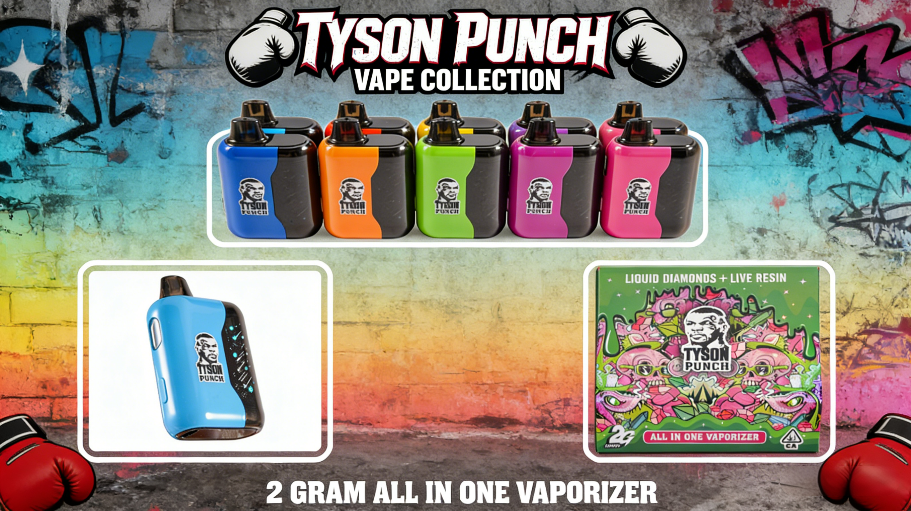
Tyson punch bulk carts offer you three key benefits: standardization, process reliability, and scalable quality. Once packaging dimensions, protection, QC SOPs, and traceability are clearly defined, material handling becomes not only faster but also predictable. And this predictability is the real profit driver in the bulk business.
If you briefly tell me whether you are working with pure carts (without battery) or All-in-One/Disposable (with battery), I will adjust the blog immediately – including an ultra-short “compliance box” (DE/EU shipping) and without many additional sources.
Attention : tyson punch 2g vapes | wholesale tyson vape | custom 2ml thc vape | custom vape






 English