The 5 best affordable shopping carts for every budget: Quality meets price.
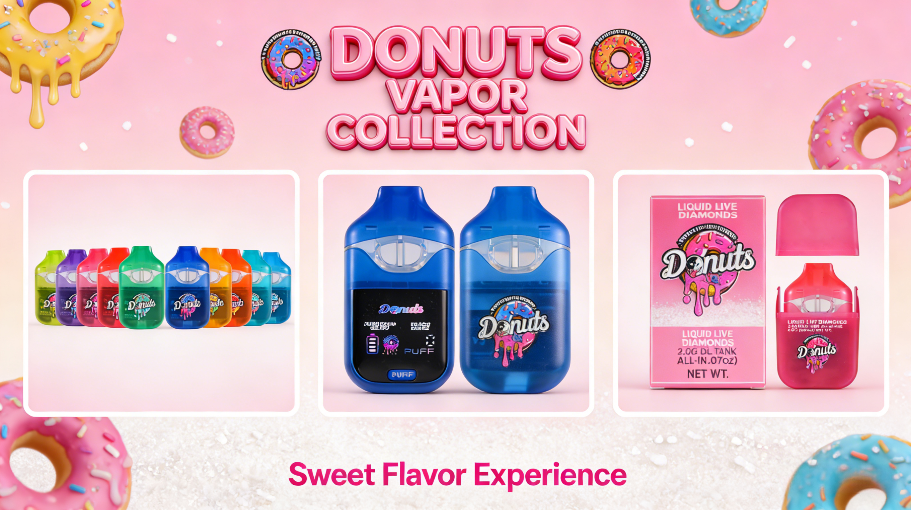
Keyword: cheap donuts v3 carts
When buyers talk about "cheap carts," they usually mean the hardware (empty cartridges or "carts") – that is, without the e-liquid. This MOFO guide focuses precisely on this: comparing options, minimizing quality risks, and selecting the right specifications for your budget and target market.
What "Quality Meets Price" truly means in the MOFO phase.
A low unit price is only an advantage if failure rates, leaks, returns, and support costs don't negate all the savings. In practice, the most important quality levers are:
- Heating element & wick/porosity (Flavor, dry hits, consistency)
- Materials (Glass/Metal/Seal material, odor, corrosion)
- Airflow & Intake Design (for thinner vs. viscous liquids)
- Sealing (O-rings, crimp/press-fit, tolerances)
- Filling process compatibility (top-fill, needle-fill, automation)
- Batch-to-batch consistency (AQL, test protocols, traceability)
Top 5 "affordable carts" based on budget – with a clear application logic.
1) Entry-level price: cheap donuts v3 carts as the "Budget Line" (for price anchoring & promotional SKUs)
Suitable for: Retailers who need a price-aggressive entry-level product line (to drive traffic, encourage first-time purchases, and offer bundle deals).
What to watch out for (to prevent cheap from becoming expensive):
- Request the technical drawing + materials list (tank, mouthpiece, seals).
- Insist on a leak test protocol (e.g., temperature cycling + storage) and AQL.
- Define acceptance criteria (e.g., maximum leak rate, tensile strength tolerance, visual defects).
Trade-off: Budget lines often fluctuate significantly – therefore, scale only with a robust QC setup.
MOFO Tip: Use cheap donuts v3 carts as a price anchor, but manage your margin through mixed pricing (better carts as an upsell).
2) "Best Value": 510 standard cartridge with ceramic core (0.5 ml / 1.0 ml)
Suitable for: The typical sweet spot for the mass market + stable return rate.
Why it offers great value for money: The ceramic core is often more fault-tolerant than very cheap coils and delivers a more consistent flavor.
Checklist for the supplier:
- Core and inlet specifications (e.g., porosity/intake area)
- Seal type (O-ring material) and tolerances
- Packaging standard (single blister pack vs. tray) – relevant for transport damage.
3) Taste & Brand perception: Full-ceramic / "Premium feel" (usually 0.5 ml)
Suitable for: Brands that prioritize taste, feel, and appearance and are less sensitive to price pressure.
Strengths: Perceptibly "cleaner" branding; often better consistency in performance.
Risk: Incorrect specifications or the wrong e-liquid can lead to a decrease in performance; testing with your target e-liquid is essential.
4) Viscous Liquids: "High-Viscosity" cartridge with larger intake / optimized airflow
Suitable for: If you are working with thicker liquids or more demanding viscosities and still need to stay within budget.
Important: The intake design and seal are crucial for preventing leaks and ensuring proper flow.
Test setup (MOFO):
- 24–48 hours of storage at warm/cold temperatures, followed by a tensile test.
- Drop test in the outer carton/tray
- Series draw test (e.g., 30–50 draws) for flow stability.
5) Scalable/Automation-friendly: Cartridge design with a robust filling process (needle/top-fill)
Suitable for: Teams looking to transition from manual filling to semi-automatic/fully automatic filling.
Advantage: Reduced "hidden costs" in production (speed, rejects, rework).
Selection criterion: Your filling equipment (needle size, pressure, cycle time) must be compatible with the cartridge – otherwise, leaks and returns will increase.
Compliance: What is often overlooked in the EU/Germany (crucial in MOFO)
If cartridges containing nicotine-based liquid are placed on the market in the EU, TPD/notification and labeling requirements apply (including via EU-CEG, with a lead time).
If you sell devices with electronics (e.g., disposables with a battery/PCB) instead of just cartridges, RoHS-relevant substance restrictions are a typical compliance point.
And if you deliver/sell to Germany (B2C or as a "producer"), LUCID registration in the context of packaging obligations is a frequent stumbling block.
MOFO workflow: How to choose affordable cartridges without compromising on quality
- Shortlist (2-3 designs per budget tier)
- Samples (e.g., 20–50 pieces per design) + defined tests (leak, tensile strength, storage)
- Pilot run (200–500 units) with real fulfillment/transportation process
- Scaling up only after a stable complaint rate and documented quality control (AQL, batch labeling).
Decision in 60 seconds: Which option is right for you?
- They need maximum pricing power → Start with cheap donuts v3 carts, but only with strict quality control and clear acceptance criteria.
- You want minimal hassle at a good price → "Best Value" ceramic core.
- They manufacture brand/flavor → full ceramic.
- They have viscous liquids → High-viscosity design + rigorous leak tests.
- They are planning scaling/automation → design that is robust to the filling process.
If you tell me whether you need 0.5 ml or 1.0 ml, what viscosity (rather thin/medium/thick), and whether it's EU-only or global, I can tailor this top 5 list to specific specifications + a testing plan (including a questionnaire for suppliers of cheap donuts v3 carts).
Attention : US Donuts V3 Switch | donuts vape bulk | led disposable vape | USA Stock vape | wholesale vapes
 English