The Benefits of Using 510 Ceramic Cartridges for a Cleaner Vaping Experience: What US Buyers Should Know
The market for cannabis vape hardware is becoming technically more sophisticated. For American brands, distributors, and purchasing managers, it is no longer sufficient to select a cartridge based solely on capacity, price, and external design.
Material composition, ceramic structure, resistance tolerances, oil compatibility, heavy metal tests, and production consistency are emerging as critical procurement criteria.
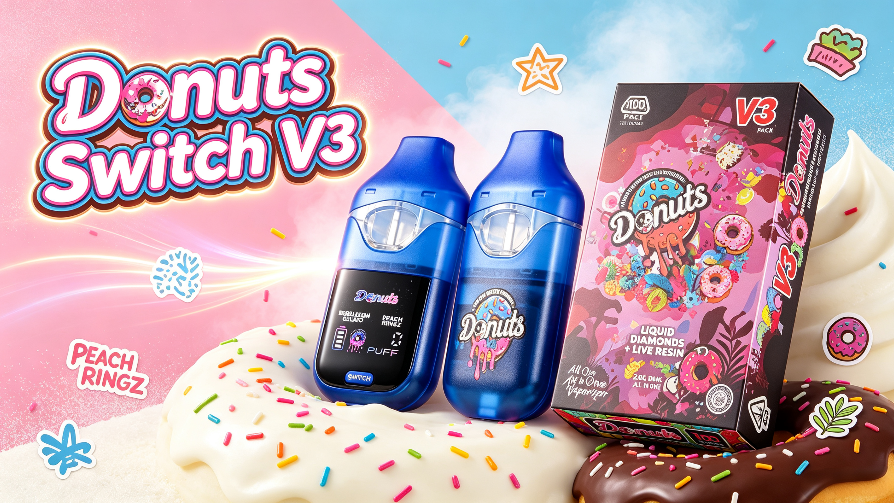
This is precisely why the search term **donuts switch v3 510 ceramic cartridge** is gaining relevance. The 510 format combines an established interface with the ability to utilize modern ceramic heating systems. For B2B buyers, however, the true value lies not in the term "ceramic" itself, but in the level of control applied to the manufacturing, testing, and integration of that ceramic into the overall cartridge system.
Why 510 Ceramic Cartridges Remain Attractive to B2B Buyers
The 510 thread is one of the most well-known interfaces in the vape hardware sector. For brands, this standard offers a crucial commercial advantage: the cartridge does not necessarily have to be developed in conjunction with a proprietary battery platform.
This gives rise to several potential advantages:
- broad hardware compatibility
- simplified product development
- lower tooling costs
- more flexible supplier selection
- simpler warehouse planning
- favorable conditions for OEM and private-label projects
For purchasing managers, standardization also means that different cartridge concepts can be more easily compared and tested.
However, "510-compatible" does not automatically mean that every cartridge works optimally with every battery. Voltage, resistance, airflow, and contact dimensions must still be validated together.
1. Ceramic heating systems enable more controlled product development.
Porous ceramic is frequently used as a wicking or heating system in modern cannabis cartridges. Its structure allows it to absorb liquid and transport it to the actual heating element.
Ceramic systems can be interesting for OEM projects because of properties such as:
- Porosity,
- thermal conductivity,
- Fluid intake,
- mechanical strength,
- Heating habits
have it specifically tailored to the desired hardware platform.
Yet this is precisely where the quality check begins for professional buyers.
ASTM is currently developing a specification for ceramic materials used in electronic cannabis concentrate vaporizers. Key areas of focus include mechanical and thermal properties, chemical composition, porosity, conductivity, and crystallinity.
This is an important signal for the market: "Ceramic" is not a sufficient material specification.
A supplier should be able to explain which ceramic is used, how it is produced, and how its properties are controlled across different batches.
2. "Ceramic" does not automatically mean "clean."
The term "cleaner vaping experience" should be used with caution in B2B marketing.
A ceramic cartridge is not automatically free from metals or other potentially problematic materials.
Many ceramic heating systems also contain:
- metallic resistance elements,
- electrical contacts,
- solder connections,
- metal housing parts,
- Gaskets,
- Adhesives or polymers.
Therefore, brands should not use sweeping claims such as “metal-free,” “toxin-free,” or “100% safe” unless these assertions are substantiated by appropriate testing.
ASTM is also currently developing a specification regarding restricted substances in materials used in cannabis and hemp extract vaporizers. This work explicitly addresses metal, ceramic, glass, plastic, polymers, corrosion, and potential toxicity.
For procurement managers, this is a clear indication: material testing must consider the entire cartridge system, not just the visible ceramic core.
3. The quality of the ceramic itself becomes a purchasing factor.
Not all porous ceramics possess the same properties.
Manufacturing parameters can influence:
- pore size,
- pore distribution,
- mechanical strength,
- fluid transport,
- thermal stability,
- Particle formation.
As part of its ongoing vape device safety initiative, ASTM points out that the manufacturing of ceramic atomizer cores requires precise control. Improperly formed ceramic structures can affect porosity and potentially promote the formation of cracks or particles.
For a purchasing manager, therefore, the question should not simply be:
“Is it ceramic?”
The better question is:
“What ceramic specification do you use, and how do you control porosity, composition and mechanical integrity from batch to batch?”
This distinction separates a simple product vendor from a technically competent OEM partner.
4. Oil compatibility must be tested with the actual formulation.
A cartridge can function excellently with a standard test oil yet develop problems with the customer's actual formulation.
Differences arise, for example, from:
- Viscosity,
- terpene content,
- Cannabinoid composition
- Crystallization tendency,
- Storage temperature,
- Additives.
For a project involving **Donuts Switch V3 510 ceramic cartridges**, procurement managers should therefore require tests based on the actual target specifications.
Important questions are:
- How quickly does the ceramic become saturated?
- Does the supply to the heating core remain constant?
- Do blockages occur after prolonged storage?
- How does the system behave at low temperatures?
- Are there leaks at higher temperatures?
- How much material remains in the tank at the end?
The optimal cartridge is not the one with the highest theoretical performance, but the one whose heating system matches the intended formulation.
5. Resistance and battery voltage must be considered together.
510 compatibility is relatively simple mechanically. Electrical compatibility is more complex.
A cartridge can physically fit onto a battery and still be operated outside its optimal performance range.
Purchasing should therefore document at least the following values:
- nominal resistance
- Resistance tolerance
- recommended voltage range
- recommended output
- maximum activation time
- Behavior during preheating
- Short-circuit threshold
Excessive power can alter thermal behavior. Conversely, insufficient power can lead to inadequate evaporation or problems with highly viscous formulations.
Therefore, a supplier should not simply claim that their cartridge is “compatible with all 510 batteries.”
Professional specifications define a recommended operating range.
6. Heavy metal tests should be part of the supplier evaluation.
The issue of metals is becoming increasingly important for US cannabis brands.
Potential sources are not limited to the cannabis extract; hardware components can also contribute to metal contamination during storage or use.
For this reason, ASTM is currently developing a guideline for the collection of vaporizer aerosols for elemental analysis. The planned approach is specifically aimed at hardware manufacturers, testing laboratories, and researchers, and addresses inorganic constituents—specifically metals—within the aerosol.
For a professional procurement process, this means that a simple material report may not be sufficient.
Depending on the target market and risk profile, the following may be appropriate:
- Material analysis of the hardware
- Testing of unfilled components
- Examination after contact with the formulation
- Aging tests
- Aerosoltests
- ICP-MS analyses
- batch-specific control tests
The question of whether tests were conducted immediately after filling or only after a defined storage period is particularly relevant.
Migration can be time-dependent.
7. Full ceramic and ceramic core are not the same.
Various terms are frequently conflated in the market:
**Ceramic Mouthpiece** refers solely to the mouthpiece.
Ceramic Mouthpiece bezieht sich lediglich auf das Mundstück.
Ceramic Center Post refers to a ceramic component within the cartridge.
"Full ceramic" is frequently used as a marketing term for a design in which as many components as possible that come into contact with oil are made of ceramic.
However, electrical and metallic components can also be present in so-called all-ceramic products.
Therefore, an exploded view or a BOM should always be available to purchasing managers.
It was intended to show:
- Tank material
- Mouthpiece material
- Center post material
- Heating wire
- Ceramic type
- Sealing material
- Contact material
- Soldering material
- adhesives used
Only then can a meaningful comparison between suppliers be made.
8. Leakage remains one of the key quality metrics.
A high-quality ceramic core alone does not prevent leaks.
The entire system must be coordinated:
- Inlet opening
- Tank geometry
- Gaskets and seals
- Mouthpiece
- Center Post
- Filling method
- Closure methods
- Oil viscosity
For American distributors, a low leakage rate can be more economically significant than a small difference in unit price.
Even a relatively low error rate can incur significant costs for large orders.
For 100,000 cartridges, for example, this means:
- 0.5% error rate = 500 potentially problematic units
- 1.0% error rate = 1,000 units
- 2.0% error rate = 2,000 units
In addition, there are potential costs associated with complaints, replacement goods, shipping, retailer credits, and internal processing.
Therefore, the actual error rate should be part of every supplier negotiation.
9. What tests should a 510 ceramic cartridge project pass?
A defined validation plan should be in place prior to mass production.
Leak test
Cartridges should be stored in various positions and under different temperature conditions.
Viscosity test
Several relevant formulations or viscosity ranges should be tested.
Resistance test
The resistance distribution within a production batch should be documented.
Tensile test
The activation should be tested over a defined number of cycles.
Thermal test
The behavior upon repeated activation must be investigated.
Drop and vibration test
These tests simulate stresses encountered during transport and distribution.
Aging test
Filled cartridges should be re-examined for leakage, material changes, and performance after prolonged storage.
Emissions and material testing
Depending on the market, product, and risk profile, additional metal and aerosol analyses may be advisable.
ASTM D37 is currently working on several corresponding standards and test methods for cannabis vaporizers, covering topics such as ceramic materials, metals, emissions testing, and device safety.
This clearly shows the direction in which the professional market is moving: away from purely visual quality control and towards measurable hardware specifications.
10. How US buyers should evaluate an OEM supplier
A reliable manufacturer should be able to provide more than just price, MOQ, and delivery time.
Technical Documentation
Request:
- technical drawings
- complete material specifications
- Resistance data
- recommended operating voltage
- Material declarations
- Reviews
Quality Management
Ask about:
- Incoming Quality Control
- In-process quality control
- Final inspection
- Outgoing Quality Control
- AQL standards
- Batch Traceability
Ceramic Expertise
The manufacturer should be able to explain:
- which type of ceramic he uses
- how porosity is controlled
- which tolerances apply,
- how mechanical stability is tested.
Oil compatibility
Ask whether tests can be conducted using your actual formulation.
Change management
Especially important:
An OEM should not alter the heating core, metal alloy, seal, ceramic formulation, or other critical components without the customer's written consent.
A less expensive substitute material can alter the behavior of the entire cartridge.
11. Golden sample prior to serial production
A common mistake in OEM projects is approving a visually perfect sample without formally establishing its technical specifications.
A "golden sample" should therefore be archived together with the following documents:
- technical drawing
- BOOM
- Material specifications
- Resistance specification
- Ceramic specification
- Color reference
- Print data
- Packaging version
The series-produced goods should subsequently be checked against this reference sample.
If a supplier replaces components, it must be re-evaluated whether revalidation is required.
12. Total Cost of Ownership instead of the cheapest cartridge price
For a US purchasing manager, the FOB unit price is only part of the actual cost.
Total Cost of Ownership also includes:
- Tooling costs
- Laboratory tests
- Inspections
- Committee
- Leaks
- Complaints
- Replacement deliveries
- Express freight
- Packaging rework
- potential product recalls
Suppose Cartridge A costs a few cents less than Cartridge B but has a higher return rate. With several hundred thousand units, the apparent purchasing advantage can quickly vanish.
Therefore, suppliers should not be compared solely on the basis of price quotes.
Better KPIs are:
- Defect rate
- Leakage rate
- Resistance Cpk
- On-time delivery
- Complaint rate
- Batch Consistency
- Corrective Action Response Time
These key figures provide a much better indication of whether a manufacturer is suitable for long-term OEM projects.
13. Where is the 510 ceramic cartridge market heading?
The next generation of cartridge hardware is expected to be defined more by engineering than by mere aesthetics.
Of particular relevance are:
- more precise ceramic porosity
- improved material traceability
- optimized heating profiles
- stricter metal checks
- Aerosol analyses
- higher leakage resistance
- formulation-specific hardware
- automated quality inspection
- improved batch documentation
- custom-developed OEM platforms
Standardization work also reflects this development. ASTM already maintains a standard classification for cannabis/hemp extract vaporizers and is simultaneously working on new specifications for ceramic heating materials, restricted substances, and emission analyses.
For purchasing managers, this means that technical documentation will become just as important as design and price.
Procurement Checklist for Donuts Switch V3 510 Ceramic Cartridge
Before placing a large order for **Donuts Switch V3 510 ceramic cartridges** or comparable 510 ceramic hardware, the following points should be clarified:
- exact cartridge capacity
- complete list of materials
- Ceramic type and porosity
- nominal resistance and tolerance
- recommended voltage range
- Compatibility with the formulation of objectives
- Leak test passed
- Aging test performed
- Material or metal testing available
- Golden sample confirmed
- AQL requirements defined
- Production batch traceable
- Component changes subject to approval
- Packaging approved
- Complaint and replacement process agreed upon
Conclusion: Ceramics is an engineering topic, not a marketing term.
The greatest advantage of a high-quality Donuts Switch V3 510 ceramic cartridge does not lie solely in the fact that it uses ceramic.
For professional US buyers, the details matter: controlled ceramic structure, stable resistance values, suitable materials, formulation compatibility, low leakage rates, and traceable test reports.
Having the right expectations is equally important. "Ceramic" does not automatically mean metal-free, free of harmful substances, or safer. A high-quality cartridge is only created once the entire system—from the ceramic core, electrical contacts, and seals to the tank—has undergone technical validation.
This is precisely where a long-term OEM partner differs from a simple hardware provider.
Leerervape supports vape brands, distributors, and procurement teams in the development and sourcing of custom 510 cartridge solutions—ranging from material and ceramic selection, prototype development, and compatibility testing to packaging and mass production.
If you are planning a new 510 ceramic cartridge project, please contact our team with your requirements regarding capacity, oil viscosity, resistance, materials, order quantity, and target market. Based on this information, a suitable hardware platform for your OEM project can be evaluated.
Attention : donuts switch v3 dual chamber 1g+1g | donuts disposable bulk | dual chamber disposable bulk | custom vape
 empty 1g vape
 empty 2g vape
 empty 3g vape
 empty dual chamber vape
 empty led vape
 USA STOCK VAPE
 EU German stock vape