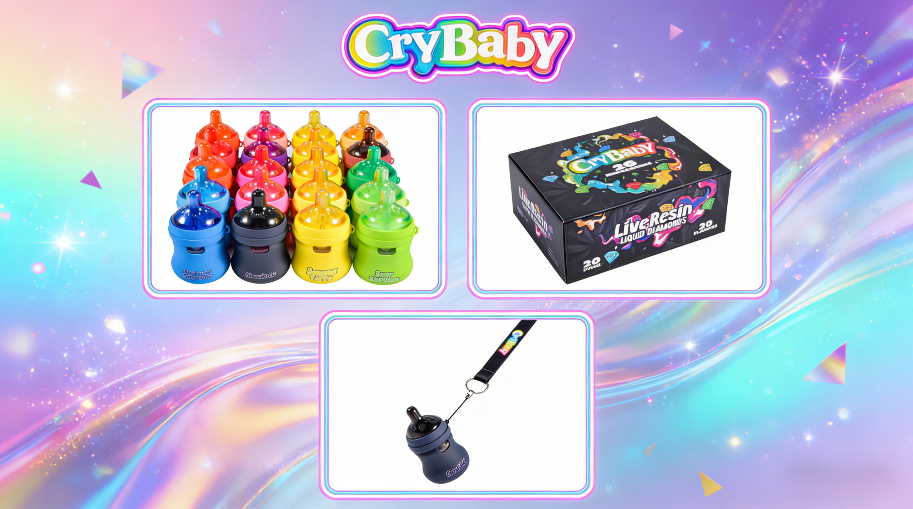
In the cannabis market, packaging has long been more than just a casing. Especially for brands with strong brand recognition, like crybaby button vape packaging, the box becomes a touchpoint for legal compliance, brand building, and trust. This is particularly true in Germany: According to the Federal Ministry of Health, around 5.05 million adults between the ages of 18 and 64 consumed cannabis at least once in the previous 12 months in 2024; at the same time, total consumption of medical and non-medical cannabis for 2024 was estimated at 670 to 823 tons. Anyone developing packaging for cannabis vapes today is therefore working in a growing, but also highly regulated market.
The first major trend is compliance-first design. In Germany, distribution by growers' associations must be in neutral packaging; in addition, an information sheet is required with details such as weight, harvest date, shelf life, strain, and average THC and CBD content. Canada goes even further: There, laws and regulations require plain packaging and labeling with restrictions on logos, colors, branding, and designs aimed at young people. California also prohibits cannabis products, advertising, packaging, and labeling that are attractive to children. For modern crybaby button vape packaging, this means: less visual overload, more controlled brand management.
The second trend is Safety as User Experience. In regulated markets, child-resistant, tamper-evident, and—for multi-doses—resealable systems are becoming the standard. California mandates that cannabis products sold in stores must be packaged in a tamper-evident and child-resistant package; when leaving the store, they must also be transported in an opaque exit package. New York also requires child-resistant packaging throughout the entire lifespan of the product, explicitly referencing US standards for special packaging and requiring resealable packaging for multi-doses. This development is not abstract: US Poison Control Centers reported up to the 30th By April 2025, there will already be 2,578 cases of exposure to cannabis edibles among 0- to 19-year-olds in 2025 alone, and 39,497 cases since 2019. This shows why safety features are strategically, and not just regulatory, relevant for vape packaging.
The third trend is called Connected Packaging. Packaging is becoming digitally readable and traceable. Californian regulations define a Unique Identifier (UID) as an alphanumeric code to reference a specific plant and derived cannabis products; upon sale or delivery, cannabis products must include such an identifier for tracking purposes. In parallel, the new EU regulation on packaging and packaging waste is making digital data carriers such as QR codes an increasingly important tool. It stipulates that certain packaging information and – where applicable – QR codes or other standardized digital data carriers must be visibly displayed; for information on the recycled content, these requirements apply from August 12, 2028, or later depending on the implementing act. For Crybaby Button Vape Packaging, this is a clear indication: authenticity, COA, batch information, recycling instructions, and age information should be accessible via a single, clean digital touchpoint.
The fourth trend is material reduction instead of material staging. According to Eurostat, a total of 79.7 million tonnes of packaging waste were generated in the EU in 2023, which corresponds to 177.8 kilograms per capita. Germany, at 215.2 kilograms per capita, was significantly above 200 kilograms. Across the EU, 35.3 kilograms of plastic packaging waste per person accounted for, of which 14.8 kilograms were recycled. This is precisely why the EU is tightening its regulations: The PPWR requires that all packaging placed on the market must be recyclable; furthermore, double walls, false bottoms, or similar volume illusions will no longer be permitted. By February 12, 2028 at the latest, empty space in sales packaging must be reduced to the functionally necessary minimum. For vape brands, this means: less unnecessary plastics, fewer show inlays, more mono-material, fiber molded parts and precisely fitting boxes.
The fifth trend concerns perhaps the most difficult balance of all: strong brand impact without appealing to young people. Health Canada explicitly warns that illegal cannabis products are often sold in eye-catching packaging that imitates familiar sweets or snacks and can therefore appeal to children. California also emphasizes that enticing packaging can lead to unintentional consumption by children. This is crucial for concepts with playful, nostalgic, or pop-cultural imagery. Future-proof crybaby button vape packaging should therefore present a mature, clear, and regulatory-compliant image—with a calm color palette, clean typography, and unambiguous information—and evoke emotional brand moments through texture, materiality, and digital content rather than childishly accessible symbolism.
Ultimately, competition in the cannabis sector is shifting from "loud and flashy" to precise, secure, digital, and circular. The most successful packaging for vape products in the future will not be the most eye-catching, but rather the one that accomplishes four things simultaneously: regulatory compliance, product protection, digital trust building, and efficient material use. This is precisely the future of crybaby button vape packaging: as a brand interface, compliance system, and sustainability tool all in one.
Attention : crybaby 2g disposable | wholesale crybaby vapes | empty 2 gram disposable | custom vape
 empty 1g vape
 empty 2g vape
 empty 3g vape
 empty dual chamber vape
 empty led vape
 USA STOCK VAPE
 EU German stock vape