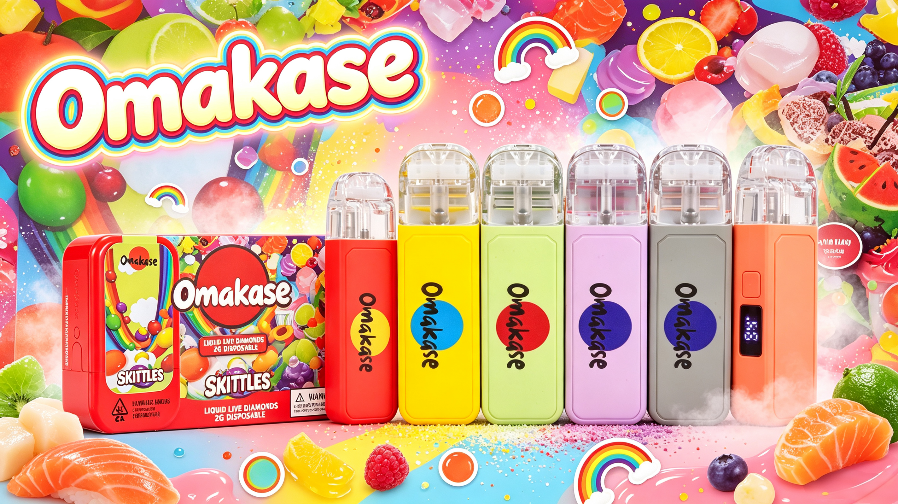
Anyone looking for the best Omakase 510 carts should evaluate them differently as a professional buyer than an end consumer would.
For vape wholesalers, distributors, importers, brands, and purchasing teams, the priority is not which product name is currently garnering the most attention. Rather, the decisive factor is whether a specific 510 hardware offers a stable foundation for their product range across successive production batches.
Especially with Omakase, the interesting B2B positioning therefore lies less in maximizing brand awareness than in other factors:
Sophisticated single-chamber design, robust hardware quality, reliable 510 connection, consistent heating performance, and reproducible serial production.
This aligns with a hardware standard that remains highly relevant. In its market analysis published in 2026, Headset reports that 510-threaded products account for 91.3% of US cartridge sales. In Canada, that figure is as high as 99.8%.
The broader category also remains commercially significant: in the US markets tracked by Headset, vapor pens generated approximately **$4.8 billion in revenue** between June 2025 and May 2026, ranking second among cannabis product categories.
For B2B buyers, this raises a clear procurement question:
What qualities make an Omakase 510 cart a reliable wholesale hardware product that impresses not only with the sample but also with subsequent orders?
What makes a good Omakase 510 cart?
A high-quality Omakase 510 cart should not be judged based on a single feature.
The relevant B2B quality arises from the interplay of:
Design + 510 connection + Heating system + Airflow + Material + Assembly + Production control.
Simplicity is not automatically a disadvantage.
A classic single-chamber or single-tank design, in particular, can be attractive to high-volume users because it features less complex functional paths than multi-chamber systems or those with extensive electronic enhancements.
That doesn't mean that single-chamber hardware is automatically better.
It means that it has a clear focus:
a cartridge, a reservoir, a heating system, and a standardized 510 connection.
For a buyer who values reproducible hardware and recurring bulk orders, this clarity can be a significant advantage.
Why Single-Chamber 510 Carts Remain Attractive to B2B Buyers
The vape hardware market is evolving rapidly.
All-in-one systems, displays, dual-chamber models, and larger devices are gaining attention. Nevertheless, the market shows that the classic 510 standard continues to dominate within the cartridge category.
With a **91.3% share of US cartridge sales**, 510-threaded products are—according to Headset—not only well-established but remain the clear standard compared to proprietary systems.
This offers practical advantages for B2B buyers.
A standardized 510 interface can:
simplify compatibility with existing battery platforms;
facilitate the switch between hardware suppliers;
Make product portfolios clearer;
reduce reliance on proprietary battery systems;
and make reorders easier to plan.
Single-chamber hardware also offers a relatively clear product architecture.
This can be particularly interesting for brands that wish to build product differentiation not through complex electronics, but through hardware consistency, formulation tuning, packaging, and brand positioning.
The most important criteria when choosing an Omakase 510 cart
1. Consistent hardware construction
The first criterion is not design.
It is reproducibility.
A sample can look excellent and yet reveal little about how a production run of 50,000 units will perform.
Professional buyers should therefore verify whether the design and manufacturing process are sufficiently mature to ensure consistent results across different production batches.
These include, among others:
Reservoir geometry;
Mouthpiece fit;
Gaskets;
Center Post;
510 Connector;
Heating Element;
Airflow;
Materials;
and assembly process.
With mature Omakase hardware, the B2B value therefore does not lie in adding as many new features as possible.
The value lies in a stable and known product structure that can be produced repeatedly.
This is relevant for distributors because a product must work not only on the first order.
A successful wholesale program typically follows this logic:
Sample → Opening Order → Repeat Order → Scaling.
Quality must support this entire cycle.
2. Reliable 510 connection
"510 thread" sounds like a simple mechanical specification at first.
In practice, however, a reliable connection depends on several tolerances.
B2B buyers should pay attention to the following points, among others:
Thread quality The thread should be cleanly manufactured and show no significant, unnecessary variations between units.
Center-pin contact The electrical contact with the battery must be capable of being established reproducibly.
Connector dimensions A mechanically imprecise design can result in individual battery systems seating differently.
Connection stability The cartridge should neither fit unnecessarily loosely nor require excessive tightening.
Precisely because 510 is such a widely used standard, a professional supplier should be able to say more than:
It is 510 compatible.
A better purchasing question is:
"Which mechanical tolerances are monitored, and how is the connection tested in serial production?"
For wholesalers, this is significantly more relevant than a mere compatibility statement on a product page.
3. Uniform heating performance
With flavor-focused hardware, the heating system plays a central role.
With flavor-focused hardware, the heating system plays a central role.
Crucial to this is a uniform, controllable heating output that matches the intended hardware and product configuration.
Deviations in the heating element can affect several areas:
Heat generation;
Vapor output;
Flavor consistency;
Material consumption;
and perception of overall quality.
From a professional purchasing perspective, the following should therefore at least be clarified:
which type of heating is used;
which resistance range is intended;
which production tolerance is accepted;
how the resistance is monitored during QC;
and whether several production batches perform comparably.
This is particularly important for taste-oriented product concepts.
A product that heats very differently across different units makes it difficult for a brand to create a consistent product experience.
4. Flavor-Focused Single-Chamber Design
The term "flavor-focused" should not be used merely as a marketing phrase.
From a hardware perspective, the aim is to provide an architecture that is as clear and controllable as possible for **a single formulation per cartridge**.
With a single-chamber design, there is no second chamber and no switching logic.
The product focuses entirely on a single reservoir and heating path.
For B2B buyers, this can offer several practical advantages:
Clear SKU structure One cartridge corresponds to one product profile.
Simplified quality analysis When a problem occurs, fewer different channels or operating modes need to be investigated.
Simplified product range Retailers can clearly distinguish between individual profiles.
Formulation-related tests Each hardware/formulation combination can be evaluated separately.
For a taste-oriented brand, this very simplicity can make sense.
Instead of integrating ever more functions into a single device, the focus can be placed on stable hardware, consistent airflow, and reproducible heating.
5. Consistency with larger orders
This fifth criterion is likely the most important one for B2B buyers.
A good product is not just a good sample.
It is a product that is also known as:
10,000 units
50,000 units
or can be supplied in a manner that is as comparable as possible for subsequent repeat orders.
This is where actual wholesale suitability comes into play.
Purchasers should therefore not only ask:
"What is the MOQ?"
But also:
"How do you monitor consistency between production lots?"
Relevant points may include:
Incoming Quality Control;
In-Process Inspection;
Final Inspection;
AQL-Standards;
Resistance check;
Leakage Testing;
Dimensional check;
Dimensional check;
Lot Traceability;
and documented corrective actions.
A supplier capable of producing 100,000 units does not automatically possess a good serial production capability.
Capacity and consistency are two different things.
Why product consistency can be more important for wholesalers than mere brand awareness
A well-known brand name is helpful in the wholesale business.
However, it does not replace reliable hardware.
A less dominant brand can still be commercially attractive if it offers the distributor a stable product base.
This is particularly relevant to the omakase positioning.
The hardware does not need to be presented as the "biggest brand on the market" to be attractive to B2B customers.
A more practical value may lie in the following properties:
mature product quality
proven single-chamber structure
consistent production
clear 510 compatibility
reliable repeat-order base
In the long run, a wholesaler earns more than just the profit from the initial order.
He earns money from products that retailers reorder.
A product with high brand recognition but inconsistent production quality can lead to more complaints and a higher support workload.
In contrast, a less hyped piece of hardware with consistent quality can become a more predictable part of the product range.
Mature hardware can offer an advantage for repeat orders.
When it comes to hardware procurement, there are basically two situations.
New hardware that has not yet been extensively tested
A new mold or a completely new design can bring innovation.
At the same time, however, even more development variables may remain open:
Tolerances;
Material adjustments;
Assembly optimization;
Tool offsets;
and changes following early production runs.
Mature hardware
With an established hardware structure, there is more practical manufacturing experience available.
This can mean, among other things:
known critical production steps;
more stable assembly processes;
more predictable tolerances;
clearer QC checkpoints;
and a better starting point for repeat orders.
In this context, "mature" does not mean "error-free."
Every production batch requires quality control.
The advantage lies, rather, in reduced development uncertainty.
For a distributor that does not want to constantly test new hardware, this can create significant procurement value.
Why Omakase 510 Carts Can Be Attractive for Wholesale
The current vape market offers an interesting combination:
On the one hand, new all-in-one formats are developing rapidly.
On the other hand, 510 remains the dominant hardware standard in the cartridge sector.
For 2025, Headset reports that 510-threaded products account for a 91.3% share of US cartridge sales.
At the same time, vape pens generated approximately US$4.8 billion in US markets tracked by Headset between June 2025 and May 2026.
For Omakase 510 hardware, this results in a clear positioning:
Not necessarily an attempt to generate attention through maximum technical complexity.
Rather, a practical, standardized, and consistent single-chamber solution for wholesale and recurring B2B procurement.
This may be of interest to:
Vape hardware wholesaler;
Distributors;
Importers;
Retail chains;
Brands;
OEM/ODM customers;
and companies with their own legitimate production or filling concepts.
Empty 510 Cart: Clearly separate hardware and product concept
The product context relevant to this article is empty vape hardware.
That means:
The 510 cart is considered empty hardware rather than a pre-filled consumer product.
This distinction is important for professional buyers.
It makes it possible to qualify the hardware independently of its subsequent formulation.
Typical empty 510 hardware includes, for example:
Reservoir;
Mouthpiece;
Heating Element;
510 Connector;
Airflow structure;
Gaskets;
and housing or tube.
For OEM or private-label projects, discussions regarding packaging, branding, finish, or other customization options can follow—depending on the manufacturer's actual offering.
The respective regulatory requirements depend on the target market, the intended use, and the final product.
Flavor doesn't start only at the formulation stage.
With "flavor-focused" products, the discussion often centers exclusively on the formulation.
For hardware buyers, that is too short-sighted.
Perceived performance arises from a system:
Formulation + heating element + airflow + reservoir + power supply via the battery.
A high-quality formulation cannot fully leverage its strengths if the hardware varies significantly.
Therefore, for flavor-focused B2B projects, the cartridge should always be tested in conjunction with the intended battery setup and the actual formulation.
An empty cartridge may appear mechanically sound when dry, yet exhibit different characteristics after being filled.
Relevant test points include, for example:
Material compatibility;
Viscosity behavior;
Leakage;
Airflow;
Heating;
Storage;
and performance after aging.
Why the lowest unit price doesn't automatically result in the best 510 cart
It becomes problematic when only the unit price is compared.
Assumed:
Supplier A offers a cartridge for $0.08 less than Supplier B.
For 100,000 units, this corresponds to a visible saving of:
8,000 US dollars.
However, if the cheaper hardware causes more problems, additional costs may arise from:
Sorting;
Complaints;
Replacement goods;
lost fill material;
Returns;
Vendor credit notes;
additional QC;
and support.
Professional procurement should therefore rather ask:
What is the Total Procurement Value?
This is composed of, among other things:
Unit Price + Quality + Consistency + Availability + Service + Repeat-Order Reliability.
Mature hardware can therefore be more economically attractive, even if it does not represent the absolute lowest offer.
Golden Sample and BOM Control
A reference sample should be defined before placing a large bulk order for Omakase 510 carts.
This "golden sample" serves as a physical quality benchmark.
In addition, the buyer should know which critical components determine the production version.
This may include:
Area
What should be documented?
510 Connector
Design and tolerances
Heating Element
Type, resistance, and tolerance
reservoir
Material and capacity
Mouthpiece
Material and fit
Seals
Material and specification
Airflow
approved design
Outer Hardware
Material and finish
Packaging
confirmed version
The larger the order, the more important a clear change control process becomes.
A supplier should not replace critical components without consultation if doing so could affect the confirmed product specification.
What B2B buyers should check before placing a bulk order
Before ordering Omakase 510 Cart wholesale hardware, it is advisable to prepare a concise shopping list:
Hardware specification
Which exact version is being produced?
Capacity, materials, dimensions, resistance, and other technical data should be recorded in writing.
510 connection
Check the mechanical fit and electrical contact quality with the intended battery systems.
Heating system
Ask about heating technology, resistance, and production tolerance.
material
Ensure that the relevant hardware materials are documented, particularly for components that come into contact with the product.
Airflow
Assess whether the airflow is consistent across multiple samples.
Leak Testing
Ask about the test method instead of a blanket "leak-proof" claim.
Conditions such as the following are of interest:
Duration;
Temperature;
Positioning;
Sample Size;
and accepted error rate.
Sample Quality
Examine multiple samples, not just a single sales model.
Production consistency
What checks are used during mass production?
Golden sample
Define a released reference product.
Lot traceability
Can a subsequent complaint be traced back to a production batch?
Packaging
Clarify:
Individual packaging;
Inner Box;
Master Carton;
labeling;
Barcode;
branding;
and possible customization.
MOQ
Do MOQs differ for:
Standard Product
and
OEM / Custom Packaging?
Bulk Pricing
Compare only identical specifications.
A cheaper offer featuring a different heating element or different materials does not constitute a genuine price comparison.
Lead Time
Please inquire separately about:
Sample Lead Time
Initial Production Lead Time
Repeat-Order Lead Time
After-Sales Support
What happens in the event of a documented production problem?
A professional B2B supplier should offer a transparent complaint and corrective action process.
USA and Europe: Not automatically the same procurement strategy
The USA is a particularly important market due to the widespread adoption of the 510 standard.
For Europe, the strategy should be more differentiated.
The regulatory treatment of an empty 510 cartridge can depend on the target market, its intended use, and the resulting end product.
Additional national and European requirements may become relevant, particularly in the event of subsequent use with regulated substances or products containing nicotine.
For importers, this means:
Qualify the hardware technically first – then assess market requirements separately for each target country.
A product well-suited for a US customer should not automatically be adopted for all European markets with identical packaging and product specifications.
Frequently Asked Questions
What are the "best Omakase 510 carts" from a B2B perspective?
In professional procurement, "best" should not be equated with brand recognition or the lowest price.
Key factors are consistent hardware quality, a reliable 510 connection, heating consistency, clean design, and reproducible production.
Why is 510 hardware still relevant?
Headset reports that 510-threaded products account for around 91.3% of US cartridge sales. This confirms the standard's clear dominance within the cartridge market.
Are Omakase 510 carts single-chamber hardware?
The B2B product context addressed in this article refers to a classic single-chamber/single-tank 510 cartridge.
Why can a single-chamber design make sense for flavor-focused products?
The design features a clear heating and fluid path for a formulation. This can simplify product qualification and SKU management.
Is mature hardware automatically free of defects?
No.
Even established hardware requires QC and serial number tracking.
The strength of a mature design lies in the greater predictability of manufacturing, critical components, and repeat orders.
What should be tested before placing a wholesale order for Omakase Carts?
Why is the lowest price not sufficient as a decision criterion?
Because complaints, production deviations, additional QC, and poor reorderability can quickly exceed the initial savings.
Is OEM or private label possible?
This depends on the specific supplier offering. With empty vape hardware, elements such as packaging, branding, finish, or other design features can be customized depending on the project. MOQs and technical limitations should be confirmed in writing beforehand.
The bottom line: The best Omakase 510 cart is the one that can be reliably reordered.
For professional buyers, the search for the best Omakase 510 carts should not lead to a popularity ranking.
The more important question is:
Which hardware provides the most reliable foundation for my business?
Five factors are particularly relevant in B2B purchasing:
1. consistent hardware construction
2. Reliable 510 connection
3. Uniform heating performance
4. flavor-focused single-chamber architecture
5. Consistent quality for large and repeat orders
The market confirms the fundamental relevance of this hardware category. According to Headset, 510-threaded products account for 91.3% of US cartridge sales, while vape pens recently reached annual sales of approximately $4.8 billion in the US markets tracked.
In the case of Omakase, there is no need to construct a narrative of market leadership around it.
The more credible B2B positioning is:
Consistent product quality, mature single-chamber hardware, consistent manufacturing, and practical suitability for wholesale.
Especially for wholesalers, this can be more valuable than short-term hype.
After all, long-term wholesale success does not stem solely from retailers placing their first order.
It arises when the hardware is reliable enough to lay the foundation for the second, third, and subsequent orders.
Are you looking for reliable Omakase 510 cartridge hardware for wholesale or distribution?
If you are evaluating Omakase 510 empty hardware for wholesale, distribution, your vape brand, or a B2B project, you should examine the actual hardware before placing a large order.
Contact our B2B team for specifications, samples, MOQs, bulk pricing, packaging options, and information on production capacity.
Ideally, please let us know your desired order quantity, target configuration, packaging requirements, and quality criteria.
A reliable vape hardware supplier should be able to do more than just explain how much a product costs.
He should be able to demonstrate how the same hardware can be produced and delivered as consistently as possible, even for repeat bulk orders.
Meta Title: BackpackBoyz Runty Vape Taste: Ursachen und Hardwarequalität Meta Description: Warum schmeckt eine BackpackBoyz Runty Vape anders? Erfahre mehr
Einleitung Die Wahl der passenden Vape Battery ist ein wichtiger Schritt bei der Bewertung von Cartridge-Hardware. Anschlusskompatibilität, technische Spezifikationen, Ladefunktion
 empty 1g vape
 empty 2g vape
 empty 3g vape
 empty dual chamber vape
 empty led vape
 USA STOCK VAPE
 EU German stock vape