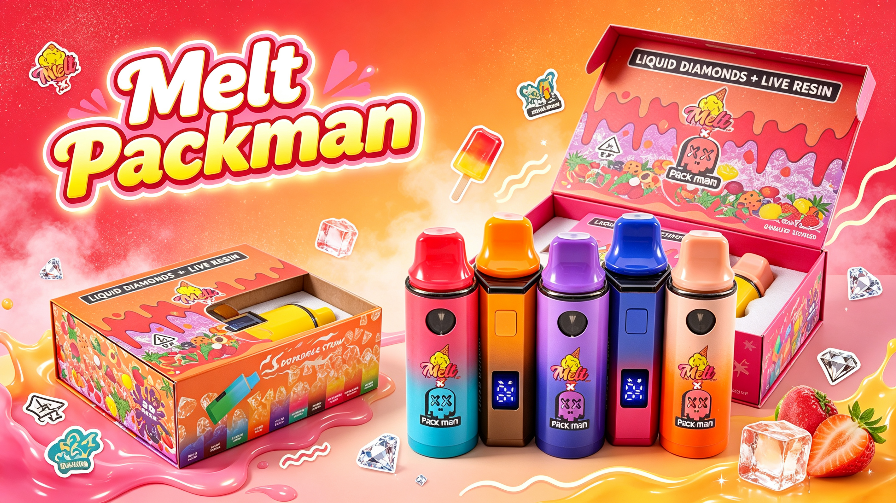
The Benefits of Using Empty Melt Packman Vape 510 Cartridges for Your Vaping Experience
The market for vape hardware is increasingly evolving in two directions: on the one hand, integrated all-in-one systems are gaining importance; on the other, the classic 510 cartridge remains relevant for brands, distributors, and OEM projects.
The search for "510 cartridge empty melt packman vape" reflects interest in empty cartridge solutions designed to be filled later with a specific formulation. This concept offers flexibility to professional buyers, yet it also places higher demands on material selection, heating technology, leak resistance, and quality control.
After all, a good cartridge is not merely a container. It is a technical system whose components can directly influence performance and product safety.
What is an empty 510 cartridge?
An empty 510 cartridge is an unfilled hardware component designed to connect to a compatible 510-thread battery.
Typically, a cartridge consists of:
- Mouthpiece
- reservoir
- Heating core
- Air duct
- Gaskets and seals
- electrical contacts
- 510 thread
After professional filling, the cartridge is connected to a suitable battery.
For vape brands, this separation offers a key advantage: hardware and formulation can be developed and tested separately.
Why does the 510 system remain attractive to brands?
The 510 connection is one of the established interfaces for cartridge-based vape hardware.
From a B2B perspective, this offers several advantages.
1. Flexible hardware platform
A brand can develop various cartridge designs while maintaining a compatible battery platform.
This can simplify product development and assortment planning.
Instead of having to develop a completely new electronic device for each variant, it is possible, for example, to...
- Cartridge capacities
- Mouthpieces
- Materials
- Colors
- Packaging concepts
test within an existing product family.
2. Battery and cartridge are separate.
In an all-in-one product, the reservoir, heating system, and battery are combined into a single device.
A classic 510 system, on the other hand, separates the rechargeable battery from the cartridge.
This can be of interest to brands if a reusable hardware platform is part of the long-term product strategy.
3. More opportunities for OEM projects
Empty cartridges can be customized for private-label and OEM projects.
Depending on the manufacturer, the following are possible, for example:
- custom mouthpiece
- logo
- Housing finish
- Reservoir size
- Packaging
- Heating core configuration
The more extensive the technical modification, the more important prototypes and validation tests become.
Why the cartridge material is crucial
When purchasing a **510 cartridge empty melt Packman vape**, the choice of material should not be judged solely on appearance.
Cartridges can contain various metals, ceramic components, seals, and plastics. These materials can interact with the filled formulation as well as with heat.
The topic has gained additional significance through recent research.
A study published in *Scientific Reports* in 2025 analyzed metals along the path from cannabis vape liquids to the generated aerosol. The researchers found particles of various metals—including cobalt, chromium, nickel, lead, tin, and zinc—in the aerosols examined. Material alterations were also observed in the cartridge components analyzed.
For hardware purchasers, this leads to an important conclusion:
Material quality should be part of the product specification, not just part of the marketing.
Ceramic does not automatically mean "metal-free."
In the vape market, terms such as "ceramic cartridge" or "full ceramic" are frequently used as indicators of quality.
Professional buyers should scrutinize such designations more closely.
A cartridge can feature a ceramic mouthpiece, reservoir, or heating element while still containing metallic electrical components.
Concrete questions are therefore more important than the marketing designation:
- Which materials come into contact with the formulation?
- Which alloys are used?
- Which components are part of the heating system?
- Which sealing materials are used?
- Are there material test reports?
- Are finished hardware and filled products tested?
This information enables a significantly more well-founded supplier evaluation.
Heating core and oil viscosity must match.
Not every cartridge works equally well with every formulation.
The viscosity of the intended material influences, among other things:
- Fluid supply to the heater core
- Warm-up behavior
- Risk of dry hits
- Leakage behavior
- Draft resistance
Therefore, a hardware platform should always be validated using the configuration actually intended for use.
A common mistake in OEM projects is testing cartridges exclusively with standard test material.
The pattern works—however, problems arise after it is subsequently filled with the actual formulation.
A multi-stage testing process is better.
The most important tests before a bulk order
Compatibility test
The cartridge is tested with the intended battery platform.
The following are checked:
- thread
- contact
- Resistance
- Tension
- Air ducting
- mechanical fit
Leakage test
Leaks can occur immediately after filling or only after storage.
Professional tests should include various:
- Temperatures
- Stock locations
- Time periods
- Transport Conditions
take into account.
Heating test
The heating system should function consistently over multiple activation cycles.
For example, the following need to be examined:
- Resistance stability
- Temperature behavior
- Heating reaction
- Material condition after repeated use
Aging test
A freshly filled cartridge can function without issues and exhibit different characteristics weeks later.
Therefore, the hardware should also be re-examined after a defined storage period.
Transportation Simulation
Vibrations and temperature changes during transport can place stress on seals and connections.
Such simulations are particularly useful for international supply chains.
510 compatibility: Standard does not mean universal.
The 510 thread makes it easy to combine various components. However, "510-compatible" does not mean that every battery and cartridge will work together perfectly.
Differences may exist regarding:
- Cartridge diameter
- Contact position
- Thread tolerance
- Air ducting
- Resistance
- Tension
- Housing shape
The outer diameter must be checked, particularly for batteries with a recessed cartridge mount.
For bulk orders, therefore, the supplier should not merely state "510 compatible" but provide a complete technical drawing.
Why empty cartridges are of interest for B2B projects
For professional brands, one of the biggest advantages of blank hardware lies in the control over the subsequent production process.
Personal formulation strategy
Companies can select the hardware to match their intended, legally permissible wording.
Separate procurement
Hardware and content may originate from different specialized supply chains.
Branding
The cartridge and packaging can be adapted to an existing brand identity.
Scaling
Following successful pilot production, larger quantities can be ordered based on an already validated hardware standard.
However, these benefits only materialize if specifications and quality control are consistently documented.
What should B2B buyers look for in a supplier?
A professional cartridge manufacturer should be able to provide more than just product images and a low unit price.
Technical Documentation
Ask for:
- technical drawings
- List of materials
- Resistance specification
- Dimensional tolerances
- recommended operating parameters
- Storage conditions
Quality Management
Ask about:
- Incoming Quality Control
- In-process quality control
- Final Quality Control
- Outgoing Quality Control
- AQL standards
- Batch Traceability
Production capability
A good sample does not automatically prove stable series production.
Check:
- monthly capacity
- Level of automation
- Manufacturing tolerances
- Tool management
- First-pass yield
- Production lead time
Change management
A particularly important point is often overlooked.
The manufacturer should not modify important components without written consent.
This applies, for example, to:
- Heating core
- Metal alloys
- Gaskets and seals
- Mouthpiece material
- Adhesives
- Suppliers of critical components
A product can look identical on the outside yet have undergone technical changes.
Golden sample instead of product photo
A structured approval process is recommended before placing a production order:
- Engineering samples
- Filling and compatibility test
- Pre-production sample
- Golden sample
- Pilot Run
- Series production
The golden sample becomes the binding reference for subsequent production.
In this process, not only should color and logo be defined, but also:
- Dimensions
- Weight
- Materials
- Resistance zone
- Heating core
- Air ducting
- seal
- Packaging
This makes it possible to prevent the mass-produced goods from deviating technically from the original sample.
OEM Opportunities for Empty 510 Cartridges
For brands, empty 510 cartridges can serve as a flexible foundation for custom hardware programs.
Depending on production volume, OEM customizations can include:
Branding
Logo, engraving, or other visual brand elements.
Mouthpiece
Shape, material, and surface finish can significantly alter the appearance.
Hardware finish
Metal parts and other visible components can be customized to match the branding.
Packaging
Customized packaging enables:
- Brand communication
- Batch coding
- Product protection
- information required by regulation
Technical adjustments
For larger ODM projects, the heating core, air ducting, or other technical components can also be modified.
However, such changes require re-validation.
Safety and quality control are becoming increasingly important.
Current research underscores why hardware materials should be subjected to more rigorous testing.
A scientific study published in 2025 showed that metals from cannabis vape cartridge components can contribute to contamination. For consumers, this does not mean that every cartridge is automatically problematic. However, it highlights the importance of material selection, manufacturing quality, and independent testing.
Standardization is also evolving. Among other things, ASTM is working on safety and data requirements for electronic cannabis and hemp vaporizers in the medical sector.
The trend is clear:
Professional vape hardware is increasingly being evaluated based on demonstrable quality rather than merely design and unit price.
Why the lowest price is not automatically the most economical option
Suppose Supplier A offers a cartridge for a few cents less than Supplier B.
At first glance, A appears more attractive.
However, the actual total costs may increase due to:
- Leaks
- faulty contacts
- Committee
- Complaints
- Replacement deliveries
- additional inspections
- Express freight
- Customer Service
- damaged brand reputation
For professional procurement, therefore, Total Cost of Ownership is more relevant than the pure FOB unit price.
B2B Checklist for Empty 510 Cartridges
Before placing an order, buyers should confirm at least the following points:
Hardware
- Technical drawing available
- Materials documented
- Resistance range defined
- Heating core specified
- 510 dimensions confirmed
compatibility
- Goal formulation tested
- Battery platform tested
- Airflow validated
- Voltage-matched
Quality
- Leak test performed
- Aging test performed
- Transport test conducted
- AQL agreed upon
- Golden sample approved
supplier
- Production capacity confirmed
- Batch traceability available
- QC process documented
- Change management agreed upon
- Complaint process defined
FAQ
What is an empty 510 cartridge?
An empty 510 cartridge is an unfilled vape hardware component with a compatible 510 connection. It typically contains a reservoir, a heating system, a mouthpiece, and electrical contacts.
Are all 510 cartridges universally compatible?
No. Threads, dimensions, contacts, resistance, airflow, and required voltage can differ.
Why is the heating system important?
The heating system influences heat transfer and must be compatible with the viscosity and composition of the intended formulation.
Are ceramic cartridges completely metal-free?
Not necessarily. Cartridge systems with ceramic components can also contain metallic heating or contact components. Buyers should check the actual list of materials.
What should wholesalers test before placing an order?
Key tests include compatibility, leakage, storage, temperature behavior, heating performance, and transport stability.
Can empty 510 cartridges be customized?
Yes. Depending on the manufacturer and order quantity, the mouthpiece, finish, branding, packaging, and—in some cases—technical components can be customized.
Conclusion
The search for "510 cartridge empty melt packman vape" highlights the interest in modular vape hardware, where the cartridge and battery can be developed and sourced separately.
For brands and wholesalers, the advantages of an empty 510 cartridge lie primarily in:
- flexible product development
- established 510 platform
- OEM customization options
- separate hardware and formulation processes
- scalable procurement
However, the decisive factor remains technical quality.
Recent research on metal particles in cannabis vape systems highlights why material selection, heating components, and manufacturing processes require careful evaluation. Therefore, a high-quality cartridge should not be judged by its appearance or price, but rather by documented materials, reproducible production, and real-world compatibility testing.
For companies wishing to develop their own line of empty 510 cartridges, it is advisable to begin with a technical sampling phase using the intended battery and formulation. Production should only be scaled up after successful leakage, aging, and functionality tests.
Leerervape can assist brands, wholesalers, and distributors in developing custom 510 hardware, OEM packaging, and scalable cartridge projects. An initial project discussion should begin with technical requirements, the target market, and quality standards—not merely the desired unit price.
Attention : 2g disposable vape | screen vape disposable | cheap vape
 empty 1g vape
 empty 2g vape
 empty 3g vape
 empty dual chamber vape
 empty led vape
 USA STOCK VAPE
 EU German stock vape