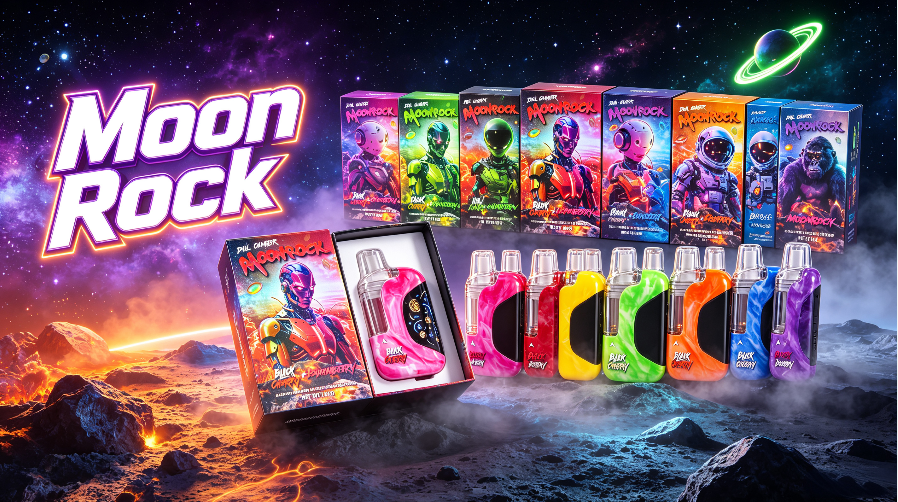
Exploring the Art of Turning Moon Rock Pens: Techniques and Tips for Successful Product Development and Sourcing
The term "moon rock pen" is increasingly attracting attention in the cannabis vape market. For purchasing managers, distributors, and brand owners, however, it is about more than just an eye-catching product concept. The crucial factor is whether an idea can be transformed into a product that is technically reliable, compliant with regulations, and economically scalable.
That is precisely where the true art of "turning" lies: transforming an initial design concept into a market-ready vape product that combines hardware quality, brand positioning, supply capability, and compliance.
The global market for cannabis vaporizers was valued at approximately US$5.9 billion in 2024. A market volume of around US$7.6 billion is projected for 2026, rising to approximately US$13.1 billion by 2030. In 2024, North America accounted for a 38.3 percent share of global revenue. For US buyers, this means that while demand is growing, so too is the pressure regarding competition and quality.
What does "Turning a Moon Rock Pen" mean from a procurement perspective?
For a B2B buyer, developing a moon rock pen primarily entails integrating multiple product decisions into a consistent, cohesive system.
This includes:
- Housing shape and surface finish
- Tank or reservoir construction
- Heating core and air ducting
- Battery capacity and charging electronics
- Oil viscosity and material compatibility
- Packaging and Labelling
- Quality control and traceability
A visually impressive product can only succeed in the market if these elements are technically coordinated. Particularly with high-viscosity formulations or complex extracts, the heating system, intake openings, and power curve must be tested together as early as the development phase.
1. Product concept first, decoration second
Many procurement projects begin with colors, logos, and packaging. Successful purchasing managers, however, start with a clear technical specification.
Such a specification document should define at least the following:
- planned fill quantity
- Viscosity range
- desired draft activation
- Battery capacity
- Charging Port
- Target weight and dimensions
- desired material types
- Requirements regarding leakage and transport stability
- intended market
Only once these points have been established should the shape, color, and branding be finalized.
This sequence reduces the risk that an attractive housing might later prove incompatible with the tank, the battery, or the desired formulation.
2. Hardware must match the formulation.
A common procurement mistake is expecting a universal hardware solution to work with every oil formulation. In practice, viscosity, terpene content, storage temperature, and the filling process significantly influence the performance of a vape system.
For a Moon Rock pen, buyers should therefore test samples containing the actual intended formulation, rather than just a standard test oil.
Important inspection points are:
- Saturation of the heating core
- Behavior at low temperatures
- Leakage after prolonged storage
- Formation of air bubbles
- Air duct blockage
- Flavor consistency throughout the product life cycle
- Remaining quantity in the tank
A reputable OEM partner should be willing to test multiple heater core, inlet, and performance variants before serial production is approved.
3. Material selection is a purchasing risk today.
Metal parts, alloys, coatings, ceramic components, and seals can influence product performance and regulatory assessment.
ASTM is working on standards and test methods for cannabis vape hardware covering device design, materials, aerosol emissions, component interactions, and performance characterization. This demonstrates that standardized hardware testing is becoming increasingly important for the market.
Procurement managers should therefore demand more from a supplier than a simple list of materials.
Useful options include, among others:
- Material declarations
- Alloy specifications
- Test reports for relevant metals
- Data on coatings and adhesives
- Evidence of heat resistance
- documented supplier approvals
- Batch Traceability
The lowest unit price is hardly an advantage if additional laboratory tests, product recalls, or complaints arise later on.
4. Battery technology must not be treated as a standard component.
With disposable or rechargeable vape devices, the battery determines more than just runtime; it also affects heating performance, safety, shelf life, and transport.
Among other things, the FDA recommends using only suitable batteries and chargers, adhering to manufacturer specifications, and refraining from further use of damaged devices. For B2B buyers, this underscores the importance of clear battery specifications and documented safety features.
When evaluating a supplier, purchasing managers should ask about the following functions:
- Overcharge protection
- Deep discharge protection
- Short-circuit protection
- Overheat shutdown
- defined limit on the duration of the pull
- USB-C charging specification
- Battery cell supplier
- Transport and safety documentation
In addition, the power output should be matched to the heating component. Higher battery capacity alone does not guarantee better product performance.
5. The prototype is not the production model.
A functional prototype is only the first step. During subsequent mass production, variations often arise due to tooling tolerances, material batches, assembly personnel, or changing sub-suppliers.
A professional procurement process should therefore include several approval stages:
Engineering samples
This prototype serves to evaluate the design, function, and technical feasibility.
Pre-production sample
The pre-production sample should already be manufactured using the planned production materials, tools, colors, and packaging.
Golden sample
The approved reference sample becomes the binding quality standard for production and final inspection.
Pilot Run
A limited pre-production run demonstrates whether assembly, filling, packaging, and logistics function under realistic conditions.
Purchasing should only release a production order once a representative number of units—rather than just a single sample—has been tested.
6. Which tests should a Moon Rock Pen pass?
For US B2B customers, a test plan should go well beyond a simple functional check.
A sensible test plan can include the following areas:
- Leakage test in multiple positions
- Storage at elevated and low temperatures
- Drop test
- Vibration test
- Charge cycle test
- Traction activation test
- Airflow measurement
- Resistance test
- Service life test
- Inspection after prolonged storage in a filled state
The interplay between hardware and content must also be taken into account. In California, cannabis regulators are continuing to refine their requirements for pesticide testing and limits to align them with current scientific findings. The Department of Cannabis Control published proposed amendments to this effect in December 2025.
A recall of several vape products in California in July 2026 due to pesticide contamination also demonstrates the importance of verifiable batches, laboratory documentation, and traceability in real-world supply chains.
7. Packaging must do more than just attract attention.
A moon rock pen is often positioned as a premium or lifestyle product. However, packaging design should never be evaluated solely on the basis of visual impact.
Professional B2B packaging should:
- Secure the device during transport,
- make manipulation recognizable,
- Record batch numbers,
- QR or verification codes enable,
- Display legally required information,
- address adult target groups,
- provide sufficient space for market-specific labeling.
US states may impose varying requirements regarding cannabis packaging, warning labels, and child-resistant features. A supplier should therefore be able to offer flexible packaging templates and regional adaptations.
It is particularly important that trademark rights and designs are used lawfully. Purchasing managers should never assume that an OEM is automatically authorized to use well-known names, logos, or packaging styles.
8. How US purchasing managers evaluate an OEM partner
A capable supplier should not only sell products but also actively reduce risks.
The following questions are particularly relevant during a supplier audit:
Technical expertise
Can the supplier explain the heating core, battery, air ducting, and tank assembly, or are they merely reselling standard products?
Change management
How are changes regarding materials, tools, or sub-suppliers documented and approved?
Quality Control
Are there inspection plans, AQL criteria, batch reports, and clearly defined defect classes?
Traceability
Can the production date, material batch, assembly line, and inspection data be linked to a product lot?
Scalability
Can the supplier maintain the same quality at higher production volumes following a pilot run?
communication
Are technical questions answered quickly and in writing? Is there a dedicated project manager?
Intellectual property protection
How are customer-specific drawings, tools, packaging data, and brand information protected?
A trustworthy OEM partner should provide verifiable answers and documentation, not just general sales promises.
9. Price negotiations should be based on total costs.
The purchase price per device is only part of the actual costs.
Total Cost of Ownership also includes:
- Tooling costs
- Samples and technical modifications
- Inspection costs
- Laboratory tests
- Packaging adjustments
- Committee
- Complaints
- Express shipping
- Inventory loss due to defective goods
- potential recall costs
A device that costs a few cents less can ultimately turn out to be significantly more expensive if the leakage rate, failure rate, or supply uncertainty is higher.
Professional buyers therefore compare not only offers but also the scope of testing, warranties, replacement policies, documentation, and delivery capability.
10. Current trends in the Moon Rock pen segment
The market is moving towards more highly differentiated hardware. Key developments include:
- custom-tailored ceramic heaters
- more compact housings with higher energy density
- USB-C charging
- more precise airflow systems
- visible oil reservoirs
- improved leak resistance
- Premium surfaces
- QR-based product verification
- smaller pilot batches for market tests
- custom OEM platforms
At the same time, greater emphasis is being placed on safety standards, material transparency, and regulatory documentation. Consequently, the next generation of successful products will be defined not merely by design, but by measurable reliability.
Procurement checklist for a Moon Rock pen project
Before releasing an order, US buyers should confirm at least the following points:
- final technical data sheet
- Material declaration
- Battery documentation
- Compatibility with the formulation of objectives
- passed leakage and storage tests
- confirmed golden sample
- defined AQL standards
- approved packaging files
- Production and Delivery Schedule
- Batch coding
- Änderungsvereinbarung
- Complaint and replacement process
If any of these points are missing, the project should not be automatically halted. However, the risk must be clearly assessed, documented, and resolved before the start of series production.
Conclusion: Turning an idea into a procurable product
Developing a successful moon rock pen requires more than just an attractive housing or eye-catching packaging. For American purchasing managers, key factors include technical compatibility, material transparency, battery quality, documented testing, and reproducible mass production.
The best OEM partner is not necessarily the provider with the lowest quote. What matters is which supplier understands technical questions, identifies risks early, and documents every stage of development in a transparent, traceable manner.
Leerervape supports brands, distributors, and procurement teams in the development of custom vape hardware—from initial specifications, prototypes, and packaging to controlled mass production.
Contact our team to discuss your moon rock pen project, target markets, and OEM requirements. Together, we can determine which hardware platform, materials, and testing procedures best suit your brand and supply strategy.
Attention : moon rock 2g vape | screen vape disposable | cheap vape
 empty 1g vape
 empty 2g vape
 empty 3g vape
 empty dual chamber vape
 empty led vape
 USA STOCK VAPE
 EU German stock vape