Cart Juice in Context: What the Term Means in 2026—and What Users Should Really Look Out For
Cart Juice in Context: What the Term Means in 2026—and What Users Should Really Look Out For
The term **"cart juice juice"** is not a publicly and clearly documented official product name backed by a definitive manufacturer.
Rather, it appears primarily as a **listing or search term within the context of cannabis vape cartridges**.
At the same time, market trends indicate that terms such as **"Juice Carts"** or **"Juice Cured Resin Cartridge"** do, in fact, appear in official product contexts.
For precisely this reason, in 2026, a sober and objective classification—rather than mere marketing rhetoric—is well worth the effort.
In short
„Cart Juice Juice“ wirkt öffentlich eher wie ein cartridge-naher Produkt- oder Listing-Ausdruck als wie ein klar standardisiertes Verbraucherprodukt.
Interessant wird der Begriff erst im größeren Zusammenhang: also bei Kompatibilität, Batterie, Regulierung und Entsorgung.
Cartridge-Systeme
Batterie
Regulierung 2026
Entsorgung
Begriffsklärung
1. What exactly is meant by "cart juice juice" in the public sphere?
Most visible
- A cartridge/vape cart term
- frequently found in the context of cannabis vape listings
- More of a product or variety name than a clear device standard.
What cannot be clearly substantiated in public
- that **“Cart Juice Juice Vape”** is a clearly documented, standalone official product with a complete data sheet.
- that all online listings under this term refer to the same technical specification
- that it is a clearly defined individual brand
Viewed objectively, the term appears more like a retail- or SEO-oriented expression for cannabis cartridges,
rather than a clearly standardized consumer product with comprehensive manufacturer documentation.
Data at a Glance: Why 2026 Looks Different
FDA
In the USA, 45 e-cigarettes are currently authorized.
CDC
In 2024, 5.9% of U.S. middle and high school students currently used e-cigarettes.
Nutzungsform
Unter jugendlichen Nutzern entfielen 55,6 % auf Disposables und 15,6 % auf vorgefüllte oder refillable Pods bzw. Cartridges.
UK
The sale of single-use vapes has been banned since June 1, 2025.
These figures make it clear: the real question for 2026 is not merely
which cart sounds interesting, but rather how well the format aligns with regulations, hardware quality, and disposal requirements.
2. Why Cartridge Systems Remain Relevant
The practical advantage of a cartridge system does not automatically lie in the hype,
but rather in the separation of hardware and content.
Official providers like ColdFire demonstrate this market logic very clearly:
They list cartridges, disposables, and batteries as distinct categories.
Additionally, ColdFire lists batteries that are explicitly optimized for Juice Carts.
What this means in practice
In such systems, not everything is conceived as a single, disposable product.
Instead, compatibility, voltage, charging method, and device quality play a more significant role.
Precisely for this reason, cartridge-based systems in 2026 often appear more robust than purely disposable-oriented models.
3. What Users Should Really Look Out For Regarding Cartridge-Related Terms Like "Cart Juice"
| Checkpoint |
Why He Is Important in 2026 |
| Official Manufacturer Website |
Helps distinguish whether a term is merely a listing name or a technically documented product. |
| Battery / Voltage |
Some systems deliberately operate at low voltage and utilize USB-C charging, rather than relying merely on "more power." |
| Regulatory Context |
FDA, UK regulations, and WHO positions indicate that vape categories are subject to significantly stricter scrutiny. |
| Disposal |
Devices containing lithium-ion batteries do not belong in household waste or standard recycling bins. |
4. Hardware Matters More Than Packaging Language
In cartridge-oriented systems, technical factors are often more telling than marketing buzzwords.
ColdFire, for instance, lists features for compatible batteries such as USB-C,
Preheat, and an ultra-low voltage range of 1.6V to 2.5V.
This serves as a prime example of what a segment of the market is truly looking for:
controlled power rather than merely the highest possible heat.
A Technically Sensible Focus
- Voltage range
- Charging Port
- Preheating function
- Cartridge compatibility
Less helpful than it sounds
- Vague product names
- purely subjective or hype-driven language
- Unclear online listings lacking manufacturer attribution
- Missing information regarding battery and charging method
5. The Environment and Batteries: A Point Many Underestimate
The EPA clearly states that **lithium-ion batteries—and devices containing them—do not belong in household trash or standard recycling bins.**
They must be collected separately because they can cause fires.
For precisely this reason, the question of whether or not a system utilizes replaceable hardware
is, today, more than just a matter of convenience.
Why This Is Relevant
The more a product integrates its battery, electronics, and consumable components into a single disposable unit,
the more difficult disposal typically becomes.
This logic sits uneasily with a regulatory framework that, in Europe, is increasingly focusing on
removable and replaceable batteries.
6. Why the Original "Benefits" Approach Falls Short in 2026
A title like *“Exploring the Benefits of Using Cart Juice Vape for Your Vaping Experience”*
sounds like classic product marketing.
However, more recent public data suggests a more cautious perspective:
The FDA is tightening its oversight of the market, the CDC continues to highlight this as a sensitive product category,
and regulatory developments in the UK—as well as EU battery policy—prioritize
traceability, reusability, and safe disposal over hype.
Mini-Checklist
- Is "cart juice juice" a clear, official product name, or merely a listing term?
- Is there an official manufacturer's website with verifiable technical specifications?
- Is the system cartridge-based, reusable, or disposable?
- How should a device with a Li-ion battery be disposed of correctly?
- Are we talking about actual hardware features, or just branding?
FAQ
Is "cart juice juice" an official brand name?
Publicly, this cannot be clearly substantiated as a distinct, official brand.
The term appears primarily in product listings and in the context of cannabis vape cartridges.
Is this primarily about a cart, a battery, or a disposable?
Most notably, this concerns **cartridge-oriented products**.
Official sites—such as ColdFire—distinguish between **cartridges, batteries, and disposables**,
demonstrating that these components are perceived differently within the market.
Why is this more relevant in 2026 than it was in the past?
Because regulation, youth protection, and battery/disposal issues have moved much more to the forefront.
This applies in the USA, the UK, and at the EU level as well.
Conclusion
Die beste nüchterne Antwort auf cart juice juice lautet 2026:
Der Begriff wirkt öffentlich eher wie ein cartridge-naher Produkt- oder Listing-Ausdruck als wie ein sauber dokumentiertes, eigenständiges Vape-Produkt.
The subject truly becomes interesting only within a broader context—
specifically regarding compatibility, batteries, disposal, and regulation.
That is precisely where the substantive questions lie today—not in general product hype.
Classification status: 2026. Individual product listings, market availability, and regulatory details are subject to change by region.
Sources
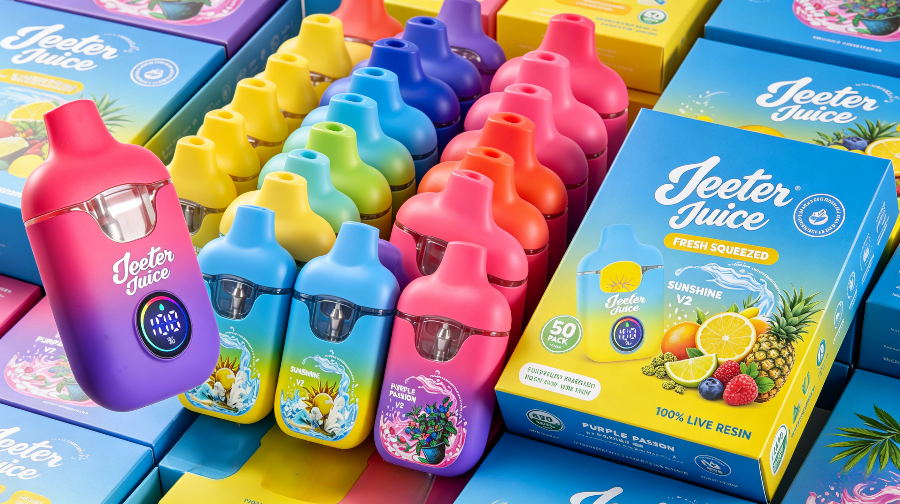
Attention : jeeter juice v2 disposable 2g | jeeter juice disposable | disposable vape with screen | wholesale vapes
 empty 1g vape
 empty 2g vape
 empty 3g vape
 empty dual chamber vape
 empty led vape
 USA STOCK VAPE
 EU German stock vape