The Rise of Rick Morty Disposable Cart Weed: Convenience Meets Quality
(Keyword: rick morty disposable cart weed)
Why the term even comes up
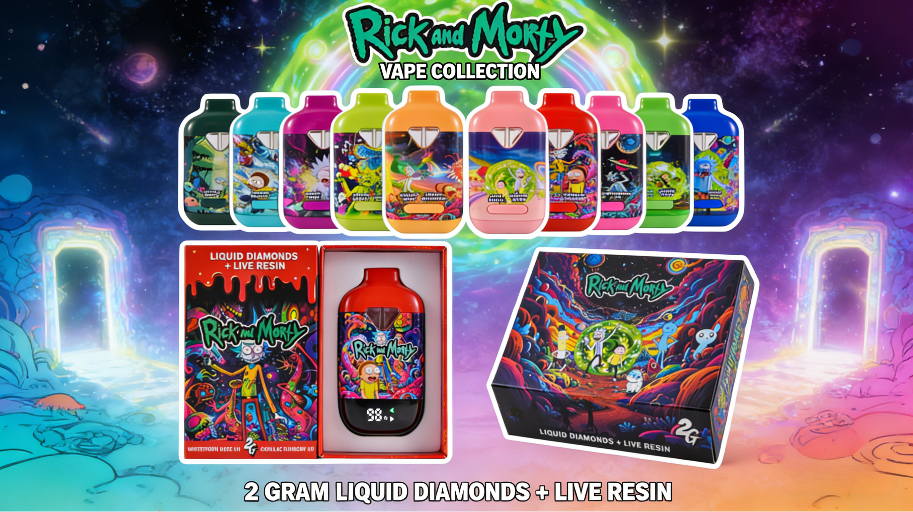
“Rick and Morty disposable cart weed” is not an official product standard, but rather a trending term originating from social media and (often) gray/illegal markets: disposable vapes combined with cannabis oil/THC cartridges (carts). Eye-catching pop culture branding is a warning sign, as it is often associated with counterfeits and a lack of quality control. For example, US customs officials have reported seizing tens of thousands of “Rick and Morty” vape pens due to copyright infringement – a typical pattern for mass-produced goods from unofficial supply chains.
“Convenience” is real – but in Germany it quickly clashes with law and regulation.
In Germany, the Cannabis Act (CanG) has been in effect since April 1, 2024, with clear limits: 25 g in public spaces, 50 g at home, and up to three plants per adult. For non-medical purposes, cultivation associations ("Cannabis Social Clubs") are also possible – but importantly: distribution is only permitted in its pure form, i.e., dried flowers and hashish, but not "oil carts" or similar extract products. In practical terms, this means that if you encounter "disposable cart weed" as a consumer product in Germany, it is very often outside the legally permitted distribution channels.
What "quality" should really mean for carts/disposables
If "quality" is to be more than just marketing, then (from a scientific and regulatory perspective) it comes down to three hard criteria:
- Ingredients & Diluents (Cutting Agents)
The EVALI outbreak in the USA has been strongly linked to vitamin E acetate in THC vaping products; the CDC explicitly advises avoiding THC vapes from informal sources.
- Heavy metals from hardware (coils/alloys/solder joints) Recent research on disposable e-cigarettes shows that disposables can release sometimes increased emissions of toxic metals/metalloids (including lead, nickel, and antimony) – with risk assessments that are significantly unfavorable depending on usage. There is also a growing body of evidence from 2025/2026 that metals from components of cannabis vapes can migrate into the liquid/aerosol.
- Transparency (Laboratory Testing & Traceability)
In a legally regulated context, “quality” means: batches, test reports, contaminant screening (pesticides, solvent residues, metals, microbiological testing) and recall capability. This traceability is a key argument for why Germany relies on home cultivation/club structures with documentation requirements for non-medical cannabis.
Why the trend is still growing: Demand pressure & usage patterns
Cannabis use is widespread – especially among younger adults. A large analysis of usage in Germany reports an overall past-year use rate of 4.6%, significantly higher in younger age groups. For adolescents/young adults, RKI-affiliated evidence shows that in 2023, 6.7% of 12- to 17-year-olds and 23.5% of 18- to 25-year-olds consumed cannabis in the previous year. At the same time, convenience (less odor, more discreet, and easier to dose) is a driving factor – precisely the sweet spot that disposable cart formats address. However, convenience does not automatically equal quality.
Convenience vs. Quality: The central contradiction with disposable trolleys
Disposable devices are optimized for rapid use and low unit costs. This often conflicts with:
- Material quality (Metal sources in aerosols)
- Branding Illusions: Pop culture designs can “simulate” trust, even though there is in fact no verifiable quality chain – counterfeit cases are documented.
- Branding-Illusionen: Popkultur-Designs können Vertrauen „simulieren“, obwohl es faktisch keine überprüfbare Qualitätskette gibt – Counterfeit-Fälle sind dokumentiert.
If you write about this: This is how the blog remains "reputable" (and not sales-promoting)
If your goal is content/SEO, but with authority:
- Clarify legality (DE: Distribution channels, club form, advertising/sponsorship bans in the context of the CanG)
- Define quality using measurable criteria (laboratory, traceability, contaminants)
- Present current research on disposables (metals/emissions) as a counterpoint to the "convenience" story.
- Harm-Reduction instead of Hype (no buying guides, no sources, no “best product”)
Conclusion
The hype surrounding "rick morty disposable cart weed" tells a modern consumer story: fast, discreet, and presented as "premium." However, the best data suggests that "disposable" and "quality" are often contradictory—especially with informal THC vapes (EVALI risks) and disposable hardware (toxic metals). In Germany, the situation is further complicated by the fact that the legally established channels for non-medical cannabis do not rely on oil carts, but rather on home cultivation/clubs with distribution in the form of flowers/hashish and documented controls.
Optional: Meta description (DE)
"What's behind rick morty disposable cart weed? A data-driven look at convenience, quality criteria, health risks (EVALI, metals) and the legal situation in Germany."
If you tell me which target group (German end-consumer education, B2B compliance, magazine style) and desired length (e.g. 1200/1800/2500 words), I will create a fully developed SEO version with H2/H3 structure, FAQ block and clean keyword placement (without sales-promoting passages).
Attention : rick morty vape | dual chamber disposable bulk | led disposable vape | custom vape



 English