Updated: January 28, 2026 · Target audience: Adults · Purpose: Safety and market information
Important note: I cannot give a specific recommendation on which voltage/power setting is "best" for THC carts, as this would constitute practical instructions on how to use THC vaping products and also depends heavily on the specific cartridge, device, and liquid formulation. This article instead explains why there is no universal "best voltage for THC carts" answer, what risks are associated with excessive power/temperature, and how to follow manufacturer instructions and safety principles.
Exploring the “best voltage for THC carts” with Muha Meds THC carts: Why there's no single perfect setting.
1) Why "the perfect voltage" is a myth
Variable voltage/wattage sounds like precision – but in practice, the resulting coil temperature is not a fixed value, but rather a combination of the device, coil/atomizer, airflow, puff profile, and e-liquid properties. Even with identical devices, different measurement methods and operating conditions can produce different temperature readings.
In addition, some hardware combinations can form high amounts of reactive carbonyls under certain conditions – others significantly less. Research consistently shows that more power/heat increases the risk of higher emissions of certain pollutants.
2) What the “best data” actually shows: Performance/temperature influences carbonyl emissions.
Several peer-reviewed studies investigate how power settings (wattage/power output) and operating conditions influence the formation of carbonyl compounds (e.g., formaldehyde, acetaldehyde, acrolein). These studies consistently observe that carbonyl levels increase at higher power outputs – especially when the vaporization process shifts to unfavorable operating conditions.
Important: Such emissions originate, among other things, from the thermal decomposition of common carrier materials and reaction pathways in aerosol formation; therefore, device settings and thermals are not just a matter of "personal preference," but safety factors.
3) The critical point is overheating ("dry puff" / liquid overheating)
Reviews and experimental studies describe that under conditions of insufficient wicking/liquid supply or overheating ("dry puff"-like conditions), the formation of carbonyl compounds can increase significantly. This is one of the main reasons why "turning up the power" without clear manufacturer limits is problematic.
At the same time, debates in the scientific literature show that while "aversive" warning signals (e.g., a burnt taste) are often cited as a natural stop signal, elevated formaldehyde levels have also been discussed under certain conditions, without all users clearly perceiving this as repulsive.
4) Why "more heat" is not automatically "better"
Higher coil temperatures can increase aerosol formation and thus the formation of certain toxicologically relevant substances. Recent studies explicitly investigate the relationship between increasing coil temperature and elevated levels of toxicants (including carbonyls).
The problem for end users is: the device interface (voltage/power display) is only an indirect control – the actual temperature depends heavily on airflow, draw duration, and liquid flow. Therefore, a "perfect setting" as a fixed number is good for marketing, but often technically misleading.
5) A reliable guideline (without specific numbers) for "best voltage for THC carts"
A. Manufacturer specifications are the primary source.
When a cartridge or a compatible battery system specifies a recommended operating range, that's the most reliable basis – because these specifications are (ideally) tailored to the coil design, wicking, and material composition. If no specifications are provided, searching for "best voltage for THC carts" is more a symptom of a lack of product transparency than a solvable setting issue.
B. Avoid modifications and "improvisation".
Health institutions explicitly warn against modifications or the addition of substances that are not intended by the manufacturer.
C. Watch out for signs of overheating.
- suddenly sharp/scratchy sensation
- a distinctly "burnt" smell/taste
- unusually strong heating of the device
- irregular aerosol formation (e.g., "spiky" performance)
These signals are relevant in the literature because overheating/"dry puff"-like conditions are associated with increased carbonyl emissions.
6) THC-specific risk perspective (public health)
Reputable health sources generally advise against using THC-containing vaping products and emphasize that devices should not be modified and no unintended substances should be added.
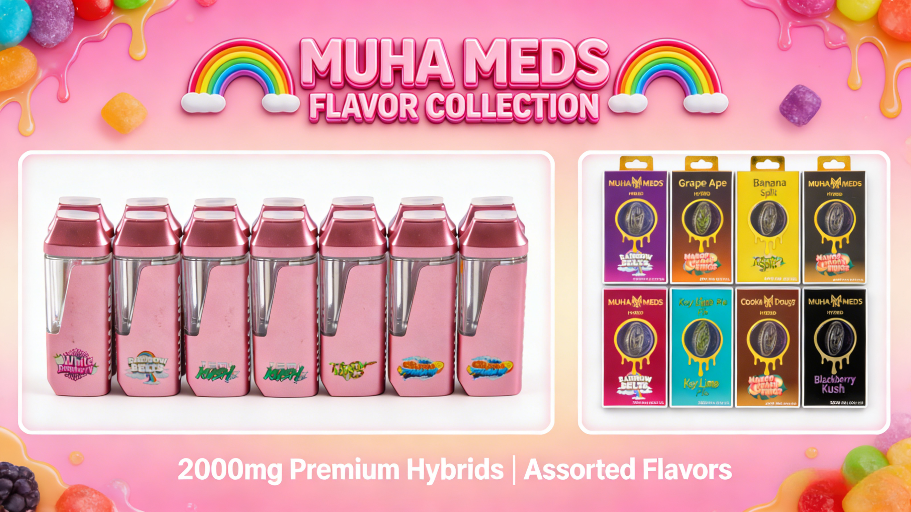
If your content plan (or your listing) mentions "Muha Meds THC carts," it makes sense for credibility and risk management to emphasize sourcing from formal, regulated channels and manufacturer transparency – instead of "performance tuning."
7) B2B/SEO perspective: What you should provide instead of a voltage rating
If your goal is conversions (inquiries/leads), this usually performs better:
- Compatibility: Which battery standards/connectors are supported?
- Documentation: clear variant identification, lot/batch traceability
- Quality: Test reports (e.g., leak test, resistance tolerances, visual inspection)
- Safety: Reference to manufacturer's specifications, no modifications.
This way you stay close to what authoritative sources emphasize: risks are real, the technology is dynamic, and unclear/excessive settings can increase emissions.
Conclusion
A universal "best voltage for THC carts" setting is neither technically sound nor safe. The strongest evidence-based statement is: Power/temperature influences the formation of carbonyl emissions, and overheating conditions are particularly critical. Following manufacturer specifications, avoiding modifications, and maintaining a clear focus on transparency and quality control are the most robust ways to reduce risks – without resorting to problematic "tuning" instructions.
Attention : muha meds vape bulk | muha meds disposable bulk | empty 2 gram disposable | custom vape
 empty 1g vape
 empty 2g vape
 empty 3g vape
 empty dual chamber vape
 empty led vape
 USA STOCK VAPE
 EU German stock vape