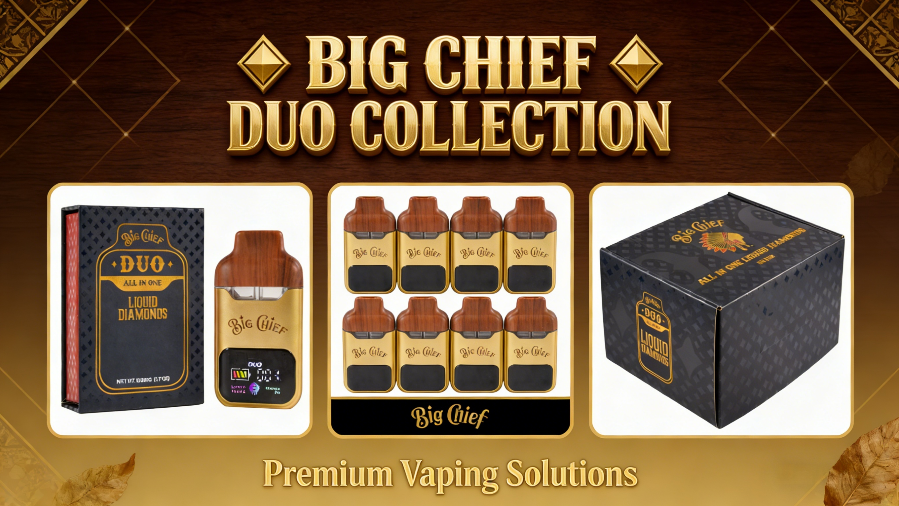
Ceramic cartridges and a "cleaner experience": What retailers should know about Big Chief Vape (2026)
When the term "cleaner experience" is used in the context of Big Chief vape cartridges, it usually does not refer to any medical benefit, but rather to three measurable or observable things:
- Sensory characteristics: fewer "metallic" or "burnt" off-notes, more stable taste over the product's lifespan.
- Material contact: lower risk of ingredients reacting with problematic materials or of extractables/leachables being released from them (keyword: "contact materials").
- Aerosol quality: minimizing unwanted by-products from the device/heating unit – without claiming that inhalation thereby becomes "healthy".
Important: Vaping aerosols are not risk-free. At the same time, research shows that metal contamination (from production and from use) can be a real quality and safety issue – regardless of whether the cartridges contain nicotine or cannabinoids.
1) Why ceramics are technically interesting
Ceramics typically appear in two roles in cartridges:
- Ceramic heating core / Ceramic coil atomizer (porous ceramic as carrier/wick + heating element)
- Ceramic components in the fluid path (e.g., ceramic mouthpiece/inner sleeve depending on the design)
From a materials perspective, the classic selling points are understandable:
- Thermal stability: Ceramics can distribute heat more evenly; this reduces "hot spots" that negatively affect flavor (and potentially promote decomposition products).
- Chemical inertness (relative): Ceramics are often less reactive than certain metals/alloys – relevant for "clean taste" and for extractables/leachables discussions.
- Capillary action/porosity: With suitable pore structures, the liquid flow can be more stable (less risk of dry hits).
However, ceramic cartridges still contain metal contacts, heating elements, solder joints, threads, etc. Therefore, ceramic is not a guarantee of "zero contamination," but rather a design component.
2) What the "latest & authoritative" data on metals actually says
2.1 Metals can originate from the device itself – not just from the oil/liquid.
A paper published in Scientific Reports in 2025 emphasizes that metal contamination is often attributed to the production process, but there is "clear evidence" that metals can also transfer into the medium during operation through contact with metal components.
2.2 Aerosols can contain relevant levels of metals (example from 2025)
A 2025 study on "u-cigarettes" (disposable ENDS) found metal profiles in the aerosols that correspond to those of classic coil devices and reported, among other things, high levels of individual elements (e.g., arsenic, selenium) in certain products; the authors call for appropriate limit values/surveillance.
Even though the device design is not directly transferable to every cartridge design, it underscores the key point: hardware design and material selection influence metal exposure.
2.3 Cannabis vapes: review literature 2025
A review of "cannabis vapes" published in 2025 concludes that metals can be released at levels exceeding regulatory guidelines and calls for improvements in designs to reduce metal leaching.
2.4 Older, but robust evidence: Metal particles in ENDS aerosols
As early as 2021, it was shown in the Journal of Analytical Toxicology that ENDS aerosols can contain toxic metal-containing particles (depending on the system/design).
Interpretation (practical perspective): Ceramics can help mitigate certain contact pathways and stabilize thermal conditions – but a "cleaner" process is not automatic. Without clean manufacturing, material control, and solder traceability, the risk remains.
3) The crucial point in 2026: Standards are inconsistent – retailers need their own testing logic.
Industry comments at the end of 2025 emphasize that a lack of standards increases the risk and that extractables/leachables (including those from ceramics, glass, or plastics) are often not tested systematically enough. For retailers, this means that claiming a product is made of "ceramic" is worthless if the supplier does not provide verifiable evidence.
4) Concrete advantages for retailers when using big chief vape "Ceramic" cartridges (if implemented correctly)
4.1 Differentiation through "quality signals" instead of lifestyle claims
Ceramics are suitable as a quality narrative that is less risky in many markets than health-related promises:
- "More stable heat distribution"
- "More taste-neutral material route"
- "Focus on material and batch control"
4.2 Fewer returns due to fewer leaks / fewer "burnt taste" complaints (indirect effect)
In practice, returns are often driven by:
- Leakage, blockage, inconsistent flow.
- "Burnt hit" at high power/low saturation
- Sensory complaints ("metallic", "chemical")
Ceramics can help here if porosity, heating curve, and sealing concept are carefully coordinated. (That's engineering, not marketing.)
4.3 Improved auditability
If you offer ceramic cartridges as a premium segment product, you expect:
- Lot/batch codes, COA discipline
- Material specifications (ceramic type, seals, metals in contact areas)
- an RMA (Return Merchandise Authorization) set of rules (DOA, leakage rate, tolerances)
Precisely because metal leaching repeatedly appears as a problem in the literature, documented quality control is a real business advantage.
5) The retail checklist: How to market your "cleaner" product credibly (without health claims)
A) Documents you want to see per batch
- COA (Content/Oil/Liquid – depending on the category and local regulations)
- Heavy metal panel (for the final product, not just raw materials)
- Batch/LOT traceability (on packaging + delivery note)
B) Hardware QC (cartridge level)
- Leak test (temperature/pressure variable)
- Resistance tolerance (Ohm range, outlier rate)
- Ceramic integrity (microcracks/crumbling, odor/off-gassing)
- Contact surface material (specification + supplier approval)
C) Claim-Hygiene für Produkttext (sehr wichtig)
Avoid phrases like "healthier," "toxin-free," "safe." More reputable and legally sound alternatives:
- "Ceramic heating core for more even heat distribution"
- "Focus on materials to reduce off-notes (design-dependent)"
- "Batch-based QC documentation available"
If you operate in the US, it's also important to understand that the FDA emphasizes that there are only 39 authorized e-cigarettes (ENDS) that are legally permitted to be sold there (context-dependent – many vape products are not authorized).
This isn't a major ruling, but a reminder: write your copy in a way that doesn't create additional regulatory vulnerabilities.
Conclusion
For Big Chief Vape retailers, "ceramic" can be a sensible approach to support a "cleaner"-seeming experience through material and thermal design. However, the latest literature clearly shows that metal and material contaminants are a real issue, can arise from manufacturing and use, and require verifiable QC documentation instead of mere claims.
If you tell me whether the blog is intended for Germany/EU or USA/Canada (and whether it's about empty hardware or filled cartridges), I can tailor the checklist and copy claims precisely to the compliance wording commonly used there, without increasing any legal risk.
Attention : USA big chief duo vape | big chief vape | led disposable vape | USA Stock vape | vape for sale
 empty 1g vape
 empty 2g vape
 empty 3g vape
 empty dual chamber vape
 empty led vape
 USA STOCK VAPE
 EU German stock vape