The rise of disposable carts: Why they will dominate the vaping market (2026)
Note on context: This article describes market mechanisms, regulation, and supply chain risks. This is particularly relevant for B2B readers if they consider "ace disposables carts" as a hardware/packaging format (e.g., empty/compatible systems, OEM/ODM form factors) and not as an invitation to consume the product. Many regulations also strictly differentiate between therapeutic and non-therapeutic vaping products.
1) What does "Disposable Carts" mean in market jargon?
The term "disposable carts" is often used imprecisely in the retail industry and can mean different things depending on the channel:
- Disposable all-in-one devices (cartridge/reservoir + power supply + heating unit in a single housing; disposed of after use) or
- Disposable, cartridge-like form factors that are optimized for maximum convenience and high product turnover.
The core principle is always the same: "Zero friction" for the end customer and "low complexity" for retail (minimal consultation, few accessories, quick sales).
2) Current market data: Why disposables are "taking over"
Current US market observations (retail sales tracking) show how strongly disposable e-cigarettes have grown in recent years: Between February 2020 and December 2024, sales of disposable e-cigarettes increased by 206% (from 4.1 million to 12.5 million units).
In the same data context, it is reported that the unit share of disposables increased to 60.4% of total e-cigarette sales by December 2024.
In parallel, the supply side has become "unbalanced": As of December 2024, 93.4% of the 7,051 e-cigarette products surveyed were disposables (product availability/assortment structure).
For B2B, this means: Not only demand, but also assortment depth and a flood of SKUs are driving the growth of disposable e-cigarettes.
3) The main drivers behind the boom
A) Convenience + price psychology
Disposable products are advantageous when the customer:
- does not want to resolve any compatibility issues,
- kein Zubehör kaufen will,
- He wants to start "immediately".
This encourages impulse purchases and the use of convenience channels (convenience stores, kiosks, gas station shops). For brands/suppliers, this leads to higher turnover rates per shelf space.
B) Taste/Variants + faster innovation cycles
Market reports indicate that disposables are strongly driven by flavor-focused portfolios, and many brands are integrating additional "smart" elements (e.g., displays, gamification features) to differentiate themselves on the shelf. For "ace disposables carts" (as a keyword/positioning strategy), this suggests that portfolio breadth + visual differentiation is a key lever, but also a regulatory risk factor (see below).
C) Retail Operational Excellence: less friction in the store
Disposable products are attractive for retailers because they:
- reduce returns due to "incorrect compatibility",
- require less training/explanation,
- to rotate faster and allow "new products" to be tested more easily.
This is a structural advantage compared to modular systems.
4) The downside: Regulation, environmental pressure and enforcement pressure.
The market doesn't operate in a vacuum. Precisely because single-use products have grown so rapidly, they are being specifically regulated or banned in many countries.
United Kingdom: Ban in effect from June 1, 2025
The UK government has announced and implemented a restriction/ban on the sale of single-use vapes from June 1, 2025.
In the public debate, environmental aspects, in addition to youth protection, play a significant role; reports cite figures of around 5 million discarded disposable vapes per week (UK context, 2024) as one of the main arguments.
France: Ban in effect since February 26, 2025
France has banned the sale of "puffs"/disposable e-cigarettes since February 26, 2025 (official consumer/administrative information).
Belgium: Ban in effect from January 1, 2025
In Belgium, disposable e-cigarettes have been banned since January 1, 2025; the WHO Europe communication explicitly mentions this as part of its tobacco control strategy.
Australia: Import/distribution restrictions (very strict)
Australia has, among other things, severely restricted the importation of disposable vapes from January 1, 2024 (with very limited exceptions) and subsequently shifted their distribution further towards a "pharmacy only"/therapeutic framework.
USA: Tough stance on "unauthorized" products + seizures
In the USA, in addition to regulation, the enforcement reality is crucial: the FDA repeatedly documents actions against unauthorized products and large-scale seizures in cooperation with CBP, including estimated retail values of ~$76 million (October 2024) and ~$33.8 million (February 2025; communicated May 2025).
Implications for B2B (very practical): Even if demand is strong, there is an increased risk that certain "disposable" segments in individual countries are not scalable (due to bans), or that supply chains are destabilized by seizures, platform delistings, and customs stoppages.
5) What does this mean for "Ace disposable carts" in 2026?
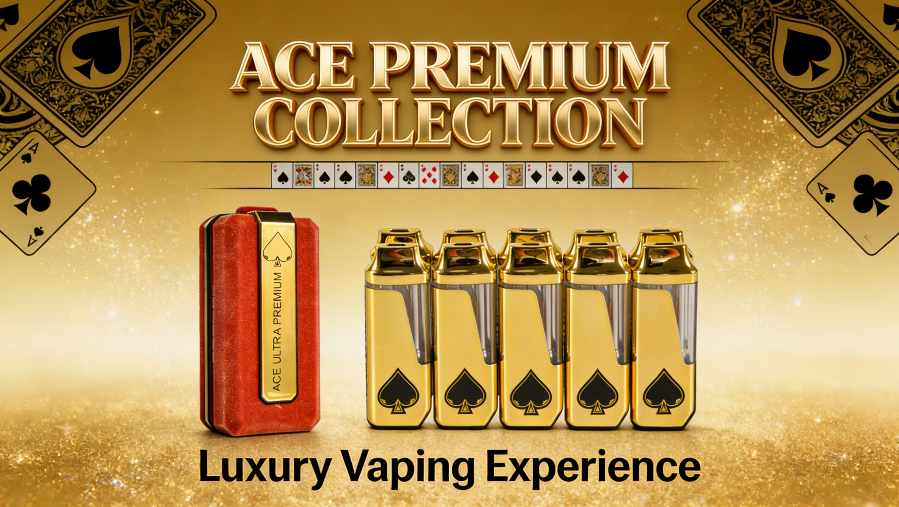
If you want to strategically target the keyword "ace disposables carts" (through content/SEO or B2B positioning), the most compelling approach today is: market trend + compliance readiness instead of a purely "hype" narrative.
A) Positioning: "Convenience format – but compliant and auditable"
Since disposable products are under pressure in many jurisdictions, suppliers who offer the following are gaining ground:
- Clear product classification (what is single-use vs. reusable),
- clear documentation/traceability (lot codes, supplier records),
- Provide a clear country matrix (where it is permitted/where it is prohibited/where it is only permitted for therapeutic purposes).
B) Portfolio hedging: Not just one format
A portfolio consisting solely of disposable products will often represent a concentration risk in 2026. The more robust strategy is:
- Disposable items where legal/suitable for the sewer system.
- Parallel reusable/rechargeable/refillable systems are being implemented in areas where single-use products are restricted (e.g., the UK).
C) Separate demand signals from enforcement signals.
The US data mentioned above show strong growth and high market share for disposable products.
At the same time, US sources emphasize that a large portion of the supply in the market is unauthorized, which increases enforcement risks.
For B2B businesses, this means that sales momentum does not equal supply stability.
6) Conclusion
Disposable vapes are "taking over" the market primarily due to convenience, low friction in retail, and rapid product innovation – and this is supported by current US retail data (e.g., +206% sales growth from 2020–2024; 60.4% unit share by December 2024).
At the same time, the landscape is shifting: bans (UK, France, Belgium) and strict regulation/enforcement (USA, Australia) will make 2026 a year where winners will not only deliver "trendy formats" but, above all, demonstrate compliance readiness, traceability, and country-specific go-to-market discipline.
Attention : ace black badge 2ml | ace 2g disposable wholesale | custom 2ml thc vape | wholesale vapes
 empty 1g vape
 empty 2g vape
 empty 3g vape
 empty dual chamber vape
 empty led vape
 USA STOCK VAPE
 EU German stock vape