Why a 510 pen battery can improve your vaping experience: Control, compatibility & safety
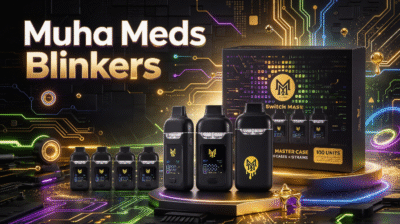
A 510 pen battery is the most practical base for many users when it comes to a consistent, predictable vaping experience: You get more compatibility, more power control (e.g., voltage/heat levels), and – with reputable devices – better safety and quality features. If you're searching for a Blinkers vape battery, a quick reality check is also worthwhile: "Blinker" is partly a brand name, partly slang (referring to drawing until the device automatically shuts off), and not every "Blinker" product actually uses 510 threading.
What is a 510 pen battery (and why is "510" so common)?
"510" refers to the screw thread used to connect the battery and the cartridge/atomizer. In practice, it's a de facto standard because many cartridges and batteries are designed for it – making a battery significantly more versatile than proprietary pod systems.
The main advantages of a 510 pen battery
1) Maximum compatibility instead of "lock-in"
The most obvious advantage: a good 510 battery can be used with many common cartridges. This saves money, reduces the need to switch devices, and makes you less dependent on specific systems. This is precisely where the catch lies with "Blinkers": some listings describe 510 compatibility, while other "Blinker" devices are tied to their own proprietary pod system. Therefore, before buying, explicitly check for "510 thread" in the specifications.
2) More control over flavor and vapor production (voltage/heat levels)
Many 510 pens offer variable voltage (often with multiple settings). This allows you to better adjust the heat and vaporization to the cartridge type, viscosity, and your personal preferences. Manufacturer and retailer guides typically specify voltage ranges for each model, often roughly categorized into lower to higher voltage levels (e.g., for a milder taste versus denser vapor clouds).
Practical bonus: In some "Blinkers rechargeable battery" offers, the voltage switching is described as being done via multiple clicks (e.g., "press 3 times to switch"). This isn't a sign of high quality, but it's a typical convenience feature that you often find on 510-thread pens.
3) More consistent performance (less frustration due to "too hot/too cold")
A common reason for a poor vaping experience isn't the cartridge itself, but rather a battery that fires too strongly or too weakly—or whose performance drops significantly under load. A reliable 510 battery with appropriate power settings can provide stability: a consistent draw, less burnt taste, and a more satisfying flavor. (Also, look for features like automatic shutoff and clean contact surfaces to ensure reliable operation.)
4) Improved security logic – if you pay attention to the correct credentials.
Lithium-ion batteries are powerful but pose safety risks. For e-cigarettes/vaping devices, UL 8139 is a key standard that evaluates electrical systems, batteries, charging circuits, and protection circuits, among other things. UL states that UL 8139 specifically covers these areas (electrical/heating/battery/charging) to address potential risks before market entry.
In addition, for many consumer products with rechargeable cells, IEC 62133-2 is known as the safety standard for portable, rechargeable lithium cells/batteries (requirements & tests for safe operation even under "reasonably foreseeable misuse").
Why this is important: Independent insights – such as those from ULSE – repeatedly highlight the fire/overheating risk associated with vapes, especially when safety mechanisms, charging systems, or component quality are substandard. Therefore, a 510 battery from a clean supply chain with a clear safety record is not just a "nice-to-have," but a crucial factor in ensuring quality.
5) Sustainability & EU battery regulations: Rechargeable is usually the better option.
In Europe, requirements for batteries and battery waste are becoming significantly stricter. The EU Battery Regulation (EU) 2023/1542 aims for greater sustainability throughout the entire life cycle (lower footprint, fewer problematic substances, better collection/recycling) and has been in force since August 17, 2023; it gradually replaces the previous Battery Directive (with effect from August 18, 2025, depending on the transition period).
For you as a user, this practically means: Rechargeable 510 pens are often the more sensible choice in terms of "less disposable electronics per use" – provided you dispose of the battery/electronics correctly (take-back systems/collection points) and don't constantly buy cheap replacement batteries.
Correctly classifying "blinkers vape battery": Brand vs. slang
In everyday use, "a blinker" often means: drawing on the device until the battery automatically shuts off for safety reasons and the LED blinks. However, there are also products listed as "Blinkers rechargeable battery"—some with 510 compatibility, others as proprietary systems. My advice: Treat "Blinkers" as a search term, but ultimately make your decision based on the thread type (510?), safety certifications, and charging/protection features.
Checklist: How to choose a good 510 pen battery
- Compatibility: Explicitly stated "510 thread" in the specifications/listing (not just in the title).
- Variable voltage: At least 2–3 levels; ideally with a clear display/logic.
- Schutzfunktionen: Auto-Shutoff, Kurzschluss-/Überstrom-/Überladungsschutz (Herstellerangaben/Tests).
- Safety orientation: Based on UL 8139 (Vape Electrical Systems) and/or IEC 62133-2 (Cell/Battery Safety).
- Charging: Use clean USB charging (e.g., USB-C) and avoid "mysterious" cheap chargers.
Bonus for retailers/logistics: Shipping and compliance for lithium batteries
When storing or shipping rechargeable batteries (including 510 pens), regulatory compliance quickly becomes crucial: For transport, lithium cells/batteries must have passed the tests according to UN 38.3; IATA explicitly refers to this in its Lithium Battery Guidance and references the applicable air cargo regulations (ICAO/IATA DGR). In the USA, PHMSA offers an official "Lithium Battery Guide for Shippers" as a guide for compliant shipping.
Note: This article provides general information only and does not constitute medical or legal advice. Use vaping products responsibly, observe local laws and age restrictions, and dispose of batteries and electronics through appropriate collection and recycling systems.
Attention : blinkers 2g disposable | blinkers disposable bulk | 2g disposable vape | wholesale vapes
 empty 1g vape
 empty 2g vape
 empty 3g vape
 empty dual chamber vape
 empty led vape
 USA STOCK VAPE
 EU German stock vape