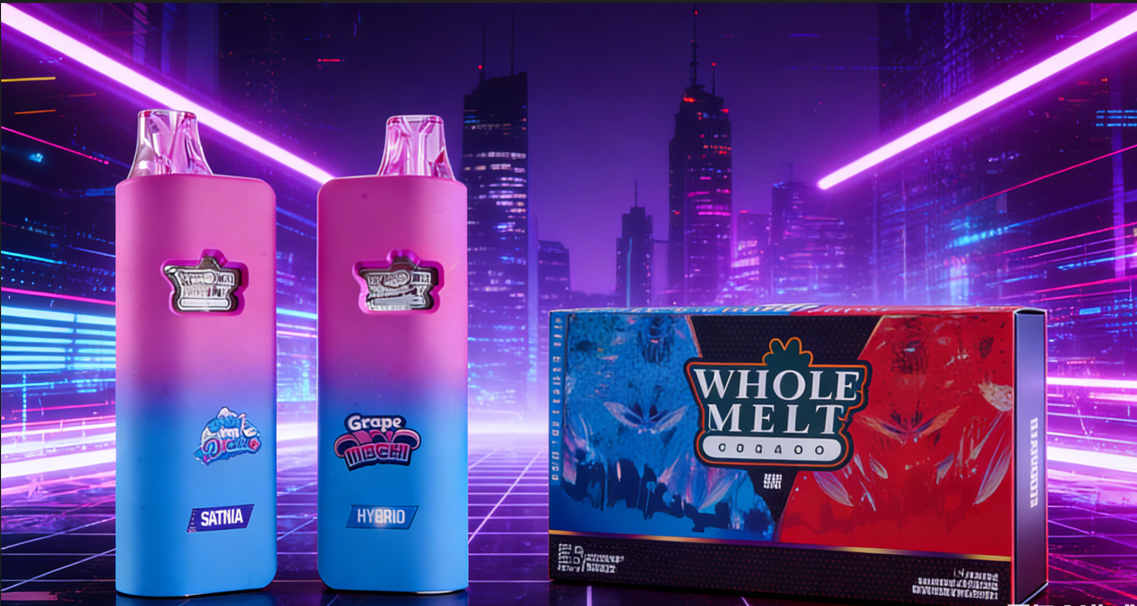
Exploring the Benefits of Variable Voltage on the Whole Melt V7 Vape
Keyword: whole melt v7 disposable
Variable voltage (VV) means that the output voltage of the disposable hardware is not fixed, but can be selected in steps or continuously (e.g., 2.6 V / 3.0 V / 3.4 V). For B2B buyers and brand suppliers, this offers clear advantages in terms of taste, consistency, complaint rate, and product differentiation—especially for devices like the Whole Melt V7 disposable.
A fixed voltage preset rarely suits all oils, temperatures, and user profiles. Variable voltage in the Whole Melt V7 disposable allows you to adjust the power output to the coil resistance (typically 1.2–1.6 Ω), the desired vapor production, and the flavor profile. The result: fewer "too hot/too cold" moments and tighter batch consistency.
2) Taste & Aerosol Quality
Flavor arises from particle size, vaporization rate, and temperature stability. VV helps control the heating ramp-up:
Low (≈ 2.4–2.8 V): smooth, terpene-forward flavor; ideal for soft first puffs and longer draws.
Medium (≈ 2.8–3.2 V): Balance of aroma and vapor volume; suitable for everyday use.
High (≈ 3.3–3.6 V): denser aerosol, warmer hit; for short, powerful puffs—provided the oil supply keeps up.
For device families like the Whole Melt V series, this results in a more consistent mouthfeel across fillings and batches.
3) Viscosity, temperature & altitude
Oils become more viscous in cold temperatures and flow more easily in warm environments. VV compensates for these fluctuations: For cold products, a higher setting is briefly used for initial startup, followed by a return to medium. After air transport (pressure change), the first 3–5 passes are moderate to stabilize the oil supply. The Whole Melt V7 Disposable with multi-stage control is ideally suited for this.
4) Battery efficiency & runtime
VV (Variable Voltage) allows you to link power consumption to the desired vapor production. With the same mAh rating, a moderate setting often delivers the best combination of flavor and battery life. Tip: For B2B testing, report "puffs per charge" separately for each VV level instead of a single average value.
5) Protection for coil & device
Excessive continuous power can cause dry hits and accelerated material fatigue. VV allows for finer adjustment of the oil supply (inlet design, wick saturation). In practice, this reduces burn issues and the variation between the first and last pull.
6) QA/QC Practice: How to Test Variable Voltage
Preparation: Condition samples for 24 h at 20–22 °C; acclimatize to room temperature for 30 min.
Step protocol: 10 moves per tension level (Low/Mid/High), 3 sets with 3-minute breaks.
Key figures: First draw smoothness, flavor stability over 10 puffs, vapor production, noise/“sputtering”.
Cold check: Cool sample for 2 hours at 0–5 °C; first 5 moves on Medium, then fine-tune.
Reset test: After 30 minutes of rest, make 5 more moves on Low—check if the smooth initial move returns.
7) Recommended voltage ranges (guide values)
The sweet spots depend on coil resistance, inlet geometry, and formulation. This matrix serves as a starting point for tuning:
Goal
Recommended voltage
Typical train profile
Notice
Terpene forward, smooth first draw
2,4–2,8 V
3–5 s, evenly
Ideal for new users or colder devices
All-Day Balance
2,8–3,2 V
2–4 s, moderate
Best blend of aroma & runtime
Dense aerosol, short "punch"
3,3–3,6 V
1.5–3 s, strong
Nur bei guter Ölzufuhr; Burn-Risiko im Blick behalten
Workflow: First evaluate on Medium, test on High density, then on Low for fineness/softness. For the Whole Melt V7 disposable, record subjective scores (1–5) plus objective measurements (draws, remaining capacity) for each stage.
8) Product Differentiation & Merchandising
3-level UI: Color code (e.g., green/blue/red) for low/mid/high—ideal for store demos.
First-time optimization: Factory default is "Medium"; a quick guide to switching settings is on the packaging.
Batch stability: VV smooths out raw material/temperature fluctuations—fewer returns.
Storytelling: “Taste tuning in three clicks”—benefit-oriented message instead of spec overload.
9) Mini-FAQ about Variable Voltage in Whole Melt V7
Is variable voltage (VV) "better" than constant voltage?
Constant voltage is sufficient under stable conditions. Variable voltage (VV) demonstrates its strength when the oil, environment, or usage style varies.
Does high voltage damage the coil?
Not as long as the oil supply holds up. Long pulls on "high" increase the risk of a dry hit—use them short and strategically.
How do you explain the stages to end customers?
Quick guide: "Gentle (Low) – Daily (Mid) – Strong (High)". A small icon card in the package is extremely helpful.
10) Key Takeaways
Variable Voltage gives noticeably more control over flavor, vapor production, and consistency.
Tuning instead of chance: 2.4–3.6 V cover most recipes and climate scenarios.
Fewer returns due to smoother first draws, better cold performance and reduced burn risk.
Meta Title: BackpackBoyz Runty Vape Taste: Ursachen und Hardwarequalität Meta Description: Warum schmeckt eine BackpackBoyz Runty Vape anders? Erfahre mehr
Einleitung Die Wahl der passenden Vape Battery ist ein wichtiger Schritt bei der Bewertung von Cartridge-Hardware. Anschlusskompatibilität, technische Spezifikationen, Ladefunktion
 empty 1g vape
 empty 2g vape
 empty 3g vape
 empty dual chamber vape
 empty led vape
 USA STOCK VAPE
 EU German stock vape