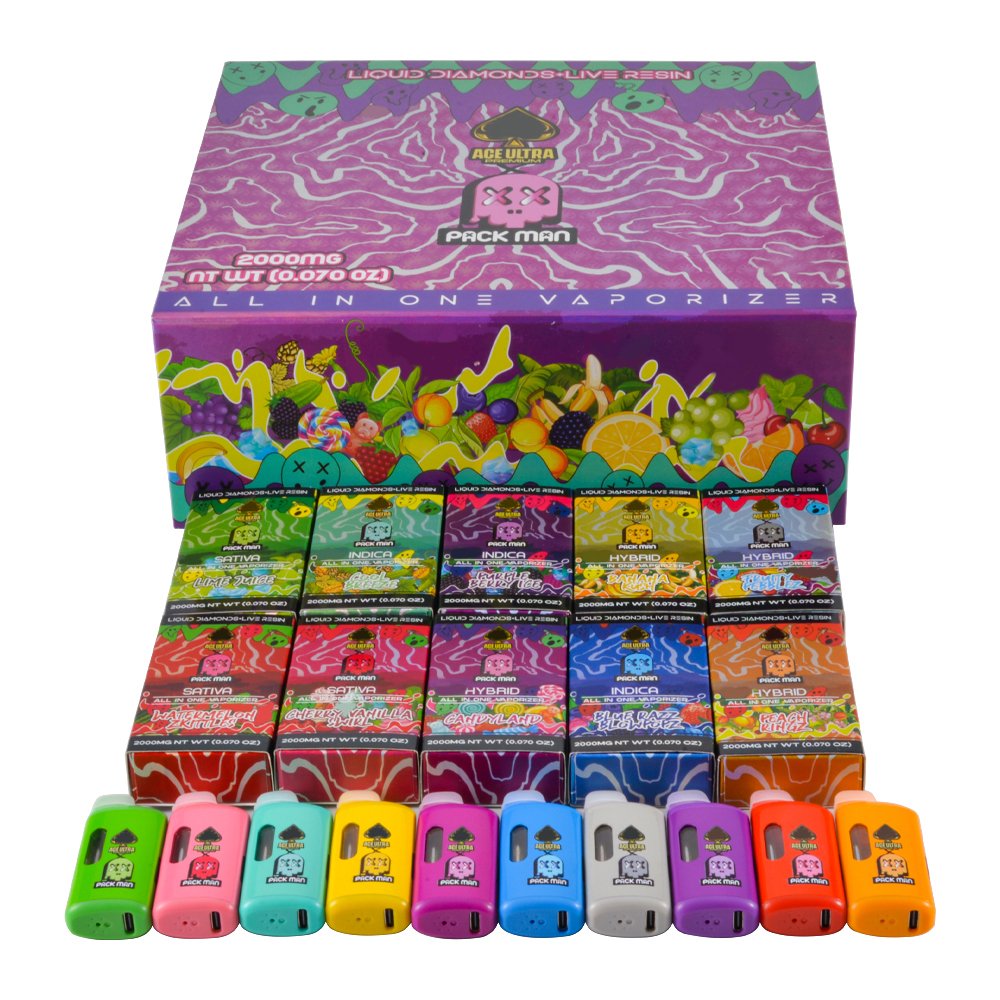



Ace Packman Vape: Displays & LEDs – Battery Algorithms, Puff Counter and UX

Ace Packman Vape Displays & LEDs: Battery Algorithms, Puff Counter & UX

Keyword: ace packman vape — purely technology-focused (hardware/engineering), without

1) Why displays (display/LED) make usage measurably better

A well-designed ad reliably does three things:

  • shows realistic residual energy (instead of “jumping percentages”),
  • counts moves reproducibly for QC & customer communication,
  • communicates states/errors with clear LED pattern codes.
    This is based on robust battery algorithms (SoC/SoE), a clean puff detection method and power-saving display layouts.

2) Battery-Algorithmen: Von „Volt raten“ zu verlässlicher Restenergie

Spannung allein ist als Ladezustands-Schätzer bequem, aber unter Last & Temperatur deutlich ungenau (Relaxation, OCV-Drift). Verlässlicher sind hybride Fuel-Gauges, die Coulomb-Counting + Zellmodell kombinieren:

  • Impedance Track™ (TI): models dynamic cell impedance + OCV curve → can incorporate voltage sag and temperature into the SoC estimate. Texas Instruments+2
  • ModelGauge m5 EZ (Analog Devices/MAXIM): combines Coulomb counter short-term accuracy with long-term voltage stability, compensating for aging/temperature/discharge rate at very low self-current (≈7 µA). [Link to: https://www.analog.com/media/en/technical-documentation/data-sheets/max17055.pdf?utm_source=chatgpt.com]
  • Practical advice: Pure voltage estimates need resting periods (several hours), otherwise they are often inaccurate. Battery University

UX consequence: If ace packman vape displays percentages or bars, the data should come from a real gauge IC – not from a simple voltage lookup.


3) Voltage Sag is the runtime killer – here's how to map it cleanly into the UI.

Under pulse load, the terminal voltage drops by I × R_innen → without a model, the display would report "empty" too early. IT/ModelGauge gauges "see" this effect and provide more stable remaining percentages based on temperature and load. UX rule: Update percentage values ​​only after gauge filtering (no "jiggling" after every move); battery warning as a two-stage LED/icon signal (low/critical). Texas Instruments+1


4) Puff counting: Sensors, algorithm & calibration

Sensor technology

  • Pressure/differential pressure trigger or flow sensor (low-pressure MEMS) in the intake path; alternatively, optical/photometric in the air duct. PMC

algorithm

  • Threshold + minimum duration (e.g. > x Pa or defined flow and ≥ y ms),
  • Hysteresis/smoothing against micro-suction & handshaking,
  • Optional energy window (P×t) per draw for comparability.
    Standardized puff profiles (e.g., 55 mL, 3 s, 30 s interval) are suitable as a "machine reference" for calibration. This allows device-to-device variations to be captured and the display (draw counter or "equivalent draws") to be kept consistent. CORESTA+1

Why important for ace packman vape: Counting errors generate customer tickets (“trains leave too quickly”). A clean topography anchor plus hysteresis prevents “double trains” and doesn’t interrupt the process during short pauses within the same train. (Photometric methods show that real train profiles vary significantly – the algorithm must be tolerant.) PMC


5) Display & LED power: Save runtime without losing readability

  • OLED displays: Power consumption ≈ active pixels × brightness; pure white is the worst-case scenario. Therefore, the UI prefers dark themes, short on-time windows (e.g., 2–4 seconds after an action), and stateless icons (no persistent animations). NKK Switches
  • Modern tandem OLEDs (where applicable) save approximately 10% power compared to single-stack OLEDs at the same brightness – useful for high-brightness UIs. [Link to Omdia.tech.informa.com/om129710/display-dynamics--april-2025-how-tandem-oled-displays-save-power-consumption-with-oled-stack-structures-that-consume-more-power?utm_source=chatgpt.com]
  • LED indicators: Constant current drivers and short duty cycles (e.g., blink 2 Hz / 50–100 ms) are significantly more energy-efficient than continuous light; “true shutdown” in the driver prevents leakage currents when the LED is “off”. Texas Instruments

UX rules of thumb

  • Priority: Readability > Decorative animation.
  • Adaptive brightness (Indoor/Outdoor presets).
  • Update frequency: Do not update battery percentage more often than 1× per move or 1× every 5–10 s.

6) Practical Mapping: From measured values ​​to usable UI elements

battery

  • %/Bars: Smoothed SoC values ​​from IT/ModelGauge; last 10% with additional filtering (sag zone). Texas Instruments+1
  • Residual puffs: Residual Wh/Epuff\text{Residual Wh} / E_{\text{puff}}Residual Wh/Epuff​. For EpuffE_{\text{puff}}Epuff​ (e.g., 7 W × 2 s), enter a factory profile and adjust it in the field (see § 4). CORESTA

Puff counter

  • Total / Today with auto-reset at 00:00; Session counter (since last power-on).
  • Quality flag (full/intermittent signal) to diagnose service cases. PMC

LED patterns (examples, energy-saving)

  • Ready: 1× short flash after inactivity (50–80 ms).
  • Low Batt: 2× short pulses every 10 s (instead of continuous flashing).
  • Fault: 3 quick flashes, 2-second pause – maximum 5 cycles, then dark (to save battery). Texas Instruments

7) Mini-blueprint for ace packman vape (B2B-compatible)

  1. Gauge IC: Integrate TI Impedance Track or ADI ModelGauge m5 EZ; mirror SoC/SoE from the IC to the UI (no "volt guessing"). Texas Instruments+1
  2. Puff Engine: Pressure/flow + hysteresis + minimum duration; factory calibration to a CRM-81-like profile (55 mL/3 s/30 s). [Link to Coresta link]
  3. Power UI: OLED dark, short on-time; LED via constant current driver, pulses instead of continuous light, provide for “true shutdown”. NKK Switches+1
  4. Data Pipelines: Sag-compensated SoC values ​​are only displayed in a throttled form (decoupled from the heating PWM) to prevent the UI from "jiggling". Texas Instruments
  5. QC Metrics: Correlate field feedback with puff histogram and battery percentage log (start/end per session) → early detection of cell/UI anomalies. Battery University

8) TL;DR for Shopping & PM

  • Ads only convince with real gauges (IT/ModelGauge) – otherwise the percentages fluctuate. Texas Instruments+1
  • Puff counting requires a sensor, an algorithm, and a CRM-81 calibration anchor; then the counters and remaining draws become reliable. CORESTA
  • Display/LED: Power consumption is high when pixels/brightness/PWM are constantly running – dark UIs, short duty cycles, "true shutdown". [NKK Switches+1]
  • Result: stable UX, fewer support cases, measurably longer runtime with the same battery.

Sources (current & authoritative)

  • TI Impedance Track™ – Theory & Selection (SLUA450; SLUA638; “Single Cell Gas Gauge Application Book”). Texas Instruments+2Texas Instruments+2
  • Analog Devices MAX17055 / ModelGauge m5 EZ – Data Sheet & Guides. Analog Devices+1
  • Battery University – SoC measurement & testing basics (OCV relaxation, limits of pure volt methods). Battery University+1
  • CORESTA – Puff Regime (CRM-81) & 2024 Guide (Calibration Anchor for Meters). CORESTA+1
  • Photometric Puff Topography – Compact Integrated Sensors in the Air Path (2023). PMC
  • OLED-/LED-Power – OLED power ~ active pixels × brightness (NKK App Notes); LED Driver Shutdown/Design (TI). NKK Switches+1
  • Display Power (2025) – Tandem OLED ≈ 10% less power consumption with the same brightness (Omdia). Omdia

Get A Free Quote

Table of Contents

Related blogs