Exploring the Benefits of 510 Thread Blinkers Battery Vapes for Cannabis Enthusiasts
Disposable vape hardware may be receiving much of the attention in 2026, but procurement managers should not make the mistake of assuming the 510-thread ecosystem is disappearing.
The latest market data suggests almost the opposite.
Headset’s February 2026 analysis found that 510-threaded hardware accounted for 91.3% of U.S. cartridge-format Vapor Pen sales through 2025, while proprietary systems represented only a small minority of the market. In Canada, 510-thread penetration reached an even more dominant 99.8%.
At the same time, another major change is happening: BDSA reports that all-in-one disposables surpassed cartridges nationally for the first time in April 2026 and reached 51.1% of total U.S. cannabis vape dollars in May.
Those two statistics might appear contradictory.
They are not.
Instead, they reveal a market dividing into two powerful hardware strategies:
high-convenience all-in-one disposables and high-compatibility 510-thread cartridge systems.
For distributors, licensed cannabis operators, hardware brands, and OEM buyers researching a 510 thread blinkers vape, understanding that distinction is more useful than simply asking which format is “winning.”
The better question is:
Where does 510-thread hardware still create a commercial advantage—and what should buyers verify before committing to a large battery order?
510 Thread Is Still the Cartridge Standard
The biggest advantage of 510 hardware is not a new feature.
It is the installed ecosystem.
Headset’s latest hardware analysis shows 510 Threaded at 91.3% of U.S. cartridge sales, while the largest proprietary alternative represented only about 5% of the market.
That matters enormously to a purchasing manager.
A proprietary system requires consumers to use the matching battery and cartridge architecture. A 510-thread system gives brands access to a far broader base of compatible cartridges and batteries.
From a B2B perspective, standardization can reduce friction across:
- product development;
- retail merchandising;
- battery inventory;
- cartridge compatibility;
- customer education;
- replacement programs;
- and OEM sourcing.
That does not mean every 510 battery works equally well with every cartridge.
Mechanical compatibility is only the beginning.
Electrical output, cartridge resistance, center-pin contact, airflow geometry, oil viscosity, coil technology, and voltage settings still influence real-world performance.
But the common 510 interface gives procurement teams a standardized starting point.
Why Blinkers-Style 510 Batteries Are Interesting to Buyers
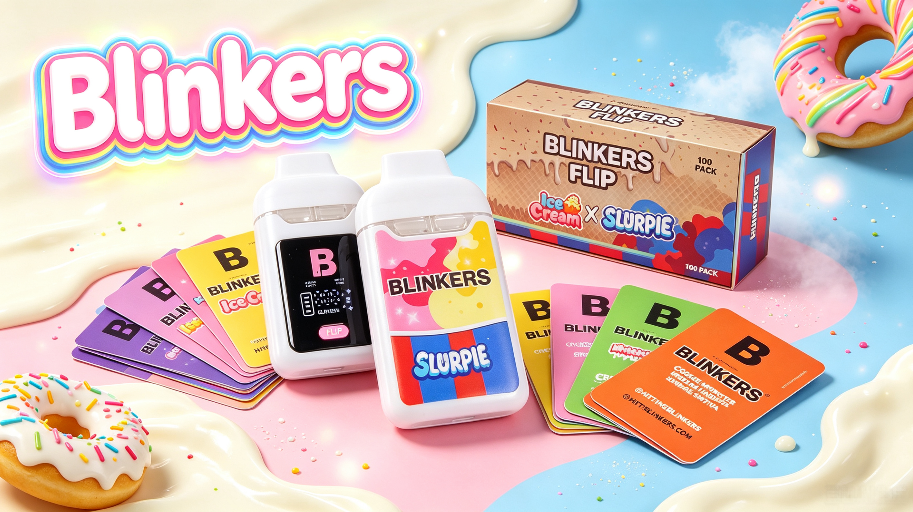
Public Blinkers product listings currently position 510-thread batteries as companions to the brand’s cartridge range. Listings describe features such as 510 compatibility, USB-C charging, adjustable voltage, preheat functionality, battery indicators, and automatic protection functions.
For a procurement manager, however, the important point is not whether these features sound attractive on a product page.
It is whether they can be verified and reproduced consistently in mass production.
That distinction matters because today’s 510 battery is increasingly being sold as more than a simple power stick.
Buyers now encounter devices offering:
variable voltage + preheat + LED indicators + USB-C charging + automatic cutoff + short-circuit protection + customized housings + branded interfaces.
Each additional feature can increase perceived product value.
Each additional feature also creates another component that must be controlled through the BOM and QC process.
That is why evaluating a 510 thread blinkers vape should begin with engineering documentation, not just exterior appearance.
Benefit #1: One Battery Can Support Multiple Cartridge SKUs
For retailers and cannabis brands, one of the strongest commercial arguments for 510 hardware is assortment flexibility.
Instead of developing a separate powered device for every formulation, a brand can build multiple cartridge SKUs around one broadly compatible battery platform.
This becomes particularly useful as vape formulations diversify.
Headset reports that distillate remained the largest U.S. Vapor Pen extract format through 2025 at 56.7% of sales, but its share declined as premium extracts gained traction. Live resin continued gaining share, while Diamonds products grew more than 60% year over year in the markets Headset tracked.
BDSA’s newer 2026 data shows the same premiumization trend. Live resin reached 28% of total U.S. vape sales in May 2026, while live resin and rosin together represented approximately 32% of vape revenue.
For product-development teams, that raises an interesting strategic possibility.
A single branded 510 battery platform may support a broader portfolio of cartridge formulations, provided the voltage characteristics and cartridge hardware are properly matched.
That can make the battery an ecosystem product rather than a one-SKU accessory.
Benefit #2: Reusable Hardware Changes the Unit Economics
An all-in-one disposable packages the battery and cartridge into every unit.
A traditional 510 model separates them.
For a consumer who purchases several compatible cartridges over the life of one battery, that means the brand does not necessarily need to supply another lithium-ion cell with every gram of extract.
For procurement departments, the business implications can include:
- fewer powered components per repeat cartridge purchase;
- separate pricing strategies for batteries and consumables;
- battery bundling opportunities;
- lower hardware content in cartridge-only replenishment;
- branded accessory revenue;
- and stronger customer retention around a battery-and-cartridge portfolio.
The exact economics depend on battery price, cartridge price, replacement frequency, state regulations, and retail strategy.
But the basic procurement distinction is significant:
with 510, the durable power system and the consumable cartridge can be sourced and managed separately.
That gives buyers more flexibility when negotiating hardware suppliers.
Benefit #3: Voltage Control Can Support Different Cartridge Strategies
Variable-voltage batteries have become a common feature in more sophisticated 510 platforms, including current Blinkers-branded listings.
From an OEM perspective, adjustable output can be valuable because different heating systems and formulations do not necessarily perform optimally under identical electrical conditions.
However, procurement managers should be careful with marketing claims such as:
“more voltage equals better performance.”
That is an oversimplification.
Higher output can increase coil temperature. Depending on the cartridge and formulation, excessive heat may negatively affect sensory performance or hardware behavior.
The correct approach is to test the battery and cartridge as a system.
An OEM validation program should therefore define:
- output-voltage accuracy;
- voltage under load;
- cartridge resistance range;
- preheat behavior;
- cutoff duration;
- coil temperature behavior;
- battery performance at low state of charge;
- and consistency between production lots.
A battery specification should be measurable.
“Powerful hits” is marketing language.
“Output: X volts ± specified tolerance under defined load” is procurement language.
Benefit #4: A Cutoff or “Blinker” Function Can Be Treated as an Engineering Feature
The term “blinker” is often associated with a battery light flashing when the device reaches a programmed draw-duration cutoff.
For commercial buyers, that feature should be evaluated as part of device protection and control logic, not promoted merely as a challenge to produce the longest possible draw.
A cutoff timer can help limit continuous heater activation according to the device’s programmed operating design.
Current 510 battery listings in the Blinkers ecosystem also advertise automatic shutoff and protection functions.
When evaluating comparable OEM hardware, buyers should ask the manufacturer to provide the actual firmware logic.
For example:
What is the maximum activation time?
What LED pattern indicates cutoff?
What happens during a short circuit?
What happens when resistance is outside specification?
What is the low-voltage cutoff threshold?
How does the battery respond to overheating?
Those answers should exist in engineering documentation before mass production.
If the supplier cannot explain what each blinking sequence means, the product is not sufficiently documented for a serious OEM program.
The 510 Opportunity Exists Even as Disposables Grow
Procurement managers should also be realistic about the competitive environment.
BDSA estimates that the U.S. cannabis vape category generated approximately $8 billion in retail sales over the 12 months ending May 2026, representing around 26% of total cannabis retail sales.
But the format mix is changing quickly.
Disposables grew roughly 41% to $3.8 billion over the trailing 12 months, while cartridges declined approximately 14% to $4.1 billion. Disposables crossed 50% of monthly vape dollars in April 2026 and reached 51.1% in May.
This means a B2B buyer should not evaluate a 510 program using five-year-old assumptions.
The question is no longer:
“Cartridge or disposable?”
It is:
“What role should each format play in our portfolio?”
A convenience-driven market may justify heavier disposable allocation.
A market with an established cartridge customer base may continue to reward a strong 510 platform.
And because BDSA reports substantial state-by-state differences in disposable penetration, the correct mix can vary materially by jurisdiction.
The strongest procurement strategy may therefore be a portfolio strategy, not an all-or-nothing bet on one hardware format.
510 Hardware Can Help Brands Avoid Proprietary Lock-In
Proprietary cartridge ecosystems can create differentiation, but they also create dependency.
If a proprietary battery is unavailable, the compatible cartridge ecosystem can be affected.
If the device manufacturer changes tooling, increases pricing, experiences production problems, or discontinues the platform, migrating to another supplier may require extensive redevelopment.
510 systems generally provide procurement teams with a wider potential supplier base because the interface is already common across the industry, as reflected in Headset’s 91.3% U.S. cartridge share.
That does not eliminate supplier risk.
But it can increase negotiating flexibility.
For a procurement manager, this matters during:
cost negotiations, capacity shortages, supplier qualification, second-source development, and business-continuity planning.
A product architecture that can be second-sourced responsibly may be less exposed than one dependent on a single proprietary vendor.
But “510 Compatible” Is Not Enough
This is where inexperienced sourcing teams often make mistakes.
Two batteries can both be marketed as 510 compatible and still perform differently.
Buyers should evaluate at least four dimensions of compatibility.
Mechanical Compatibility
Check thread engagement, center-pin height, connector depth, cartridge diameter, and physical tolerance.
A cartridge should not sit excessively loose, fail to make electrical contact, or require abnormal tightening.
Electrical Compatibility
Validate output voltage, current capability, resistance range, short-circuit protection, low-voltage cutoff, and battery-management behavior.
Thermal Compatibility
Evaluate the battery and cartridge together under realistic activation cycles.
A battery that works perfectly with one cartridge may not produce identical thermal behavior with another resistance or coil design.
Formulation Compatibility
Test the intended oil with the actual cartridge.
Premium formulations are becoming more commercially important. BDSA reports live resin alone reached 28% of vape sales in May 2026.
Viscosity and formulation behavior therefore should be part of hardware qualification rather than an afterthought.
Battery Safety Is a Procurement Issue, Not Just a Consumer Issue
Rechargeable vape batteries contain lithium cells, making battery documentation one of the most important parts of a B2B RFQ.
The U.S. Pipeline and Hazardous Materials Safety Administration states that lithium cells and batteries offered for transportation must have passed the applicable tests in UN Manual of Tests and Criteria, Section 38.3. Manufacturers are also required to make the relevant test-summary documentation available upon request.
For procurement managers, that means a supplier saying:
“Our battery is safe.”
is not sufficient.
Request the documentation.
A professional battery file should allow your team to trace the cell and battery design represented by the transport documentation back to the production product.
This becomes particularly important when a supplier changes the cell during production because of price or availability.
A lower-cost substitute cell is not automatically equivalent to the battery approved in your original sample.
UL 8139 Gives Buyers Another Useful Safety Benchmark
Procurement teams evaluating more sophisticated vape battery programs should also be familiar with ANSI/CAN/UL 8139:2024, the safety standard covering electrical systems of electronic cigarettes and vaping devices.
UL Solutions states that its UL 8139 testing evaluates areas including:
- electrical systems;
- heating systems;
- batteries;
- charging systems;
- battery-management behavior;
- mechanical stress;
- accidental activation;
- interconnected-system compatibility;
- and environmental resilience.
UL certification is not the same thing as cannabis-product regulatory approval, and UL 8139 does not evaluate the inhaled consumable itself.
But for hardware sourcing, it gives buyers a useful framework for discussing electrical and battery safety.
Even when an OEM program is not seeking UL certification, the standard can help procurement and engineering teams ask better questions.
Travel Rules Highlight Why Battery Design Matters
The FAA continues to treat electronic smoking devices as battery-powered dangerous goods for air-travel purposes.
Its updated April 2026 guidance requires vaping devices carried by airline passengers to remain on the person or in carry-on baggage rather than checked baggage. Devices must also be protected against accidental activation and cannot be charged or used onboard aircraft.
The FAA notes that electronic smoking devices were the leading cause of lithium-battery incidents on aircraft in 2022.
That is not merely a consumer-travel detail.
It illustrates why purchasing departments should care about:
accidental activation protection, switch design, battery protection, packaging, logistics documentation, and clear user instructions.
A battery problem that begins as an engineering shortcut can eventually become a logistics, insurance, return, or brand-reputation issue.
What Should a Procurement Manager Request From a 510 Battery Supplier?
If you are evaluating a 510 thread blinkers vape battery or an OEM alternative, your RFQ should go far beyond capacity and unit price.
Battery Specification
Request:
- rated battery capacity;
- nominal cell voltage;
- cell manufacturer and model;
- charge-voltage specification;
- discharge limits;
- cycle-life testing;
- low-voltage cutoff;
- overcharge protection;
- overcurrent protection;
- short-circuit behavior;
- and temperature protection where applicable.
Output Specification
Define:
- voltage levels;
- output tolerance;
- operating resistance range;
- activation method;
- preheat voltage and duration;
- maximum draw duration;
- and LED/display logic.
Connector Specification
Require dimensional tolerances for the 510 connector, center pin, threading, and cartridge fit.
The objective is repeatability—not simply “fits our sample.”
Charging System
For USB-C models, document:
- charging input;
- charging current;
- charge time;
- indicator behavior;
- overcharge protection;
- connector durability;
- and charging-cycle test results.
Safety Documentation
Request the applicable UN 38.3 test summary and relevant battery transportation records.
For more demanding programs, discuss testing against recognized electrical-safety frameworks such as UL 8139.
Quality Standards
Specify AQL requirements and defect classifications before production.
At minimum, QC should evaluate:
activation, charging, output voltage, thread fit, LEDs, buttons, preheat, cosmetic defects, packaging, and protection functions.
Golden Samples and Locked BOMs Matter
One of the biggest risks in hardware sourcing is approving one product and receiving another.
The exterior may look identical while the internal battery cell, PCB, connector, charging IC, housing material, or switch has changed.
A professional OEM program should therefore establish a golden sample together with a locked bill of materials.
The purchase agreement should also define a change-control process.
If the supplier wants to change:
cell supplier, PCB manufacturer, charging IC, connector, coating, housing plastic, firmware, or assembly process,
the buyer should receive notice and have an opportunity to requalify the change.
This is particularly important for a reusable battery because a single hardware failure can influence the customer’s perception of multiple subsequent cartridge purchases.
Do Not Buy on mAh Alone
Battery capacity is one of the easiest specifications to market—and one of the easiest for buyers to overemphasize.
A 900mAh battery is not automatically better than a 650mAh battery.
Higher capacity may support longer use between charges, but the commercial product also needs to balance:
size, weight, cell quality, discharge performance, charging time, voltage stability, cost, thermal behavior, and durability.
Similarly, a supplier should be able to demonstrate that the rated capacity on the specification sheet matches the production cell.
For large orders, procurement teams can include incoming capacity verification as part of supplier QA or third-party inspection.
The best battery specification is not necessarily the largest number.
It is the specification that performs consistently in the target application.
Brand Authorization Matters for Blinkers-Branded Products
There is an additional consideration when sourcing an established branded product instead of generic 510 hardware.
Public Blinkers-facing websites currently advertise product-verification systems and 510-compatible cartridge products.
That means buyers should distinguish between two fundamentally different sourcing projects:
purchasing legitimate branded products through an authorized channel, and
developing an original private-label 510 platform.
If a manufacturer offers Blinkers branding, packaging, or authentication features, a professional buyer should request evidence that the supplier is authorized to manufacture or distribute those branded products.
The ability to print a logo does not establish authorization.
For OEM programs without brand authorization, buyers should instead develop original trademarks, packaging, industrial design, and authentication systems.
That approach reduces intellectual-property risk while creating a brand asset the buyer actually controls.
Cannabis Regulation Still Requires State-by-State Due Diligence
Hardware standardization does not create nationwide cannabis-product legality.
As of August 2026, DEA’s current drug-scheduling information continues to list marijuana as Schedule I, while the federal proceeding proposing transfer to Schedule III has gone through new hearings during 2026.
Procurement teams therefore should not treat proposed federal rescheduling as if it had automatically created a single nationwide cannabis-commerce framework.
Commercial cannabis rules continue to depend heavily on jurisdiction.
Before sourcing filled cannabis cartridges, buyers should verify:
state licensing, manufacturing requirements, testing requirements, packaging, labeling, product-size limits, distribution rules, and local restrictions.
Hardware OEM sourcing and filled-product sourcing are not the same transaction.
510 vs. Disposable: What Should Buyers Choose in 2026?
The market data argues against choosing based on ideology.
BDSA shows disposables at 51.1% of U.S. cannabis vape dollars in May 2026, making them the national majority format for the first time.
Headset simultaneously shows that within cartridge systems, 510 Threaded commands 91.3% of U.S. sales.
Both formats therefore matter.
A 510 Strategy May Be Stronger When:
The customer base already owns batteries, compatibility is important, cartridge assortment is broad, the brand wants reusable power hardware, or procurement wants access to a standardized supplier ecosystem.
A Disposable Strategy May Be Stronger When:
Convenience is the dominant consumer proposition, retailers favor all-in-one formats, larger capacity is important, or local market data shows rapid disposable adoption.
A Dual Strategy May Be Strongest When:
The company serves multiple states, price segments, extract types, or customer groups.
For many procurement departments, the decision should therefore be made by state, SKU, price tier, and formulation, not at a national brand level.
Total Cost Matters More Than Battery Price
Suppose Supplier A quotes a 510 battery at $0.25 less than Supplier B.
On a 100,000-unit program, that appears to create $25,000 in savings.
But a complete procurement model should also include:
- DOA rate;
- charging failures;
- connector failures;
- replacement freight;
- retailer credits;
- warranty labor;
- battery returns;
- customer-service cost;
- inventory quarantine;
- and lost cartridge sales.
A reusable battery has an additional commercial effect.
If customers lose confidence in the battery, they may also stop buying the compatible cartridges.
Therefore, the hardware cost should be evaluated against customer lifetime value, not just the battery PO.
A Practical 510 Battery Supplier Scorecard
A procurement team comparing OEM manufacturers can score each candidate across five categories.
1. Engineering Capability
Can the supplier provide actual schematics, specifications, firmware logic, battery data, and tolerance information?
2. Quality Control
Does the supplier have documented incoming inspection, process control, final inspection, AQL criteria, traceability, and corrective-action procedures?
3. Battery Compliance
Can it provide legitimate UN 38.3 documentation that corresponds to the production battery?
4. Production Consistency
Will the supplier lock the BOM and notify the customer before component changes?
5. Commercial Support
Can it handle forecasting, replacement claims, customization, regional inventory, production planning, and corrective action after shipment?
The supplier with the lowest quotation may not score highest.
And in a mature B2B procurement operation, that is exactly the point.
What the Future of 510 Thread Hardware Looks Like
The current market does not suggest that 510 hardware will simply disappear because disposables are growing.
Instead, it points toward specialization.
All-in-one formats are capturing convenience-driven demand, while 510 remains the dominant standardized interface within the cartridge ecosystem.
Meanwhile, premium extracts are gaining share, forcing battery and cartridge suppliers to think more carefully about voltage, heating technology, oil compatibility, and system performance.
That makes the next generation of 510 hardware less about producing another inexpensive stick battery and more about building a reliable power platform.
For OEM manufacturers, opportunities exist in areas such as:
compact form factors, stable variable voltage, intuitive battery indication, better protection logic, improved connector consistency, stronger USB-C implementation, distinctive industrial design, and branded accessory ecosystems.
The companies that execute those features reliably will be better positioned than suppliers competing exclusively on FOB price.
The Bottom Line
For procurement managers researching a 510 thread blinkers vape, the biggest advantage of the format is not one battery feature.
It is standardization.
Headset’s latest data shows 510 Threaded representing 91.3% of U.S. cartridge hardware sales, giving it a level of ecosystem compatibility that proprietary systems have struggled to match.
At the same time, BDSA’s 2026 data makes it clear that procurement strategies must evolve: disposables have now surpassed cartridges nationally, reaching 51.1% of vape dollars in May 2026.
The takeaway is not that one format has defeated the other.
It is that each now serves a different strategic role.
For brands and licensed operators, 510 hardware can still provide:
cross-SKU compatibility, reusable battery architecture, flexible cartridge development, broad supplier availability, accessory revenue, and reduced dependence on proprietary systems.
But those benefits only matter when the hardware is reliable.
That is why serious buyers should evaluate battery cells, voltage control, connector tolerance, firmware, protection functions, UN 38.3 documentation, QC systems, BOM control, cartridge compatibility, and supplier traceability before approving mass production.
Looking for a Reliable 510 Thread Vape Battery or OEM Hardware Partner?
If your company is evaluating 510-thread batteries, cartridge hardware, custom-branded power devices, or an OEM vape hardware program for a lawful market, start with technical documentation before negotiating the final unit price.
Request a production-representative sample, locked BOM, battery specification, voltage-performance data, connector tolerances, protection logic, UN 38.3 test summary, QC standards, packaging specifications, and clearly defined warranty responsibilities.
For established branded products such as Blinkers, independently verify supplier authorization before making a commercial commitment.
For private-label development, work with a manufacturer capable of producing original, non-infringing hardware and branding built around your own market requirements.
A qualified supplier should be prepared to discuss engineering, battery safety, quality control, customization, MOQ, production capacity, and after-sales support in the same conversation.
That is what turns a 510 battery from a commodity accessory into a dependable hardware platform—and turns a vendor into a long-term OEM partner.
 leerer 1g Vape
 leerer 2g Vape
 leerer 3g Vape
 leerer Doppelkammer-Vape
 leerer LED-Vape
 USA-Lager Vape
 EU-Deutscher Lagervape